
Biden’s First 100 Days
At the start of President Joe Biden’s term, the U.S. was grappling with a deadly third wave of the coronavirus pandemic, the aftershocks of a bitterly contested election, and an unprecedented assault on the U.S. Capitol.
100 days later and the situation is very different, with coronavirus cases declining and significant progress on vaccinations. At the same time, Americans have become more optimistic, with many now looking forward to resuming aspects of their pre-COVID lives.
Ipsos public opinion data shows the reemergence of America since January 20, as consumers feel better about their personal finances, are finally venturing out to see friends and family, and are starting to turn to other concerns aside from the pandemic. Accordingly, the majority of Americans say that Biden has done a good job at the start of his term.
Yet the nation’s recovery is still far from complete. One in five Americans continue to say they have no intention to get the vaccine. Even as the economy recovers, people hardest hit by the pandemic continue to struggle and have been among the last to see material improvements. And as we emerge from the pandemic, Biden must address the fractured partisan landscape, where Republicans and Democrats have significantly opposing priorities.
For more insights on these trends and what the post-pandemic future might hold, please download our detailed POV or read our The Hill oped feature.
Overview:
America has undergone enormous change over the last year with the coronavirus pandemic, mass protests, an unprecedented election, and an assault on the seat of government.
However, public opinion data suggests the first 100 days of President Joe Biden’s administration mark an inflection point in the American experience. Just a few months ago, people were reeling from a staggering death toll and had a very bleak view of the country. Yet three months later, optimism is picking up speed, vaccinations are now widely available, and people are beginning to reemerge from their homes.
But, problems remain. Large segments of the population are unvaccinated, which presents a major challenge to stopping the spread of new strains and outbreaks. Beyond this, the country is still grappling with the inequitable economic impact of the pandemic and fractured partisan landscape.
Biden’s 100 Days:
- Americans moving out of survival mode
- The race to vaccinate
- The economic recovery
- Unifying the country
AMERICANS ARE MOVING OUT OF SURVIVAL MODE
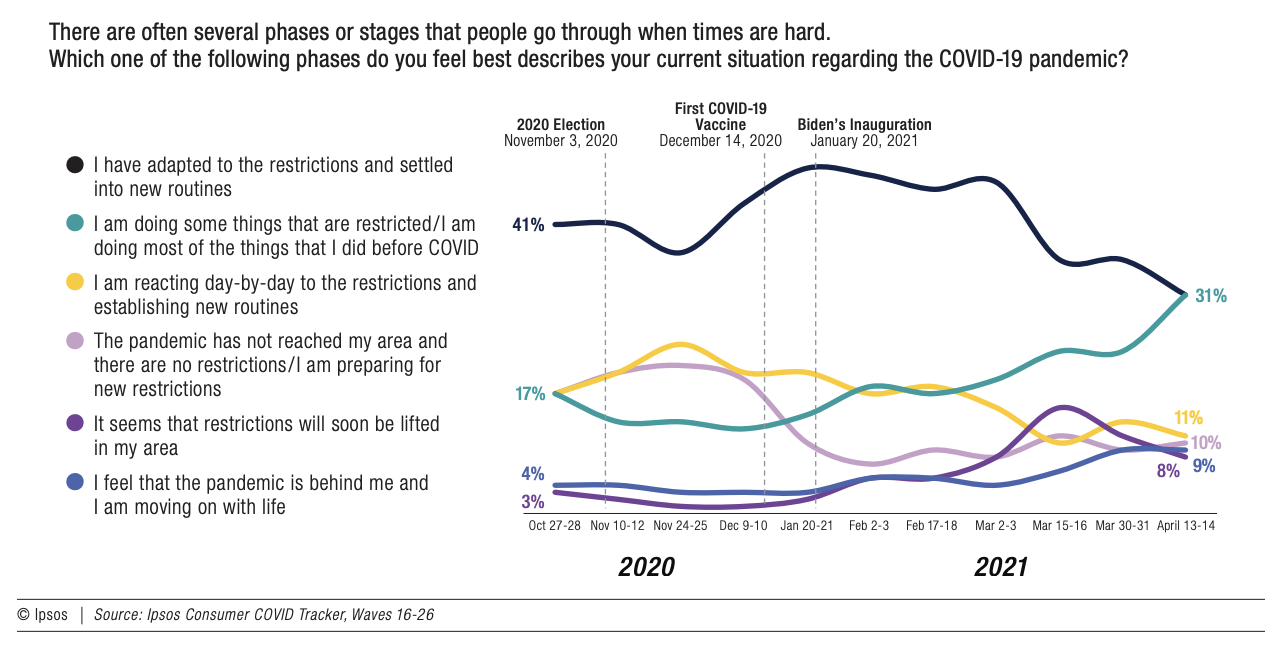
Since President Biden took office in late January, Americans are growing more optimistic about the future. Just under half (45%) think that within the next six months life will return to something like a pre-COVID normal, including the 17% who say they’ll resume their pre-COVID life within the month, or have already done so. This marks a sea change compared to the one in four (26%) who felt the same at the end of January, according to tracking from the Axios/Ipsos Coronavirus Index.
As a result of this growing optimism, people are changing their routines and engaging in pre-pandemic activities at an increasing rate. When Biden was inaugurated 17% of people said that they were doing most of the things they did before COVID hit. By the middle of April, that number nearly doubled to 31%.
Americans begin moving out of survival mode
The growing hope across the country is clear across multiple indicators. Optimism about the future of the economy rose to a 19-year high, while consumer confidence regained levels seen before the March 2020 lockdowns. After deep lows over the past year, when unemployment hit double digit numbers, economic sentiment is now near pre-pandemic levels.
THE END OF THE PANDEMIC?
The growing optimism and movement outside of the home come as COVID-19 vaccines become widely available to the public. As of mid-April, 56% of Americans have personally received at least one dose of a COVID-19 vaccine, up from nine percent at the end of January. However, despite the breakneck clip of vaccinations, many obstacles remain in the way of fully vaccinating the country and reemerging. Looking ahead, inequitable access to the vaccine and the culture war surrounding the vaccination campaign will continue to be obstacles in reaching herd immunity.
Vaccination inequalities
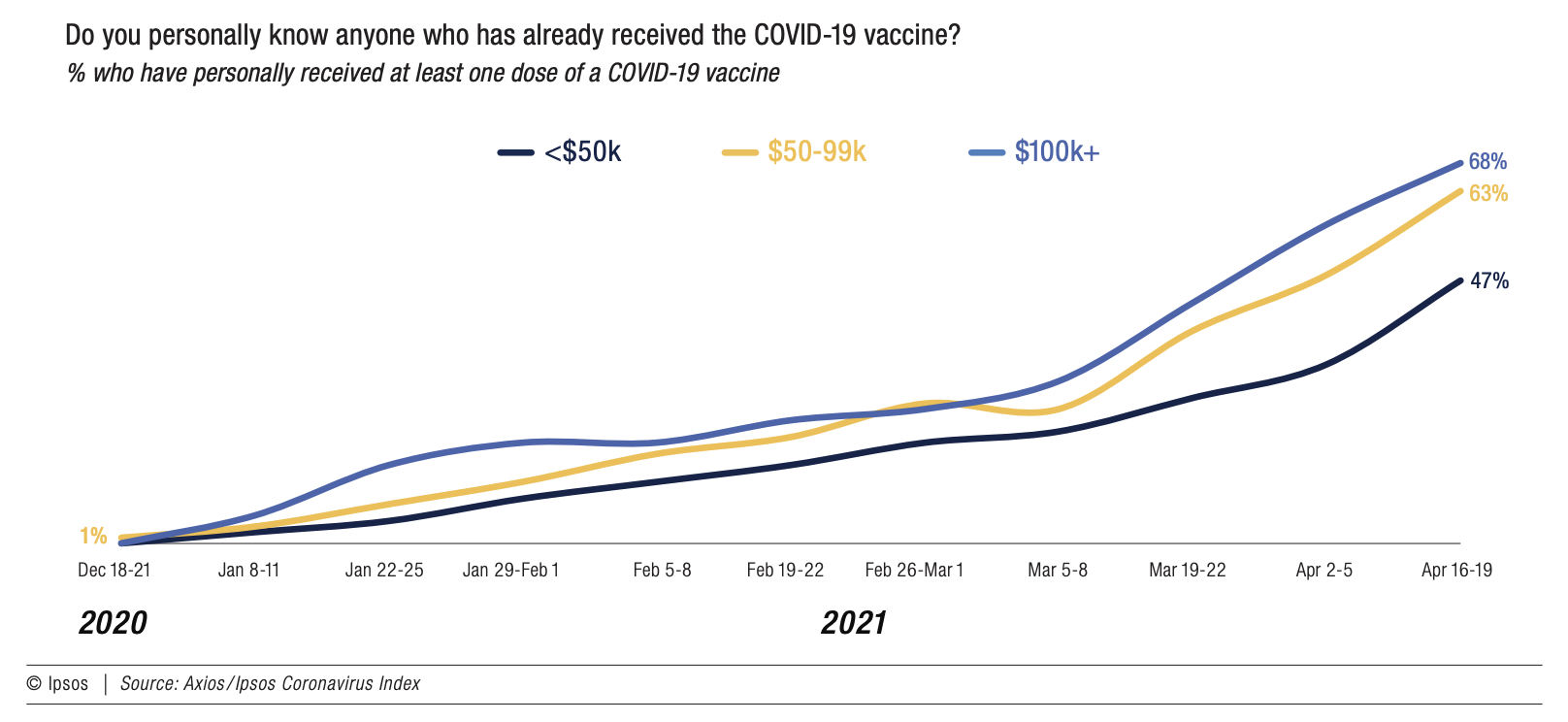
Disparate access to the vaccine remains a persistent issue. When asking people in the Axios/Ipsos Coronavirus Index if they personally received the COVID-19 vaccine, significant differences by race and income emerge. Just under half (47%) of people making under $50K have received the vaccine, while 68% who earn $100k or more have received the vaccine.
Gap between rich and poor widens for vaccine access
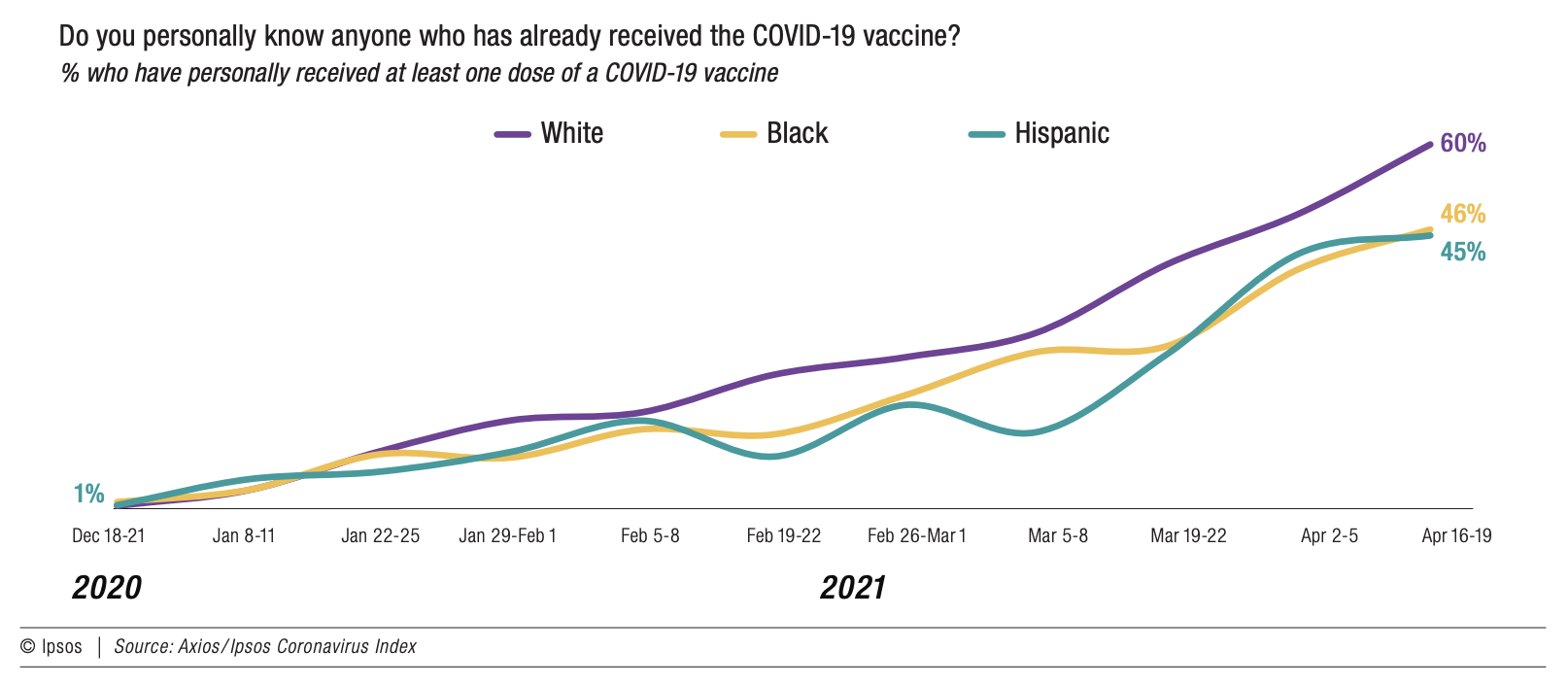
A slightly smaller but notable gap also persists by race. About three in five (60%) white U.S. adults have received at least one dose of a COVID-19 vaccine, while only 46% of Black and 45% of Hispanic Americans are in the same boat. That remains true even as COVID-19 has disproportionately infected and killed Black and Hispanic communities
Disparate access to vaccine across race and ethnicity
The vaccination race
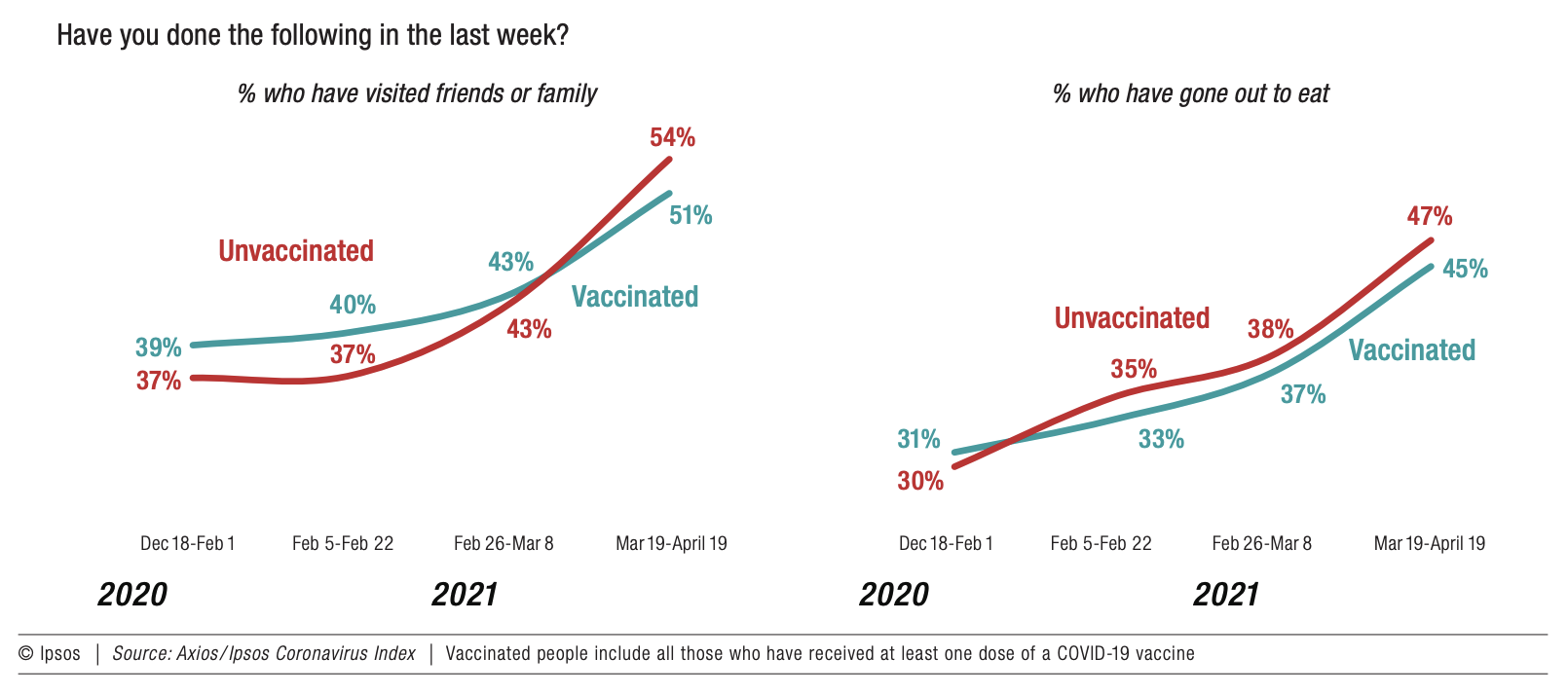
Even as vaccination rates increase, unvaccinated people are also increasingly going out of the home, contributing to the continuation of the pandemic. According to the Axios/Ipsos Coronavirus Index, 54% of unvaccinated Americans report visiting friends and family in mid-April, three points ahead of people who have received at least one dose of the vaccine. At the same time, the vaccinated and unvaccinated are going out to eat at similar rates, with just under half of both groups reporting doing so.
Vaccinated people are now leaving their homes, so are unvaccinated people
The vaccination culture war
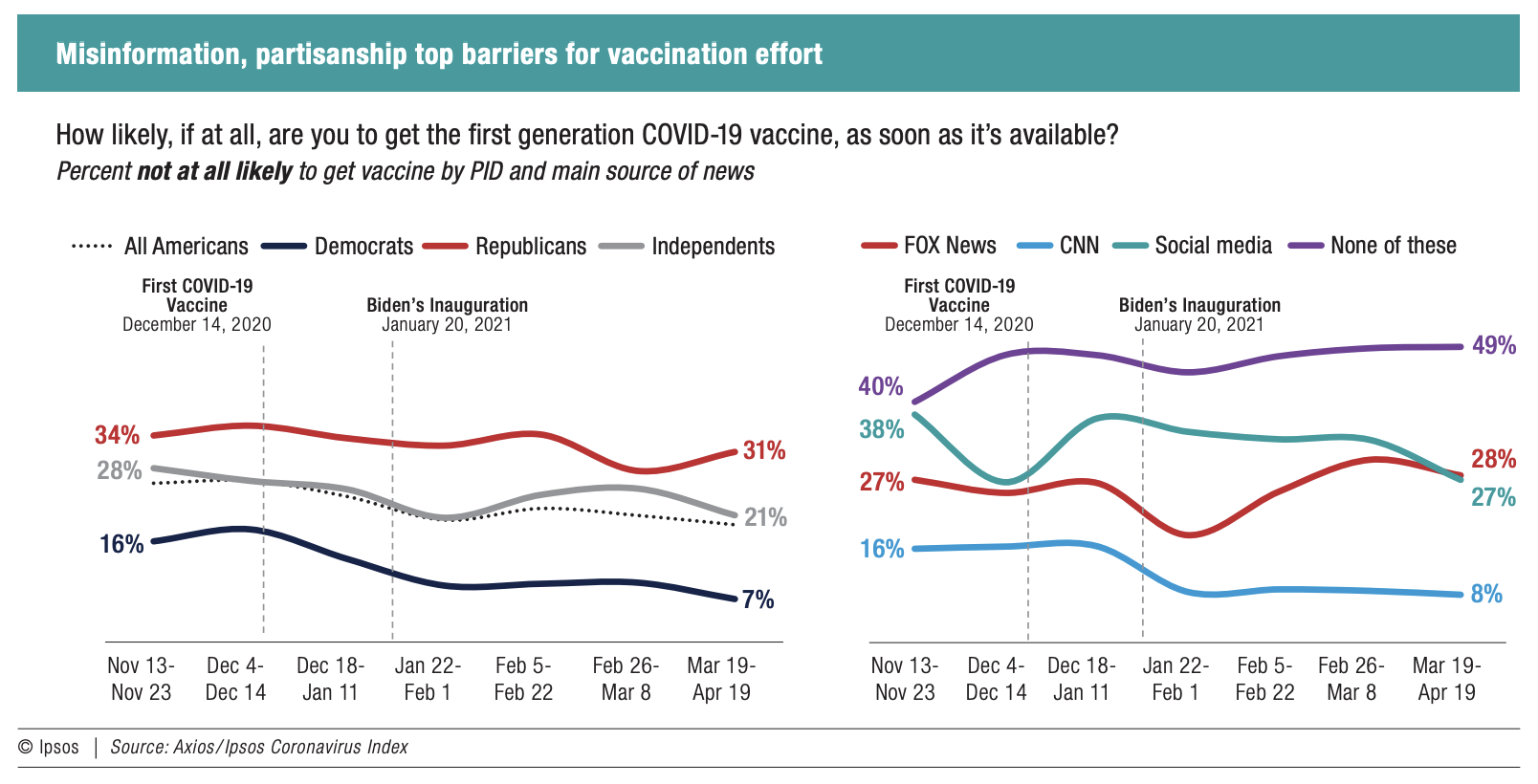
As much of the country gets the vaccine, another issue is emerging: the vaccine wall. As of late April, one in five Americans say they are definitively not going to get the vaccine. As we near the end of Biden’s first 100 days, partisanship and news source appears to be the strongest drivers of vaccine resistance, a testament to the ongoing effect of partisanship and media bubbles.
As of the middle of April, one in three Republicans and over a quarter (28%) of people whose primary news source is FOX News say they are not at all likely to get any COVID-19 vaccine. But even more stark, among those who don’t consume major news or only use very alternative news sources, 49% are not at all likely to get a vaccine.
Misinformation, partisanship top barriers for vaccination effort
In his first 100 days, Biden and his administration have successfully navigated the logistical challenges to make all Americans able to access the vaccine. But now comes the harder part of pushing through inequity and misinformation to get those that are resistant on board.
THE ECONOMIC RECOVERY
This burgeoning vaccine campaign is buoying not just spirits but the economic recovery too. More Americans are beginning to feel safer about a post-COVID future and are eager to engage in activities that they could not do during the height of the pandemic.
Americans want to go out
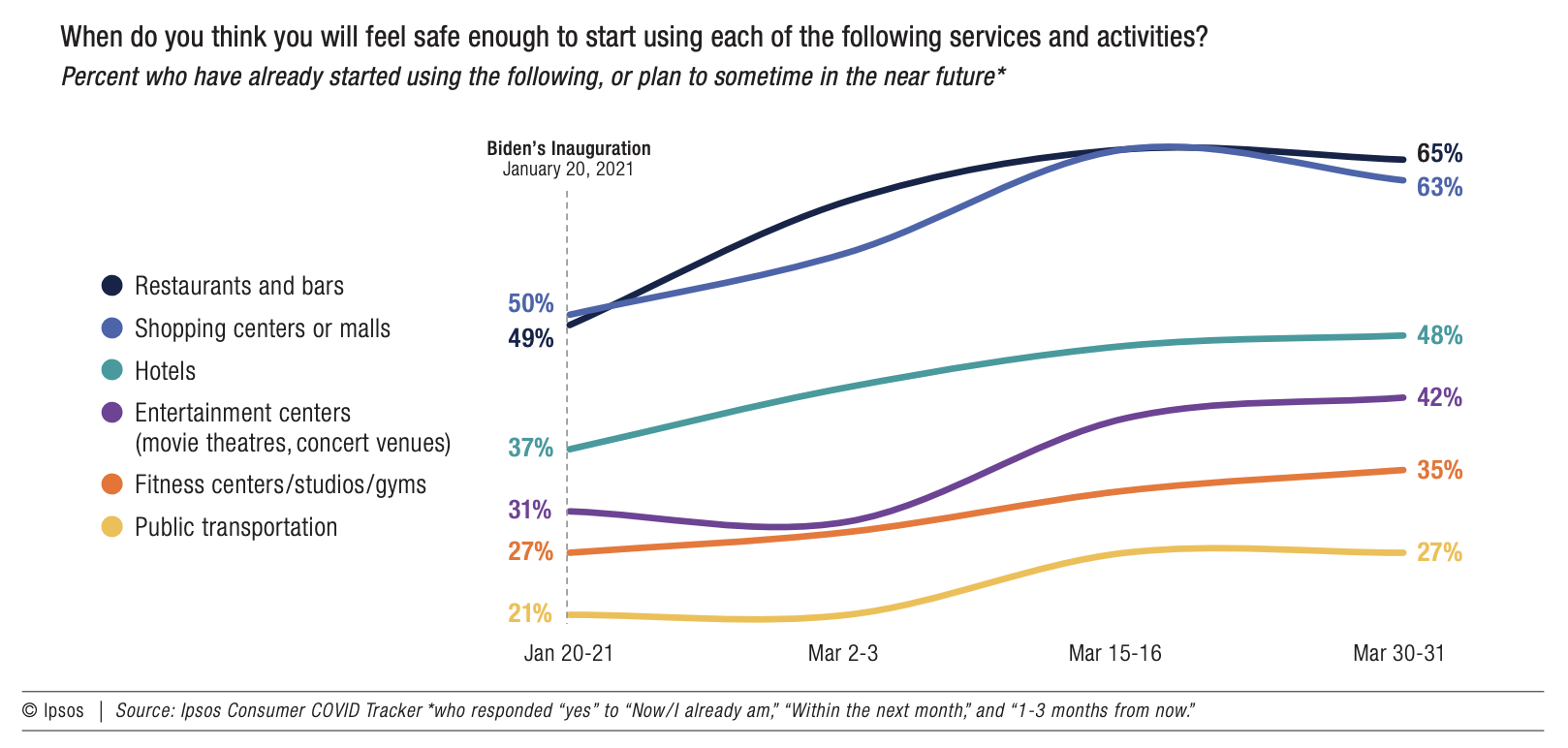
Now, about half of Americans believe they will start going to restaurants and bars the same or more than they did before the pandemic. Almost across the board, we have seen significant increases in the desire to do a whole range of consumer activities since November, according to the Ipsos Consumer COVID Tracker.
Americans begin to feel safer about reengaging with the world
People believe better times are ahead
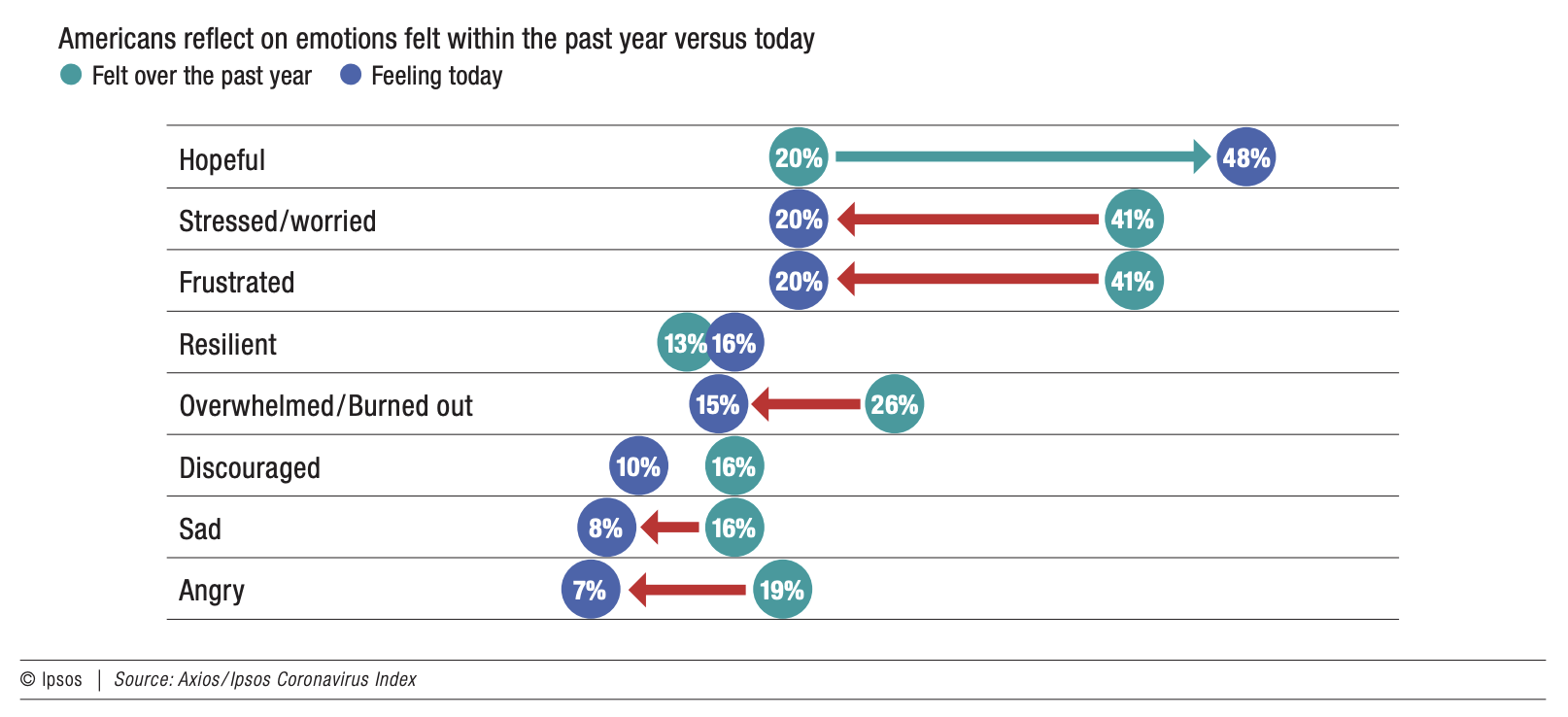
The rosy consumer outlook is part of people’s expanding sense of optimism. Americans were glad to put 2020 behind them. A year into the pandemic, Axios/Ipsos asked Americans what their dominant emotions for the past year had been. Most responded with negative feelings, like stressed or worried (41%), or frustrated (41%). But when asked about their mood now, hope dominates with half of Americans (48%) expressing optimism.
Increasing optimism
Despite improving national outlook, inequitable economic impact of the pandemic lingers
Yet, even as the economy is recovering, some people continue to fall behind.
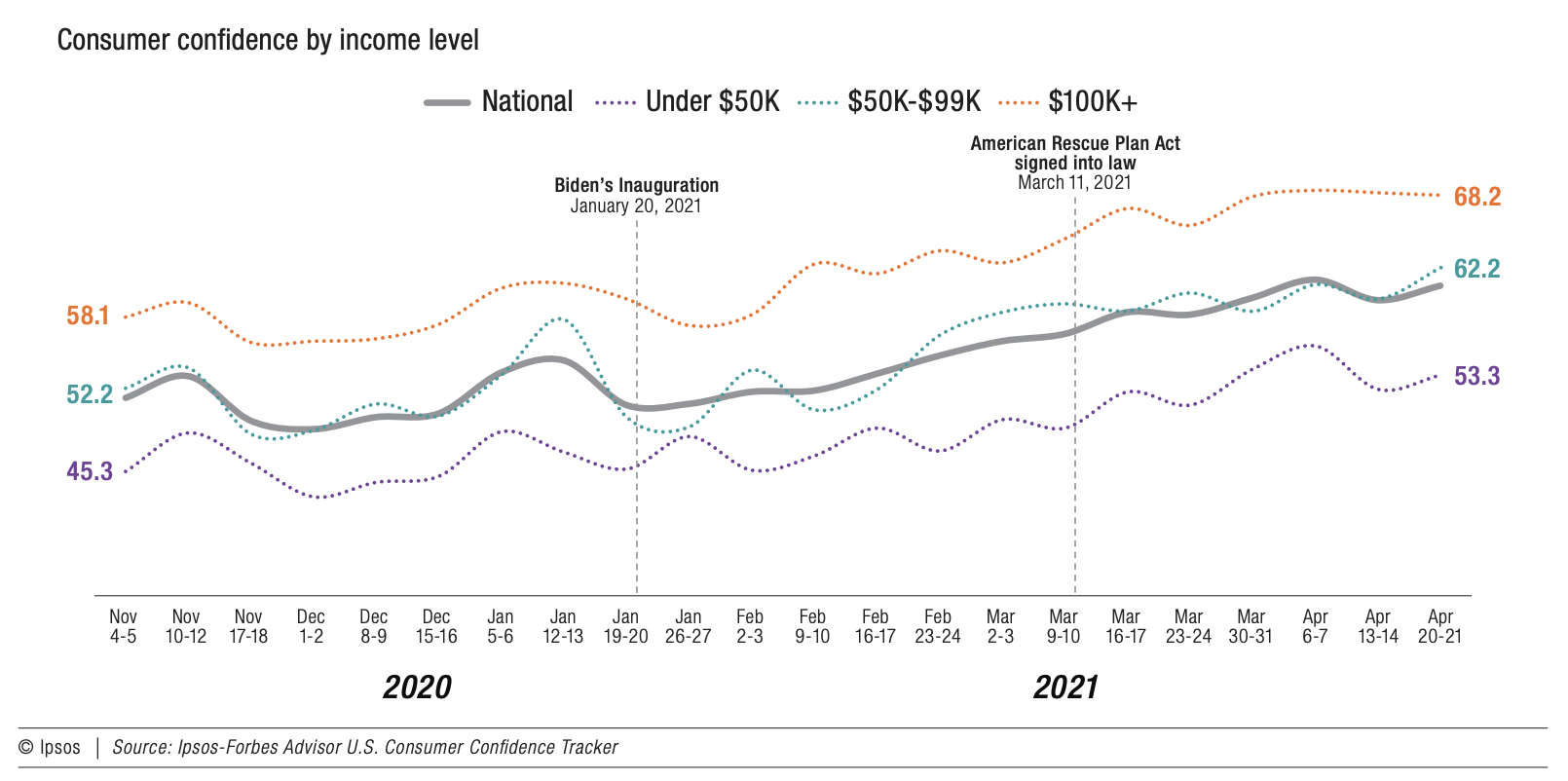
In addition to a public health crisis, the pandemic was an economic crisis. And less affluent Americans were much harder hit by the economic impact of the pandemic. Throughout 2020, the economic confidence of Americans who make under $50,000 in household income barely improved, even as wealthier Americans started feeling better as early as the summer of 2020.
Since Biden’s inauguration, less affluent Americans have started feeling better about the shape of the economy, but they continue to lag behind the more affluent, showing how the recovery hasn’t been felt equally by all.
Lower-income Americans show greater economic confidence under the Biden administration, but still lag behind
REESTABLISHING TRUST IN GOVERNMENT
National priorities
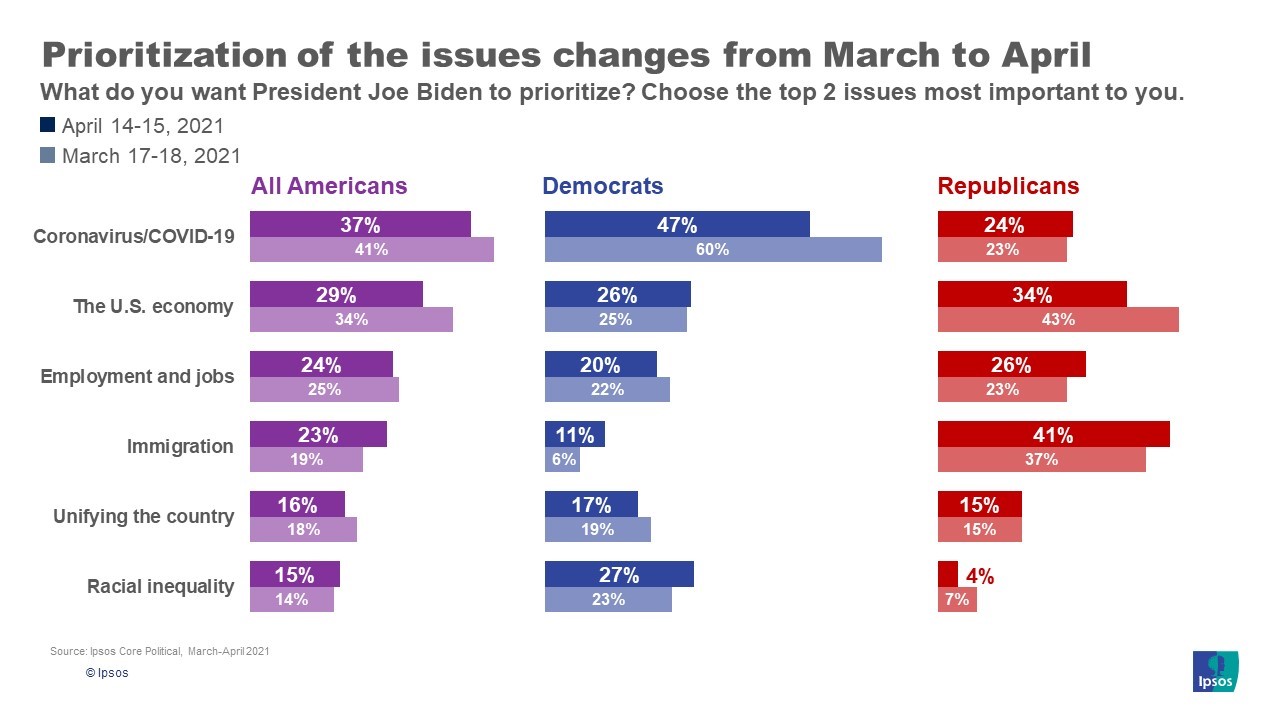
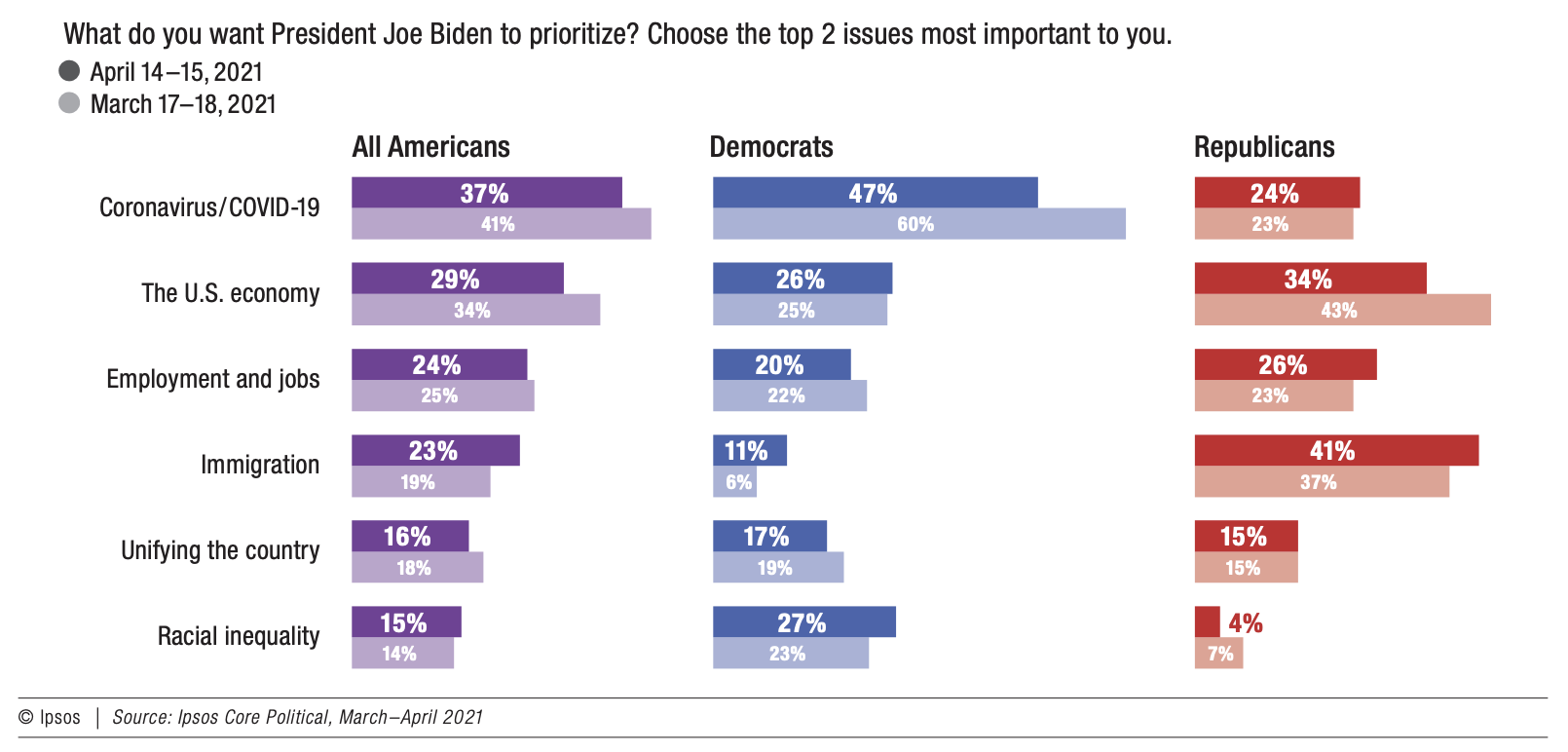
First and foremost, Americans had one task for Biden as he came into office: handle the pandemic. In addition, Biden was expected to deal with the economy and employment and jobs that had also been pummeled, according to Ipsos polling.
However, just one in four Republicans want Biden to prioritize the pandemic. More believe that the emphasis should be on immigration, the economy, and employment and jobs. In contrast, close to half of Democrats believe that Biden should be focused on the pandemic, while racial inequality and the economy vie for second place.
The gulf across the parties on what matters most underscore some of the challenges Biden faces in developing a national agenda that can bring a fractured public together.
Prioritization of the issues changes from March to April
Biden is delivering on his mandate despite societal rifts
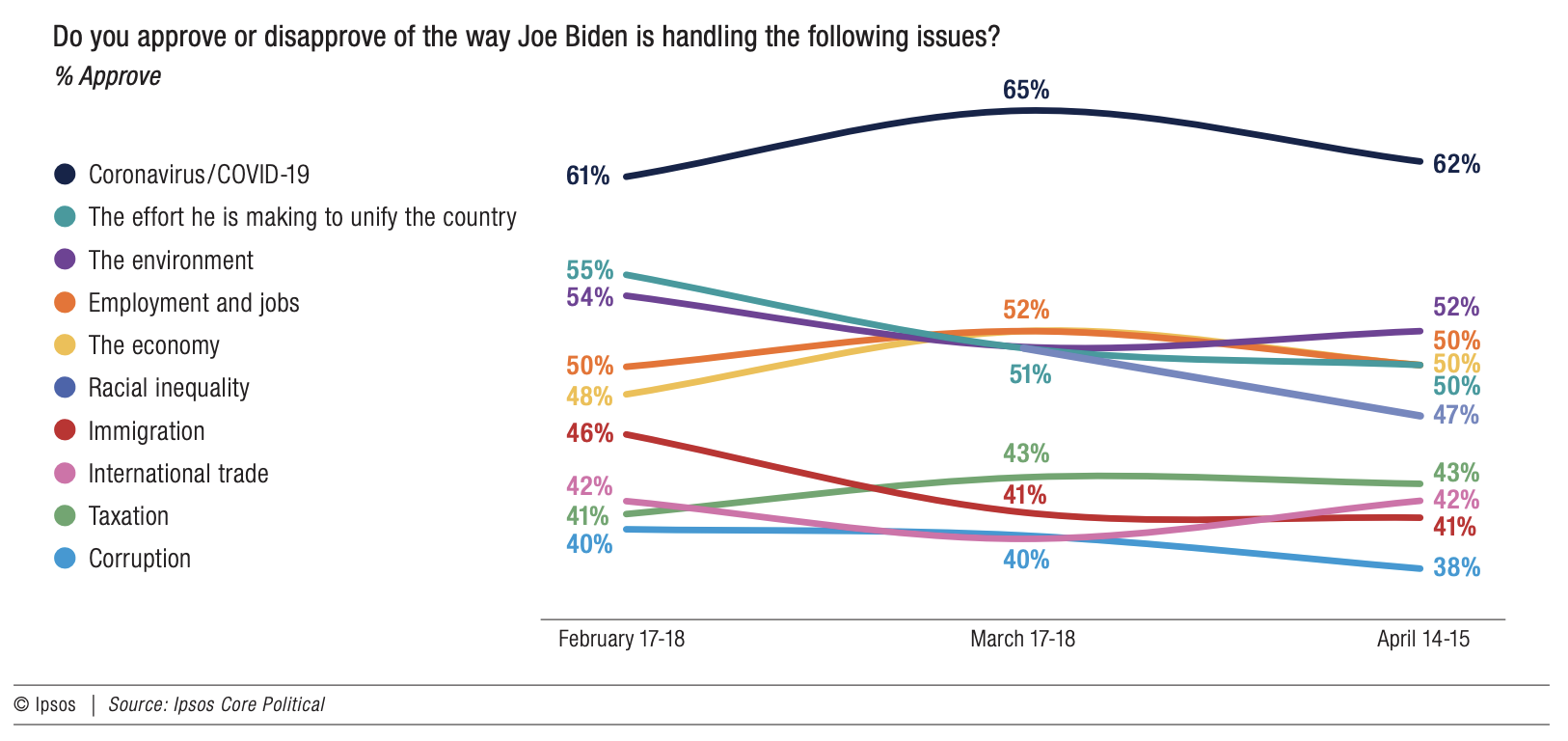
Despite these divisions in trust and priorities, the public largely approved of Biden’s performance during his first 100 days. A majority of Americans approve of his handling of the coronavirus, including 84% of Democrats and 39% of Republicans. There is no other issue for the president that wins such a relatively high level of support from Republicans. Given the broader, hyper-polarized context, these numbers are significant.
Biden was elected on a clear mandate to address the coronavirus pandemic, and his current approval rating suggests that the public believes he is delivering.
Biden performs best on COVID
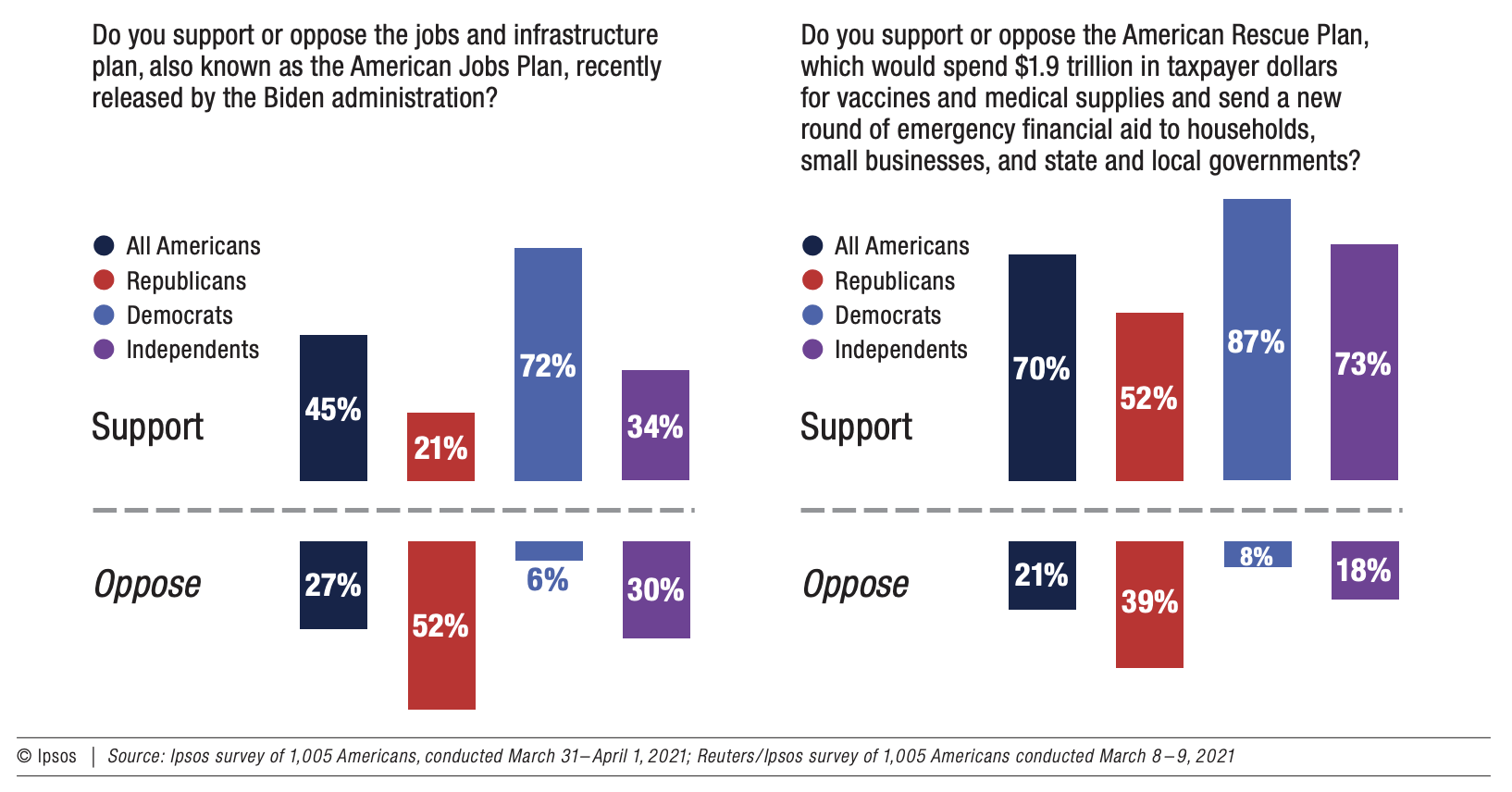
Americans are also supportive of Biden’s American Rescue Plan, according to Reuters/Ipsos polling. It has strong majority support from Democrats and Independents, while just over half of Republicans are on board. Biden’s infrastructure proposal, the Americans Jobs Plan, though similarly sweeping in scope, elicits less support and much more partisan division.
COVID response popular, will infrastructure be?
Trust in the federal government restored?
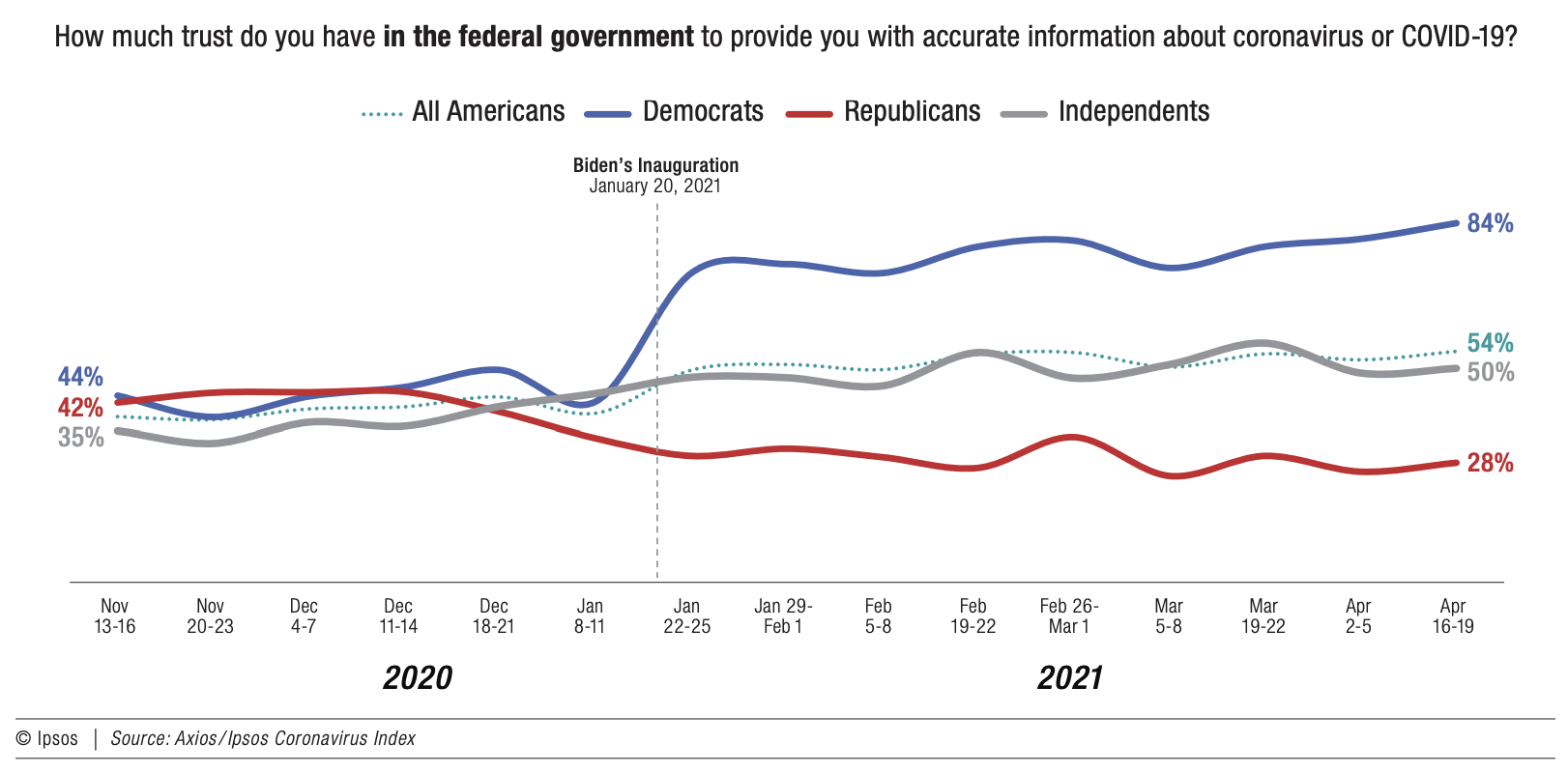
In the five months following the election, the number of Americans who say they trust the federal government to provide them with accurate information about the novel coronavirus improved, climbing from 39% to 54%, according to the Axios/Ipsos Coronavirus Index.
This shift occurred following Biden’s inauguration, when the initial vaccine rollout and distribution took off. The success to date of the vaccine campaign is likely influencing the newly positive views of the federal government. But, a closer look at the data reveals that trust hinges on what political party someone supports.
Between the 2020 election and the middle of April, Democrats’ trust in the federal government improved 40 points while Republican confidence in the federal government fell by 14 points. This divide illustrates how partisanship mediates reality for Americans.
Democratic trust in government surges as Republican fades
Trust in other federal agencies follows a similar trajectory, with partisan confidence in institutions, like the CDC, falling between November and April. As of mid-April, there was a 40-point gap in trust among Democrats and Republicans. Democrats’ trust in the CDC is now at 91%, while Republican confidence fell to 51%.
Varying levels of trust in the federal government and agencies tasked with guiding the nation out of the pandemic speak to the ongoing challenge of reassuring vaccine skeptics and getting the country on the same page. The increasing polarization around trust in the federal government and the growing vaccine wall is a testament to how complicated legislating and communicating in the next phase of the pandemic will be.
WHAT’S NEXT
America is beginning to reemerge. Between increasing vaccine access and rising optimism among the public, America is in a better place 100 days into Biden’s presidency.
Yet, for the better part of the past year, Americans were split on how dangerous the pandemic was, what to do about it, and who to trust. This fundamental dynamic has not changed over the past 100 days. Those fractures will remain a problem as the country tries to reemerge and inoculate vaccine skeptics.
Ultimately, the complicated legacy of the pandemic frames this moment as an inflection point for the country. And for President Biden, this current honeymoon phase probably represents one of his best opportunities to drive forward the most ambitious items on his agenda, those that would have the most lasting and direct impact on American lives. But how long this period will last is the real question.
Problems Past the First 100 Days:
- Social distance fatigue among the unvaccinated
- The vaccine wall
- Economic recovery and the wealth gap
- Politicized trust in federal government
- Little to no bipartisan consensus on the issues of the day
- Republican refocusing on nativism and immigration
- Democrats prioritize racial justice and equality
![[WEBINAR] Know America at 250: Public Opinion Update](/sites/default/files/styles/list_item_image/public/ct/news_and_polls/2026-09/250_0.png?itok=7pwykKmG)
![[WEBINAR] Ipsos Global Trends 2026: The U.S. Edition](/sites/default/files/styles/list_item_image/public/ct/event/2026-09/thumbnail-gt-26.png?itok=AbsiS6xk)
![[WEBINAR] AI in Higher Education: How AI is Reshaping Teaching and Learning](/sites/default/files/styles/list_item_image/public/ct/event/2026-10/How%20AI%20Is%20Reshaping%20Teaching%20and%20Learning.png?itok=XYdLaI-4)