
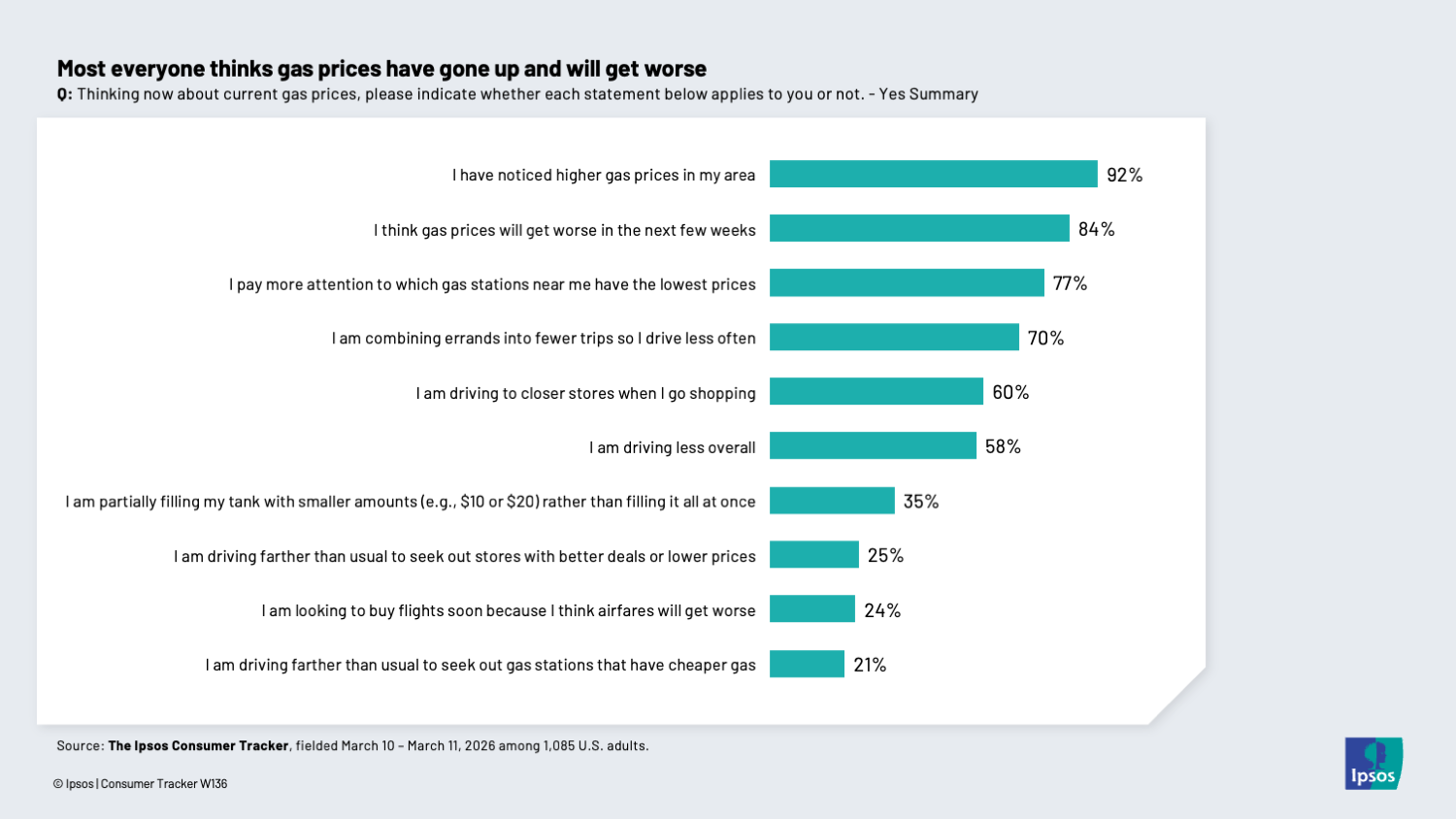
Almost all Americans think gas prices have gone up and will get worse
The Ipsos Consumer Tracker asks Americans questions about culture, the economy and the forces that shape our lives. Here's one thing we learned this week.
Why we asked about gas prices: Because Iran is laying mines in the Strait of Hormuz. That’s why.
What we found: It’s rare to see something north of 90% of Americans agree on. But almost everyone thinks gas prices have gone up (they have) and also almost everyone (84%) thinks prices will get worse (Democrats are more likely to say this, but 76% of Republicans agree, too.) According to our data, it’s already affecting behaviors, including the 70% of Americans who are now combining errands into fewer trips to combat gas prices.
Here’s one story of what that the economic uncertainty that creates looks like: My mom is one of those people who clicks “yes” when a point of sale asks if she would like a printed receipt. She pulled into a big retailer who also sells discount gas. The car in front of her got a receipt, too, but left it in the pump. She grabbed it and, not seeing someplace to trash it, put it in her pocket. She filled her tank and got her own receipt, which also went in her pocket. When she got home, she pulled them out and noticed that the car in front of her had paid $0.05 less per gallon. Curious, she then picked up a telephone and dialed the retailer. She was told they are now changing gas prices multiple times a day and she must have hit at one of those moments. That’s what gas prices today look like.
More broadly, what does this mean for American spending?
For that, let’s remember that half (48%) of Americans are living in a zero-sum economy. They pay their bills and that’s it. These are not, by the way, just low-income Americans. One in three American households making more than $100,000 a year says the same. An even bigger portion of Americans (60% overall, including 45% of higher-income households) say that when prices go up, they can’t always afford the things they need.
So when one part of the budget goes up (for a while it was food, then electricity, now gas – and food and electric never went back down) something has to give. We see in the data that people cut back first on one-offs like going out to eat, then they cut recurring expenses (or in the case of subscriptions, churn them) and finally, they are just postponing everything they can, from big purchases, to healthcare, to car repairs.
Basically, everyone’s cutting back on something.
More insights from this wave of the Ipsos Consumer Tracker:
Gas prices aren’t hurting Americans’ summer plans … yet
Despite the hype, most don’t plan to watch any NCAA March Madness
Storage, privacy and a preference for brick-and-mortar are the biggest barriers for retail apps
Most Americans agree the government should regulate AI, but party splits emerge on how
The Ipsos Care-o-Meter: What does America know about vs. what does America care about?


