
Women and COVID: One Year On
Over the past year, the coronavirus pandemic tore through society, fundamentally reconfiguring how we live and work. It also brought to light, or exacerbated, existing inequities in the United States. For women, the economic consequences of the virus have been particularly severe, chipping away at their standing in the workforce and exacerbating underlying financial inequality. Mothers are disproportionately picking up the slack around childcare, with further ramifications for their standing in the workforce.
Since the pandemic began, women have reported lower consumer confidence than men. And women, but particularly women of color, report higher levels of concern about household debt and job security. While the pandemic exacted a heavy toll on women as a group, they are not monolithic. How women fared economically and emotionally during the first year of the pandemic depends largely on factors such as race or ethnicity, parental status, and political affiliation. Understanding the many intersections women live in is the first step in addressing these inequities when building back a post-COVID world.
Download our paper for deeper insights into how the pandemic transformed women’s lives over the past year.
For more on this topic, please see our International Women’s Day survey results.
WOMEN AND COVID: ONE YEAR ON
Over the past year, the coronavirus pandemic tore through society, fundamentally reconfiguring how we live and work. It also brought to light, or exacerbated, existing inequities in the United States. For women, the economic consequences of the virus have been particularly severe, chipping away at their standing in the workforce and exacerbating underlying financial inequality. Mothers are disproportionately picking up the slack around childcare, with further ramifications for their standing in the workforce. Since the pandemic began, woman have reported lower consumer confidence than men. And, women, particularly women of color, report higher levels of concern about household debt and job security. While the pandemic exacted a heavy toll on women as a group, they are not monolithic. How women fared economically and emotionally during the first year of the pandemic depends largely on factors such as race or ethnicity, parental status, and political affiliation. Understanding the many intersections women live in is the first step in addressing these inequities when building back a postCOVID world.
HOW WOMEN FARED IN THE COVID19 ECONOMY
Three months before the pandemic, women held a slim majority of all jobs from December 2019 to February 2020, according to the Bureau of Labor Statistics, outnumbering men in the workforce for just the second time ever. The pandemic, along with the waves of historic jobs losses it brought about for both genders, erased those gains. While the Great Recession was bad for male-dominated industries, like manufacturing or construction, the pandemic wreaked havoc on sectors that predominantly employ women, like hospitality, retail or healthcare. Since February 2020, an estimated more than 2.3 million women left the labor market, meaning they left their jobs and are no longer looking for work, compared to 1.8 million men. Given these realities, it will come as little surprise that women have consistently reported lower levels of overall economic confidence as well as confidence about employment. According to the Ipsos-Forbes Advisor U.S. Consumer Confidence Tracker, consumer confidence among men averaged at 53.5 from late March 2020 to early March 2021. Among women, consumer confidence averaged 47.1, a gap of 6.4 points.
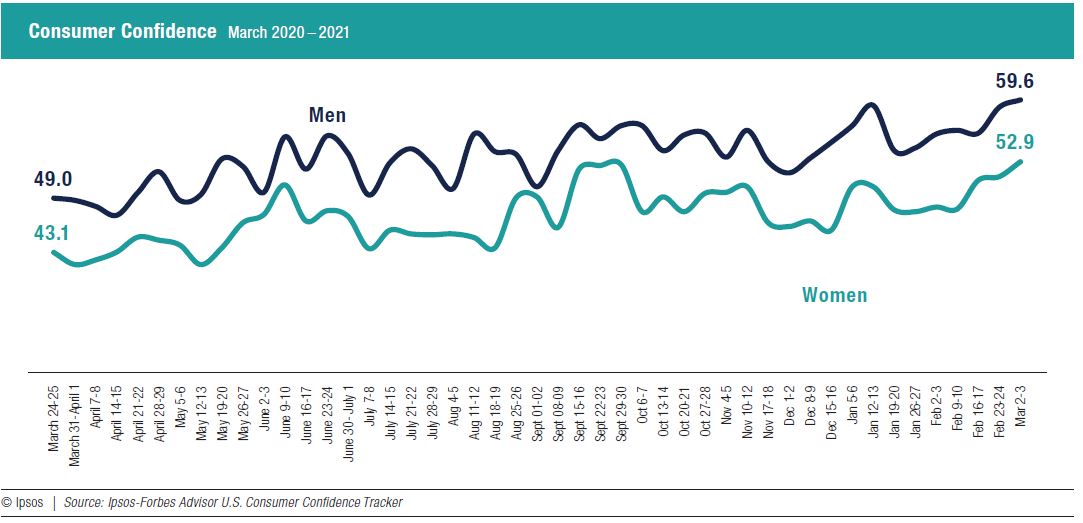
Approaching the one-year mark of the pandemic, women are more likely to report stress about savings, debt, and finances than men, according to the Ipsos consumer COVID tracker. They are much less likely than men to say they feel they have enough money saved up in case the unplanned happens and to express doubt that they will be better off than their parents.
SPOTLIGHT ON ECONOMIC IMPACT ON WOMEN OF COLOR
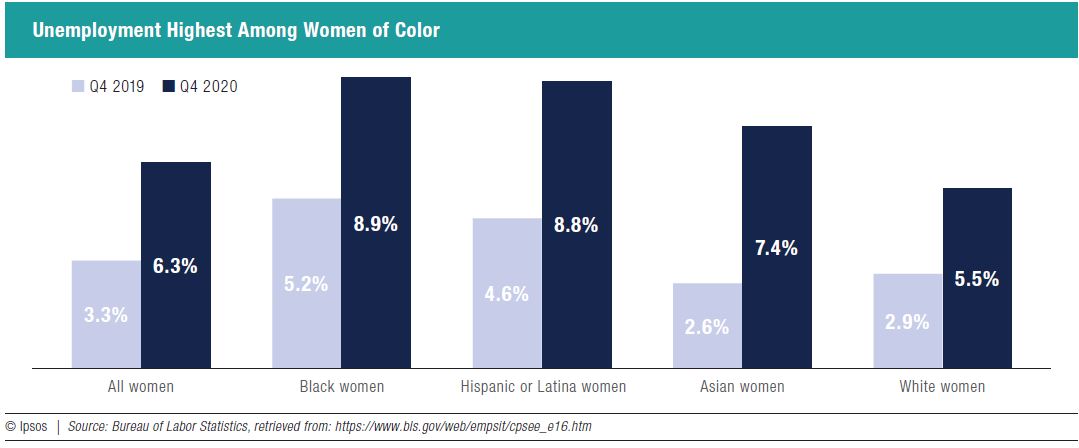
However, as negative as the pandemic economy has been for women as a group, it has been all the more severe for women of color. The job market is still far from regaining its pre-pandemic strength, with the monthly unemployment rate sitting at 6.3% in January 2021. Women of color were even worse hit by jobs losses over the past year, as a comparison of BLS unemployment data from Q4 2019 and Q4 2020 makes clear.
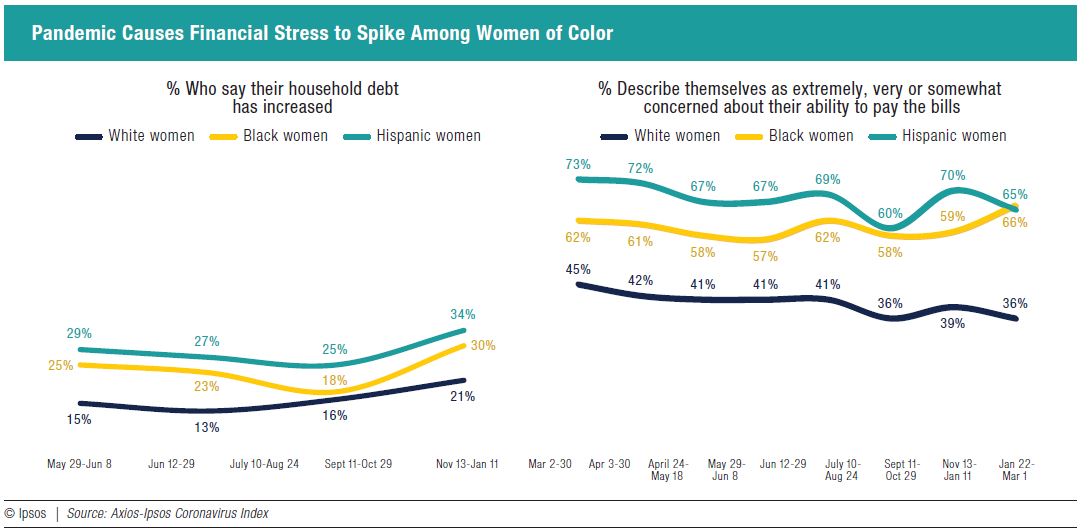
In addition, these inequities are mirrored in varying levels of stress about finances across races. Black and Hispanic women are much more likely to worry about their ability to pay the bills than white women. They are also more likely to describe their personal finances as poor.
PARENTING IN A PANDEMIC
With schools closed and other disruptions to everyday life, parenting during the pandemic is a monumental task. Reports suggest that many mothers have had to drop out of the workforce altogether or scale back their hours to pick up the slack. However, a Pew Research Center analysis of the first six months of the pandemic found that workforce participation among mothers and fathers fell by about the same amount during the pandemic. As we come up on a year of the pandemic, certain disparities linger. Fathers are now participating at a higher rate than mothers, and white mothers did not suffer jobs losses to the same extent that Black, Hispanic, and Asian mothers did. These initial unemployment figures may not tell the story, however. The Axios-Ipsos Coronavirus Index finds that mothers have consistently had a tougher go of it with work during the pandemic. For example, mothers are consistently more likely than fathers to say that their ability to do their job has gotten worse.
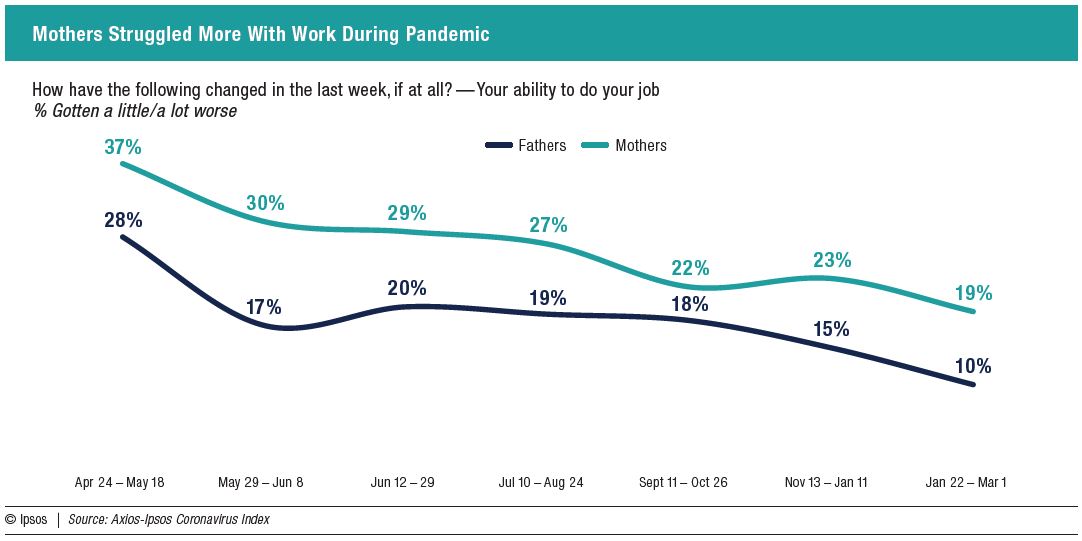
Much of this is tied to the fact that women are more still more likely than men to take on the lion’s share of caring for the family and managing the household, a dynamic has not shifted during the pandemic. Over the summer, 62% of mothers said that they would be the ones to take care of the children if schools went remote again, according to a Newsy/ Ipsos survey. Just 26% of fathers said childcare responsibilities would fall to them. Under COVID, gender norms are just as engrained as ever.
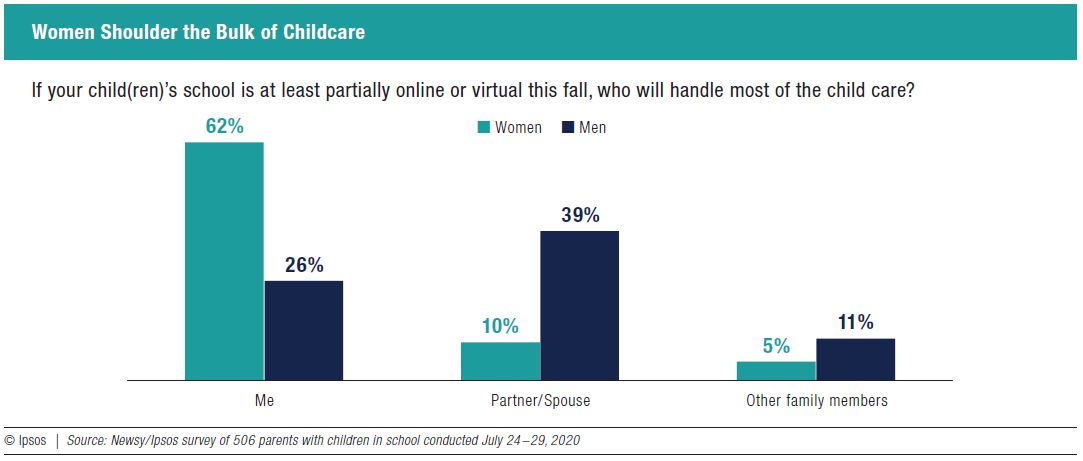
For women and men, the consequence of pulling back on work due to COVID could have lifelong implications, curtailing earning potential or altering the trajectory of their career. But for too many mothers, exiting the workforce has become the only possible option.
ENGAGING IN PRECOVID ACTIVITIES AND PROTECTIVE BEHAVIOR
Women and men interpret and respond to the virus differently. Women consistently report greater levels of concern about the virus and are more risk averse than men when it comes to engaging in pre-COVID activities. They were early mask adopters, compared to men. Throughout the past year, as people stopped or rolled back their social activity outside of their home, women tended to report doing so at higher levels than men.
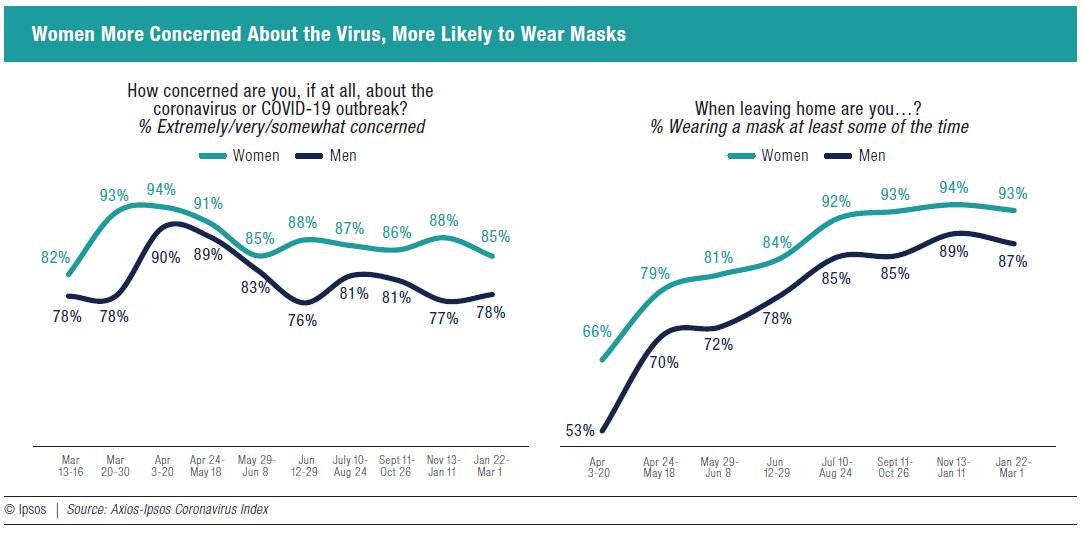
Among women, there are notable differences. Black and Hispanic women tend to view attending in-person gatherings of friends and family outside of the home as a bigger risk than white women. Likewise, mothers with kids under the age of 17 were more likely to view engaging in-person social activity outside of the home as riskier than fathers. Yet, that gap has closed since the end of January.
CHANGING ATTITUDES ABOUT THE VACCINE
Americans were initially quite skeptical of the vaccine, but as the health context shifted, that guardedness has lessened. In the middle of September only 37% of Americans said they were likely to take the first-generation vaccine as soon as it was available. That number jumped to 60% in the new year, following FDA approval of two vaccines and the beginning stages of the vaccine rollout. Still, some women remain more skeptical of the vaccine than others. Mothers and Hispanic women are less likely than all Americans to take the vaccine as soon as it’s available. Until recently, that was also the case for Black women.
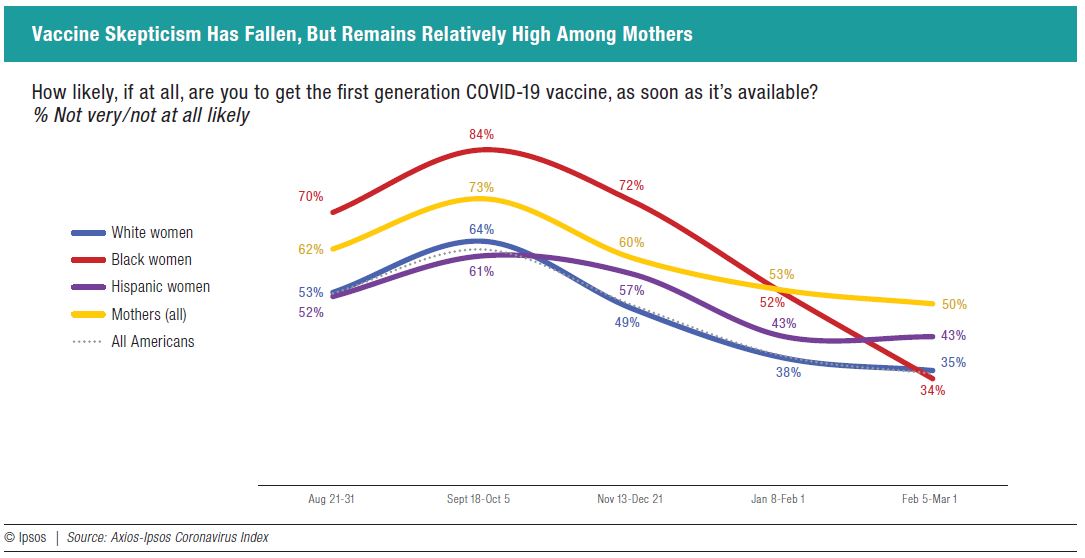
How the government is managing the vaccine rollout remains a top area of concern for most people, but particularly for women who are skeptical of the vaccine now. About three in four moms with kids under the age of 18, and three in four Hispanic women are worried about how the government is handling the distribution of the vaccine.
MENTAL HEALTH AND THE PANDEMIC
Living with COVID-19 for a year has not been easy, and women have felt the emotional toll acutely. Over the course of the pandemic, there has been a roughly 10-point gap between men and women on whether their mental health has worsened in the past few weeks.
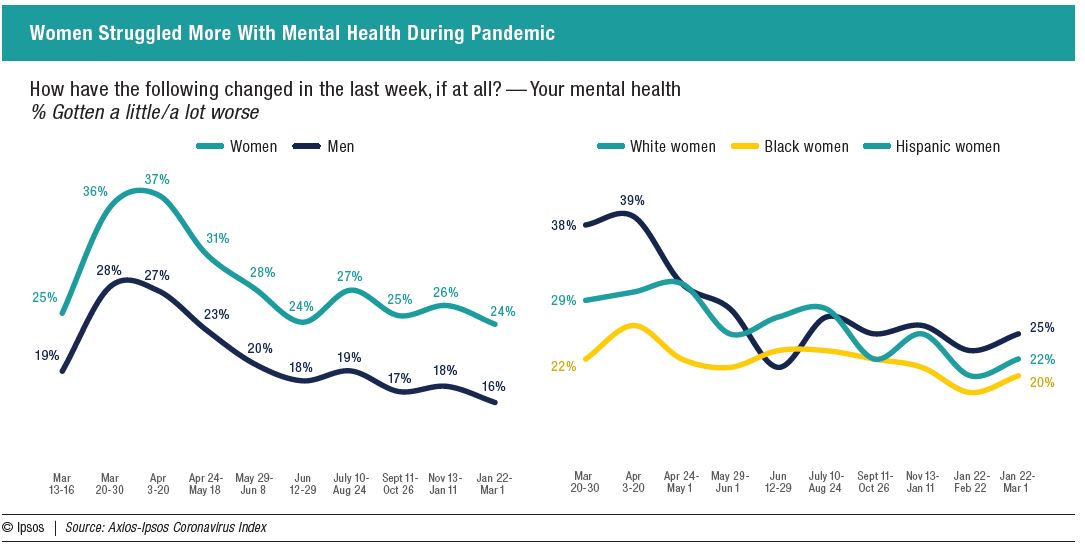
At the beginning of the pandemic, white women reported worsening mental health at higher rates than Black or Hispanic women. That changed as the pandemic wore on. One year later, white women are much less likely to report worsening mental health than in the early stages of the pandemic (39% between March 20 – 30, 2020 vs. 25% between January 22 – March 1, 2021), while Black women are doing just about the same as when the pandemic started (22% between March 20 – 30, 2020 vs. 20% between January 22 – March 1, 2021). Similarly, the emotional weight that comes with parenting has affected mothers more than fathers. At the one-year mark of the pandemic, 27% report that their mental health is getting worse week to week. Put differently, that is nearly twice as many mothers as fathers (16% of whom report worsening mental health in the same period, January through March 2021).
CONCLUSION:
The pandemic has underlined many of the inequities that are baked into everyday life for women. Black women, mothers, and Hispanic women faced greater challenges in the labor market, on the frontlines, and in the home. Women’s sense of safety was upended throughout the better part of the year, and they are more risk-averse than men. All of this is impacting women’s mental and emotional health. One year after the start of the pandemic, there are effective vaccines available and a potential end date in sight. While there is hope that in the mid-term future the pandemic will start winding down, the road out is still filled with obstacles. Some women still are not sold on the vaccine, and nearly one in three women have a lot of uncertainty about the future, according to the latest Ipsos Consumer Tracker. Understanding how women’s experiences have varied throughout the pandemic is essential for addressing the inequities that will permeate the pandemic recovery landscape.

![[WEBINAR] Ipsos Global Trends 2026: The U.S. Edition](/sites/default/files/styles/list_item_image/public/ct/event/2026-09/thumbnail-gt-26.png?itok=AbsiS6xk)
![[WEBINAR] Know America at 250: Public Opinion Update](/sites/default/files/styles/list_item_image/public/ct/event/2026-09/250_0.png?itok=zfBpfzIn)