
Did the pandemic boost credibility for e-learning?
It has pushed the door further open for the future of education to include hybrid online/at-home learning. This provides e-learning brands the opportunity to elevate their legitimacy as teaching resources, whether self-guided or in partnership with schools or companies.
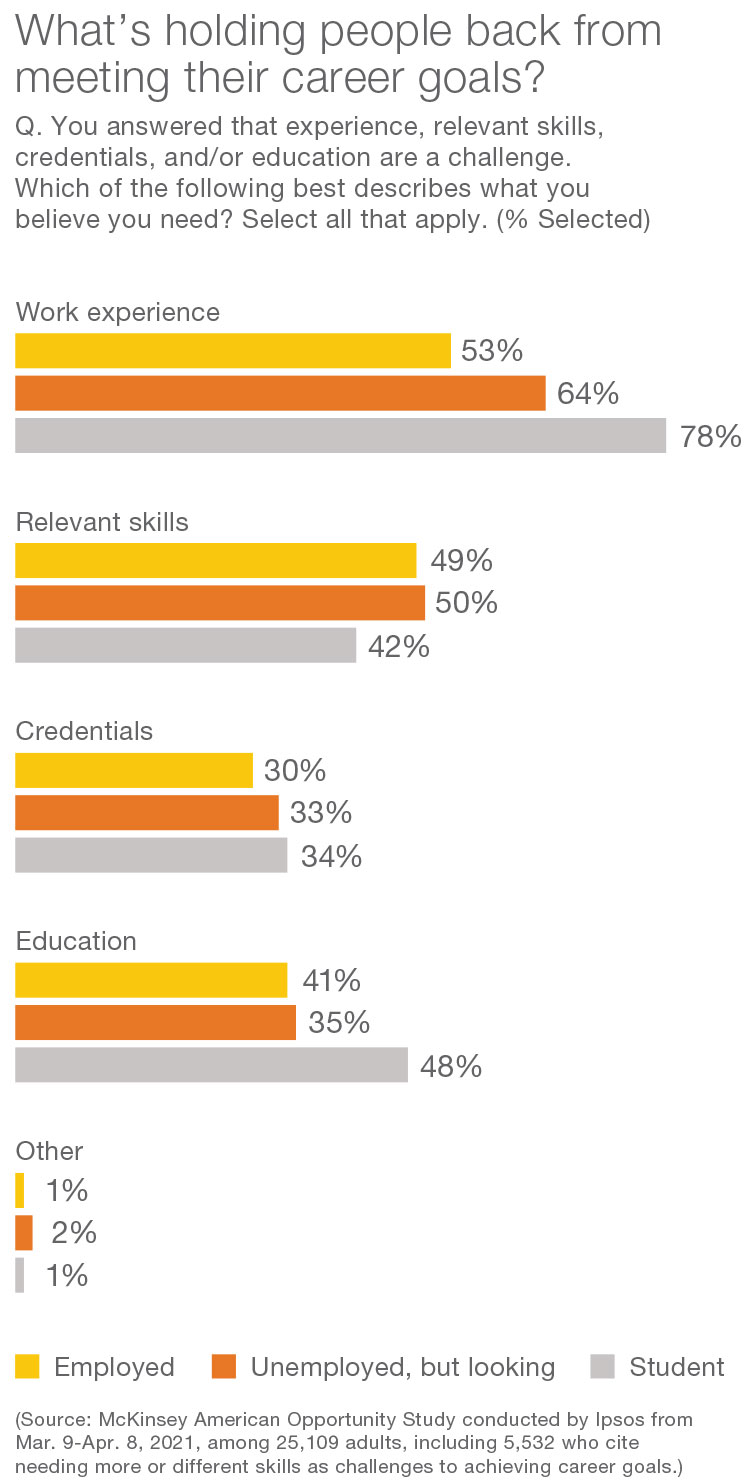
E-learning will be increasingly critical in the future because most adults say they need more relevant work experience, skills, credentials and education to achieve their career goals, per a recent Ipsos study on behalf of McKinsey. About half of employed adults and two-thirds of unemployed job seekers cite relevant work experience as a challenge. Then, about half of employed adults and half of unemployed who are looking for jobs say they need more relevant skills. For working adults or parents who may not be able to study full-time or when classes are in session, online learning offers the most flexibility.
The potential for tech brands is wide open if employers embrace them as learners have. Already, among the tools available, YouTube is the platform of choice for learning, per another recent Ipsos study. It reveals that six in ten participants choose the video platform as their online learning source ahead of employer training, online university courses and other online learning portals. Along with this, 56% rely on tech brands to provide better learning tools and platforms post-pandemic.
Within these programs, adaptive learning technologies can support students with online tutors driven by artificial intelligence. They can deliver personalized instructions based on students’ needs and provide immediate feedback with auto-grading. To increase credibility with older students, tech brands could partner with well-established universities to create curricula for continuing education.
The University of California, Berkeley, has started implementing adaptive learning technologies that automatically generate personalized help on the fly, based on AI learnings from past student interactions with the course.
Education in the future will be a more personalized experience, taking into account the knowledge people already hold, what they want to learn and specific learning challenges they face. In other words, as during the pandemic, technology is poised to shape education in all its forms for the workforce of the future.
This article was originally published in What the Future Education, a research magazine by Ipsos exploring the current state of America's education system as it prepares the workforce of tomorrow. Are we ready? Download the magazine here.


![[WEBINAR] TOAST 2026: Under Pressure - Fewer, Fragmented, Fought-For](/sites/default/files/styles/list_item_image/public/ct/event/2026-07/thumbnail-templates_1_0.png?itok=MxL-wPJW)