Tech Sustainability: Activating Consumer Desire to Make a Difference
A landmark United Nations report published August 2021 warned that the world is speeding toward runaway climate change and raises major questions about what companies are doing in response. While multinational companies certainly do have a role to play in leading sustainability initiatives, the need for technology brands to act is even more pronounced.
From carbon footprints to supply chains, tech companies face particular challenges in reassuring worried consumers that they are committed to sustainability. Many of tech’s customers want to contribute to a solution, but are challenged by not knowing what to do, which brands to trust or whether their small contributions matter. Larger efforts from tech giants are needed to reassure consumers that their purchases from companies contribute to a broader effort.
In our latest comprehensive guide, we share research illustrating ways tech companies can raise industry standards and become sustainability leaders, while differentiating what their brand is specifically doing and applying consumer behavioral change tactics to ensure policies have the most impact.
KEY TAKEAWAYS
- It is important to know your corporate ESG objectives and your competitors as well as how they influence decision making in Tech
- Tech leaders should build brand trust through consistent messaging and high-level policies, as well as via tangible policies that consumers can see/feel (such as less packaging or local impact).
- Consumers hold governments and companies responsible for progress on sustainability—but they recognize the responsibilities of citizens as
- Consumers want to contribute to Brands should employ a Behavioral Science framework which can help their customers bridge the “say-do” gap.
A landmark United Nations report published August, 2021 warned that the world is speeding toward runaway climate change and raises major questions about what companies—including in the tech world—are doing in response.
From carbon footprints to supply chains, tech companies face particular challenges in reassuring worried consumers that they are committed to sustainability. Many of tech’s customers want to contribute to a solution, but are challenged by not knowing what to do, which brands to trust or whether their small contributions matter. Larger efforts from tech giants are needed to reassure consumers that their purchases from companies contribute to a broader effort, whether it’s Apple pledging to become carbon neutral by 2030 or Amazoncreating a $2 billion sustainable tech fund.
Here’s what Tech leaders should ask themselves:
- Which sustainability initiatives and policies are relevant and appealing to our customers?
- What are consumers’ expectations of the tech industry in the sustainability space? What role do consumers feel they can play?
How do we communicate the benefits of sustainable practices and get consumers to act on their good intentions?
Sustainability Initiatives
As sustainability concerns grow, consumers are increasingly seeking out brands that clearly com- municate their policies and steadily build brand trust. Within this context, Ipsos breaks down what you need to know, the actions technology brands can take to bridge the “say-do” gap and how they can get customers to act and invest in sustainability.
Step One: Know your Sustainable Development Goals
As technology leaders, it is important to know what your company and competitors are doing
to deliver against the United Nations’ SustainableDevelopment Goals (SDGs) as seen in the most recent Sustainability Impact reports. Here’s a sampling of tech leaders, their SDGs and their progress. You will note that a common theme is carbon-neutrality; however, there is great variability in approach, programming and measurement (or lack thereof). This results in consumer confusion and lack of understanding about how their personal tech choices link to these goals.
Microsoft
Microsoft has four commitments that will guide their sustainability work for the next decade: Carbon Negative by 2030, Water Positive by 2030, Zero Waste by 2030, and Build the Planetary Computer.
HP
To date, HP has activated SDG programs against 11 of the 17 SDGs. They have earned many awards for their efforts including being named as one of the 2021 World’s Most Ethical Companies and they ranked among the top 3 ICT (information and communications technology) companies on the 2020 Corporate Human Rights Benchmark.
Apple
Apple’s Sustainability report reveals the three pillars of their strategy: climate change, resources and smarter chemistry. Their comprehensive carbon footprint informs the work they do to address our climate impact, including the roadmap to carbon neutrality. Within their resources pillar, data on environmental, social and supply impacts prioritize materials they transition to recycled and renewable sources. All the work they do aims to improve environmental health, not just for their customers, suppliers and employees, but also for broader global communities.
Amazon
Amazon has committed to building a sustainable business for their employees, customers, and communities. They are driving toward a netzero carbon future where the people that support their entire value chain are treated with dignity and respect. Amazon’s 2020 Sustainability Report highlights their sustainability progress over the last decade—particularly since 2019, when they co-founded The Climate Pledge and announced their commitment to achieve net-zero carbon emissions across our business by 2040.
Consumer Expectations
In March 2021, Ipsos conducted a Global Sustainability study across 28 markets to determine the role of multi-national companies in corporate responsibility. We measured the importance of ESG components among global consumers: Protecting the environment (E), Improving Society (S) and Practicing good governance (G).
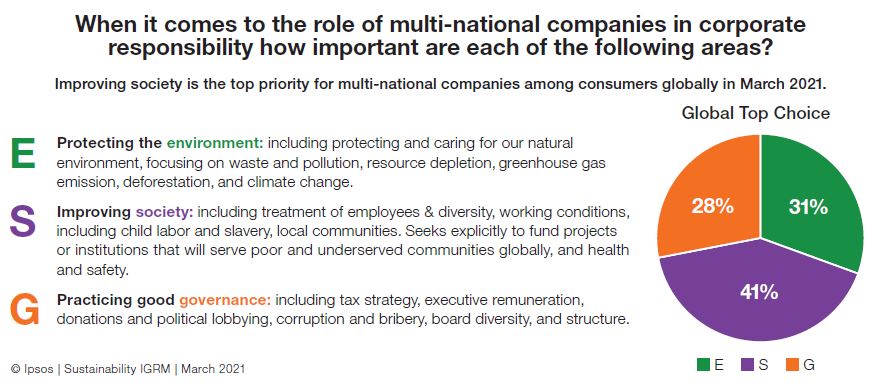
When it comes to protecting the environment, globally, companies can take these leading actions: reducing waste, reducing the use of plastic, developing more environmental products, overall caring for the environment, and reducing greenhouse gas emissions.
Being known as a brand that cares about the environment is especially relevant in today’s marketplace since younger generations are buying brands that align with their values, including planet and personal sustainability. People may feel overwhelmed, but continuous focus provides heuristics, drives brand affinity, and builds trust that the brand will “make good decisions for the environment.”
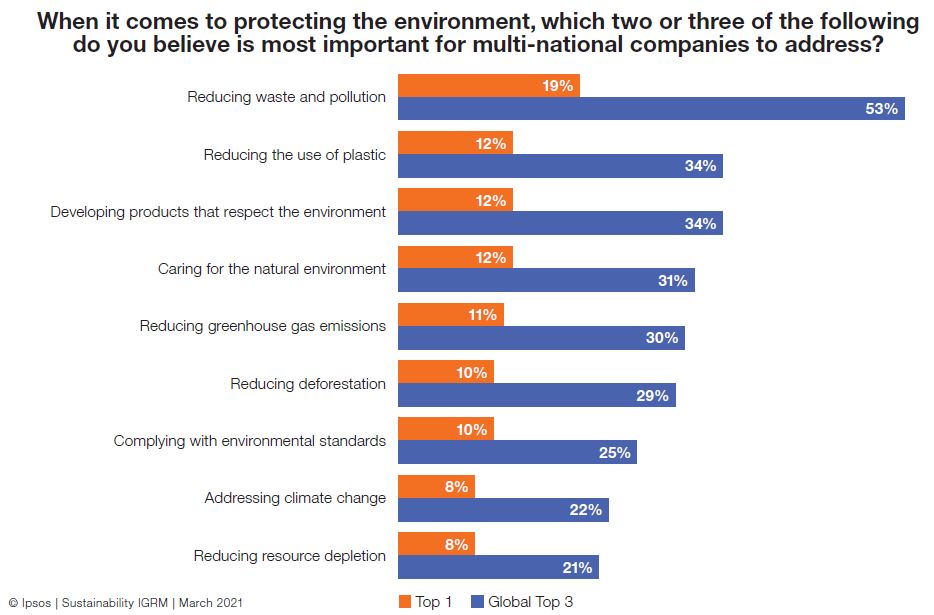
Improving Society is a top consumer priority for multi-national companies, particularly in Spain, Poland, Japan, and Korea. Specifically, Citizen consumers want multi-national companies to make a difference by improving working conditions and worker health/safety. Citizen consumers then want companies to address broader concerns like servicing the poor and ending child labor and slavery. Of note, Improving society includes: treatment of employees & diversity, working conditions, including child labor and slavery, local communities, seeks explicitly to fund projects or institutions that will serve poor and underserved communities globally, and health and safety.

Communicating the Benefits
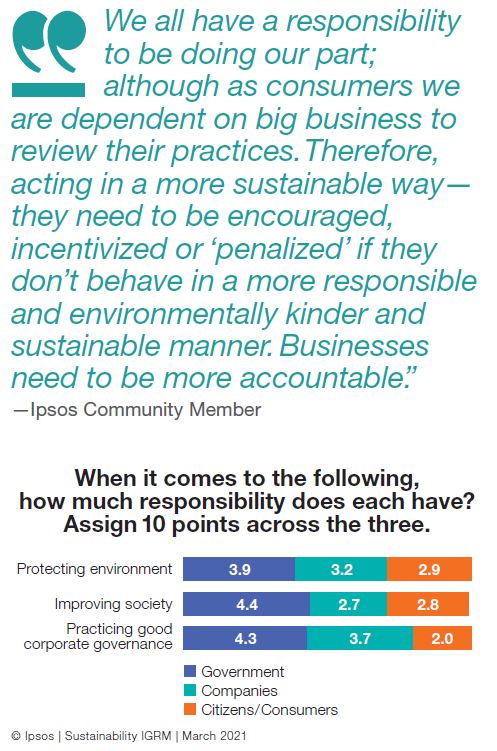
Overall, citizen-consumers tend to think that Government carries the most responsibility for each of E, S, and G. However, they assign less prominence to government on the environment with companies and citizens/consumers splitting the duty.
When it comes to improving society, government is seen by far as the most important actor with companies and citizens/consumers sharing the responsibility.
Citizen-consumers do not see a role for themselves in corporate governance.
Consumer-citizens believe that if the government and businesses do not act now, they are failing their employees and customers.
Having policies that consumers say are important to them isn’t enough. Getting consumers to know them, care about them and/or be willing to pay more for, are definite challenges. Technology brands need to under- stand human motivations and how to influence them.
Although consumers say they are concerned about the environment, there is both a “say-do gap” as well as a “believe-true gap.” Largely, consumers don’t fully understand the ramifications of their action or inaction. Many are not all ready to pay significantly for products that could make a difference. The burden lies with government and businesses to educate consumers and align their business practices with behaviors and activity supporting their corporate ESG goals.
In a separate Ipsos Point of View—click here to learnmore—our Behavioral Science experts outline how enabling actions that people are already inclined to take facilitates the adoption of sustainable behaviors. We discuss how you can leverage our MAPPS (Motivation-Ability-Processing-Physical-Social) structure to drive action.

Another Behavioral Science Framework that can be leveraged to influence consumer behavior is Regulatory Fit theory. Stated simply, there are vast differences
in what motivates people—and these differences can be characterized by whether individuals are in a Prevention or Promotion mindset.
When consumers have a Prevention mindset, they tend to focus on needs, duties, obligations and being safe (“how can I not make things worse?”) These consumers will respond positively to messaging that matches their mindset via appeals of “at least doing their part.” Conversely, when consumers have a Promotion mindset, they pay attention to things that will help them feel good about themselves, achieve goals, and improve their lives.
Leveraging a consumer behavioral change framework will help segment customers and customize messaging and sustainability policies to have the most impact.
What’s Next
Sustainability is the new business imperative, and the tech industry has a mandate to act. There is an opportunity to raise industry standards and become industry leaders by highlighting the huge impact technology has on the planet and what your brand is specifically doing. Key actions you can take now:
- Define a communication plan so your Tech customers know your ESG actions—if customers don’t know about your efforts, they will not influence their tech purchase Measure the ROI of these communications.
- Keep building trust in your brand so consumers know you are doing the right Learn the drivers of trust for your brand.
- Ensure you understand the core segments and their most salient
- Ensure you’re not putting blame or responsibility on Help them navigate the landscape whilst demonstrating your own commitment.
- Take inventory of the product and packaging requirements that align with consumer
- Dig into what will deliver the highest ROI (recyclable, cause donations, ) for tech customers.

![[WEBINAR] What the Future: Success](/sites/default/files/styles/list_item_image/public/ct/event/2026-07/thumbnail-wtf-success-.png?itok=3mnYDE70)
![[WEBINAR] Accelerating Innovation Development with Synthetic Data](/sites/default/files/styles/list_item_image/public/ct/event/2026-08/thumbnail-templates%20demo_1.png?itok=nao0XJ7q)