
How can brands help solve the chicken/egg dilemma in women’s sports coverage?
It has been nearly 50 years since Title IX laws granted women equal opportunities in sports. Yet opportunities for fans to watch women’s sports and grow their fan bases haven’t changed since the early ‘90s. This despite the birth of the WNBA, growing popularity of the United States women’s national soccer team, and, well, the existence of Serena Williams. This is a glaring miss for viewers and brands as fanbases are built on publicity.
Ipsos data shows that a plurality (46%) of Americans agree there needs to be more media coverage of women’s sports. Among sports fans (those that report following at least one sport closely), even more (60%) agree.
Just 5% of total television sports coverage focuses on women’s sports, according to a three-decade study by University of Southern California and Purdue University. Moreover, they found there’s been little growth in women’s sports coverage in TV news and highlights shows, which these researchers say are essential to build fan knowledge, engagement and audiences. Ipsos research underscores this atrophy of interest.
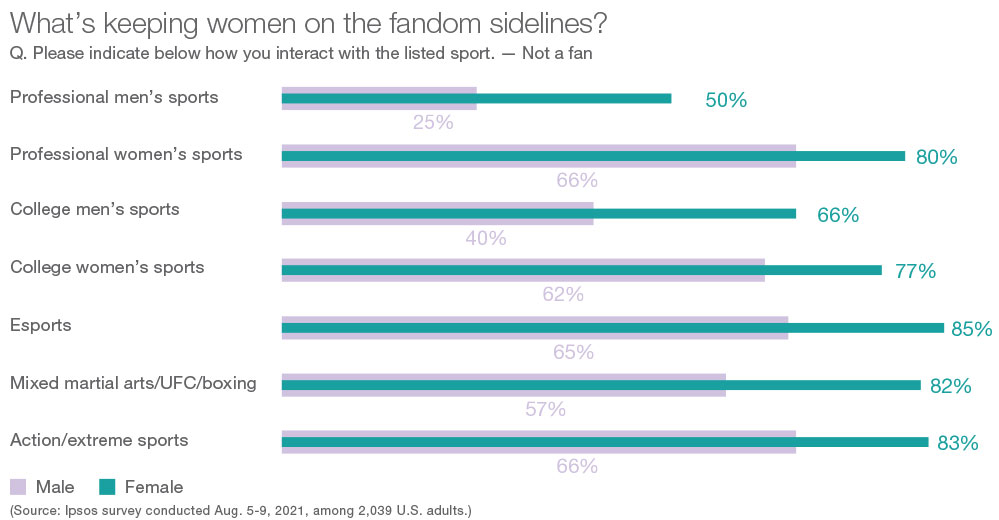
The number of Americans who say they are “not a fan” of professional women’s sports is nearly twice the amount who say the same for professional men’s sports. Worse, women are more likely than men to identify as “not a fan” of women’s pro sports (80% women vs. 66% men) and women’s college sports (77% women vs. 62% men).
With women’s sports hardly shown on TV, are the reported consumption and fandom gaps because people aren’t watching them or because they can’t? Efforts like The Fan Project show women’s sports fans are turning to digital platforms to watch the play they can’t get from traditional media. Meanwhile, it seems that athlete activism and calls for gender parity are front and center in the broader media arena (pun intended).
Female athletes have been at the forefront of using their voices to bring change to the future of sports. And we may be at a tipping point: A recent Axios/Ipsos survey found that a slim majority of Americans support professional athletes speaking out on political or social issues. In an era where brands are eager to assert their outsize influence for purpose, boosting the fan experience and access to watch women’s sports is perhaps their biggest opportunity. Women are waiting.
This article was originally published in What the Future Sports, a research magazine by Ipsos exploring the changing roles that the worlds of collecting, engaging with brands and betting will play in how we engage with the teams and players we love. Download the magazine here.
![[WEBINAR] AI in Higher Education: How AI Is Reshaping Teaching and Learning](/sites/default/files/styles/list_item_image/public/ct/event/2026-10/How%20AI%20Is%20Reshaping%20Teaching%20and%20Learning.png?itok=XYdLaI-4)

![[WEBINAR] Winning B2B Buyers: AI Gets You Considered; Trust Gets You Selected](/sites/default/files/styles/list_item_image/public/ct/event/2026-10/Winning%20B2B%20Buyers%20AI%20Gets%20You%20Considered%20Trust%20Gets%20You%20Selected.png?itok=Q4kElwY2)