
Will inequality drive policy changes that will impact wealth?
Despite its reputation as the land of equal opportunity, the U.S. leads all G7 countries in income inequality, according to the World Bank.
Ipsos data shows that ten years after the Occupy Wall Street movement, Americans tend to be less concerned about income and wealth disparities than their global peers. Until Americans and the policymakers they elect agree on solutions, wealth inequality is unlikely to improve any time soon.
Most Americans (57%) agree that inequality in income and wealth is one of the most serious forms of inequality in their country, according to a January 2021 Ipsos Global Advisor survey—close to the global average of 60%. However, in the latest installment of Ipsos’ What Worries the World, only 17% in the U.S. select poverty and social inequality among the country’s top problems—the lowest percentage among 28 countries.
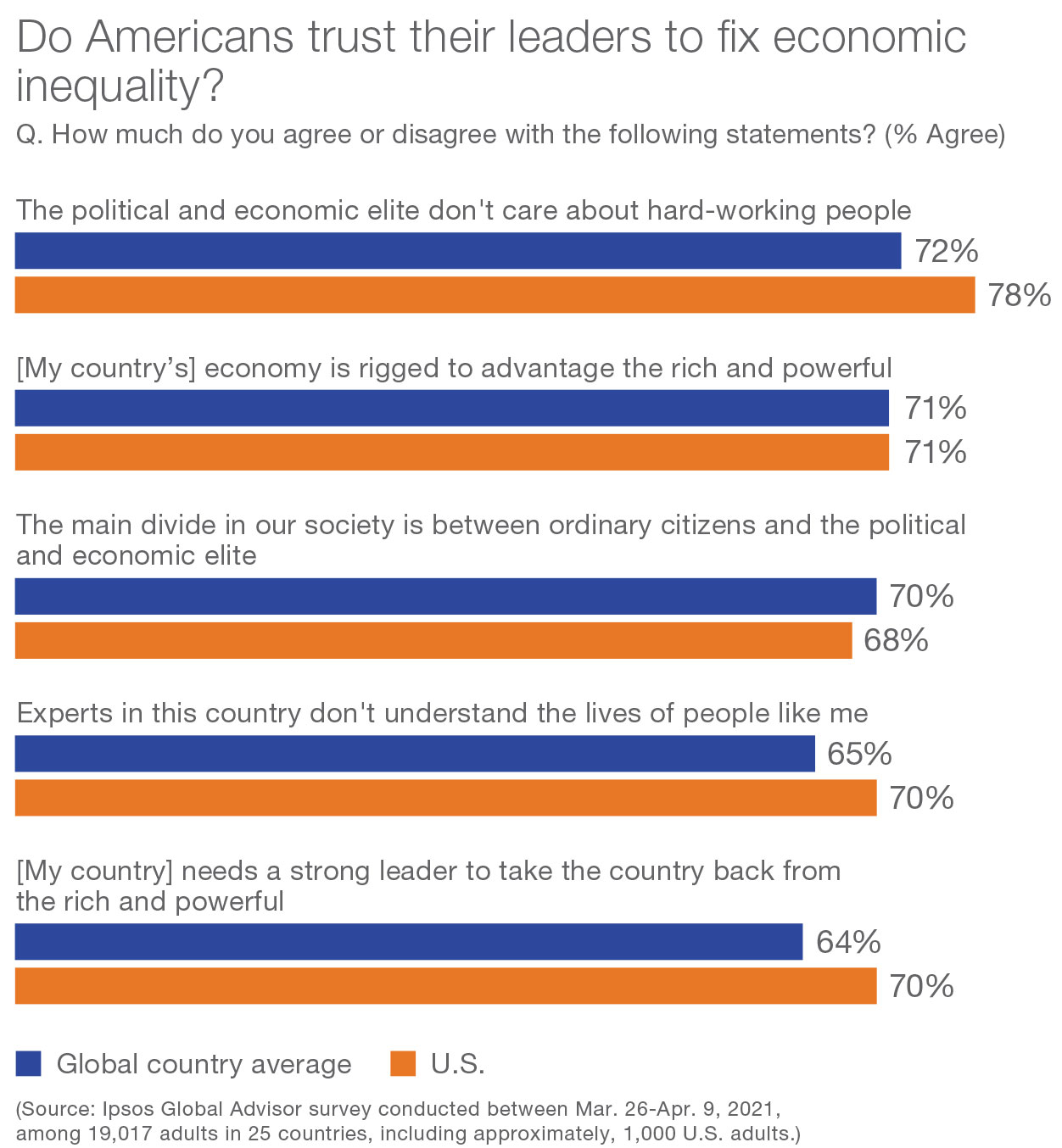
The proportion of those who agree that their country’s economy is “rigged to advantage the rich and powerful” is the same in the U.S. as it is on average across 25 countries surveyed by Ipsos in March-April of this year: 71%. This perception shows no significant differences by gender, by age, by level of education and, maybe surprisingly, by income. Considering America’s acute level of political polarization, it is noteworthy that majorities of both Democrats (79%) and Republicans (58%) share this view.
Further, they are deeply polarized on the reasons why. For a variety of reasons, Americans look at wealth inequality differently from folks in other countries. Traditionally, Americans have never resented the rich for being rich as long as they play by the rules. Americans are not class-conscious. Only 6% think they are part of the elite—the lowest percentage among 26 countries along with Japan. America is supposed to be the land of opportunity. Rather, what many in the U.S. think gets in the way of opportunity is “corruption” (i.e., “special interests,” “Washington,” “the swamp,” etc.), immigration (which some Americans think creates unwanted competition and drags down wages and home values), or taxes/government overreach.
America is unlikely to curb economic inequality until Americans agree on how much of a problem it is, its root causes, and whether tackling it will help or hurt their chances of living the American Dream.
This article was originally published in What the Future Wealth, a research magazine by Ipsos highlighting Americans’ unique view of wealth and the influence that digital, diversity and the Great Wealth Transfer will have on how we pass, share, spend and invest it. Download the magazine here.
![[WEBINAR] AI in Higher Education: How AI Is Reshaping Teaching and Learning](/sites/default/files/styles/list_item_image/public/ct/event/2026-10/How%20AI%20Is%20Reshaping%20Teaching%20and%20Learning.png?itok=XYdLaI-4)

![[WEBINAR] Winning B2B Buyers: AI Gets You Considered; Trust Gets You Selected](/sites/default/files/styles/list_item_image/public/ct/event/2026-10/Winning%20B2B%20Buyers%20AI%20Gets%20You%20Considered%20Trust%20Gets%20You%20Selected.png?itok=Q4kElwY2)