Seven years in, few see COVID as a threat
The Ipsos Consumer Tracker, fielded on Ipsos' Omnibus platform, asks Americans questions about culture, the economy and the forces that shape our lives. Here's one thing we learned this week.
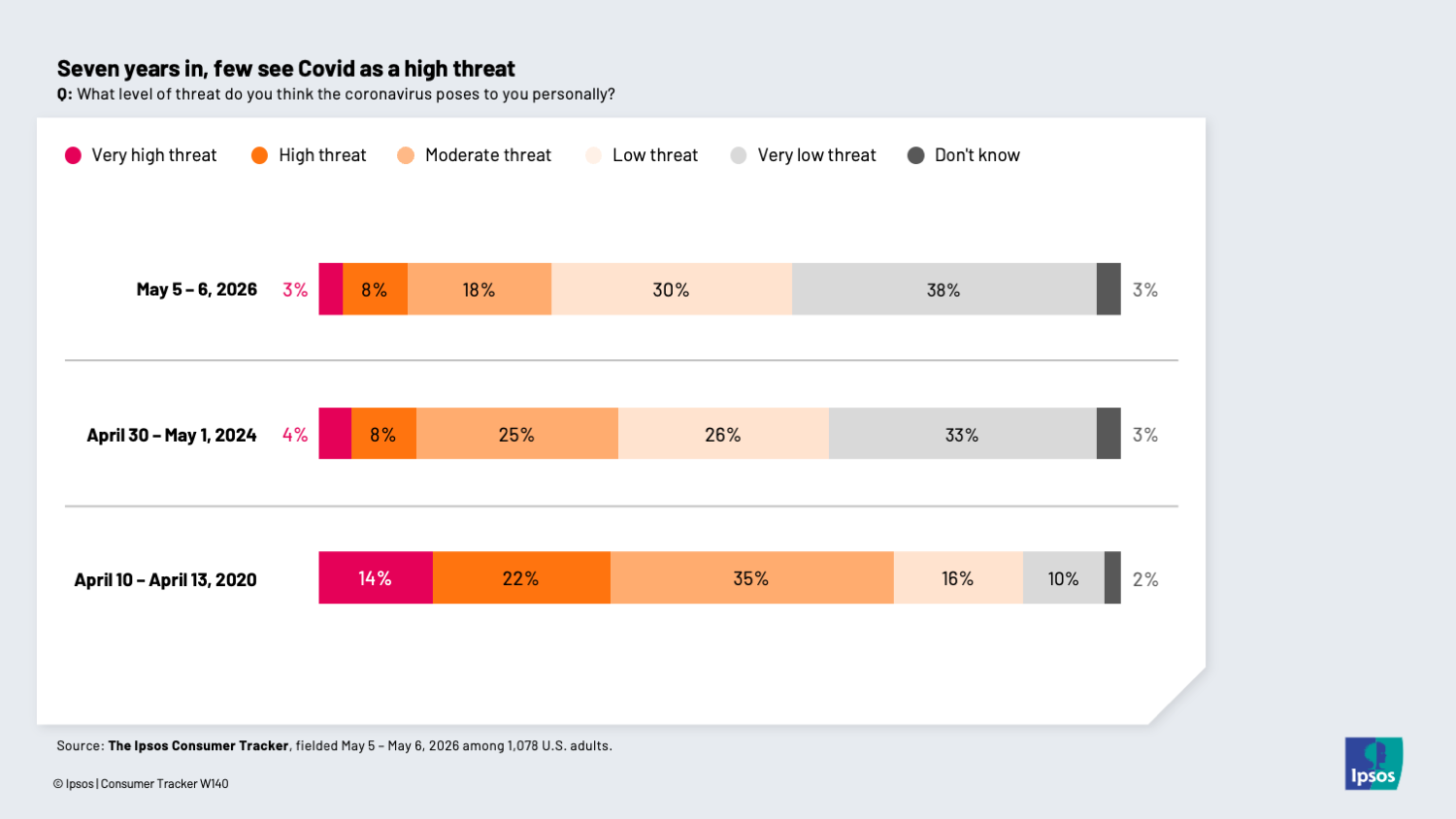
Why we asked: Seven years ago, we began what was then the Coronavirus Tracker. While it has morphed with the times to be more about general consumer sentiment, attitudes and behaviors, we like to mark the passage of time by returning to some of the questions from wave one (this is wave 140, for those keeping score.) This is actually question 1 in our cumulative numbering system, which will soon pass 700 discrete questions!
What we found: Seven years since the start of the pandemic, only 11% of Americans view COVID-19 as a very high or high threat to themselves personally. In wave one, that was three times higher (36%). Interestingly, in wave one, as today, there is a 9-point gap between Democrats and Republicans on “high threat.” The feeling of threat mirrored actual data, spiking into the 40% range in early 2021 when deaths attributed to the virus peaked. By two years ago, the last time we asked this, threat had dissipated and remains consistent now at about 11% (though again, that’s 7% of Republicans and 16% of Democrats). The 38% currently listing it as a “very low threat” is a new record. I’ll note that I actually know people with COVID-19 at the moment, so it’s still out there.
More insights from this wave of the Ipsos Consumer Tracker:
A positive signal on the economy: More people have money left over after bills
Higher-income Americans were twice as likely to have a bigger tax refund this year
AI data centers are unpopular with most Americans
If you trust AI recommendations generally, you trust them for most things
Americans are well aware of gas prices' rise
The Ipsos Vibe Check: Here's how Americans feel about the government this week
The Ipsos Care-o-Meter: What does America know about vs. what does America care about?