More people say they’re wearing masks to protect themselves from COVID-19 since March

There’s been an increase in the number of people wearing masks in many countries.

More people across 15 major countries say they are now wearing a face mask to protect themselves from the coronavirus pandemic.

In a survey of nearly 29,000 respondents conducted from April 9 to 12 in 15 countries, there’s been gradual increase in the number of people who say they are now wearing a face mask due to COVID-19 since mid-March.

Countries where most respondents are taking this personal action are Vietnam (91%), China (83%), Italy (81%), Japan (77%) and India (76%). Meanwhile, those in developed nations are least likely to do this including the United Kingdom (16%), Germany (20%), Australia (21%), Canada (28%) and France (34%).
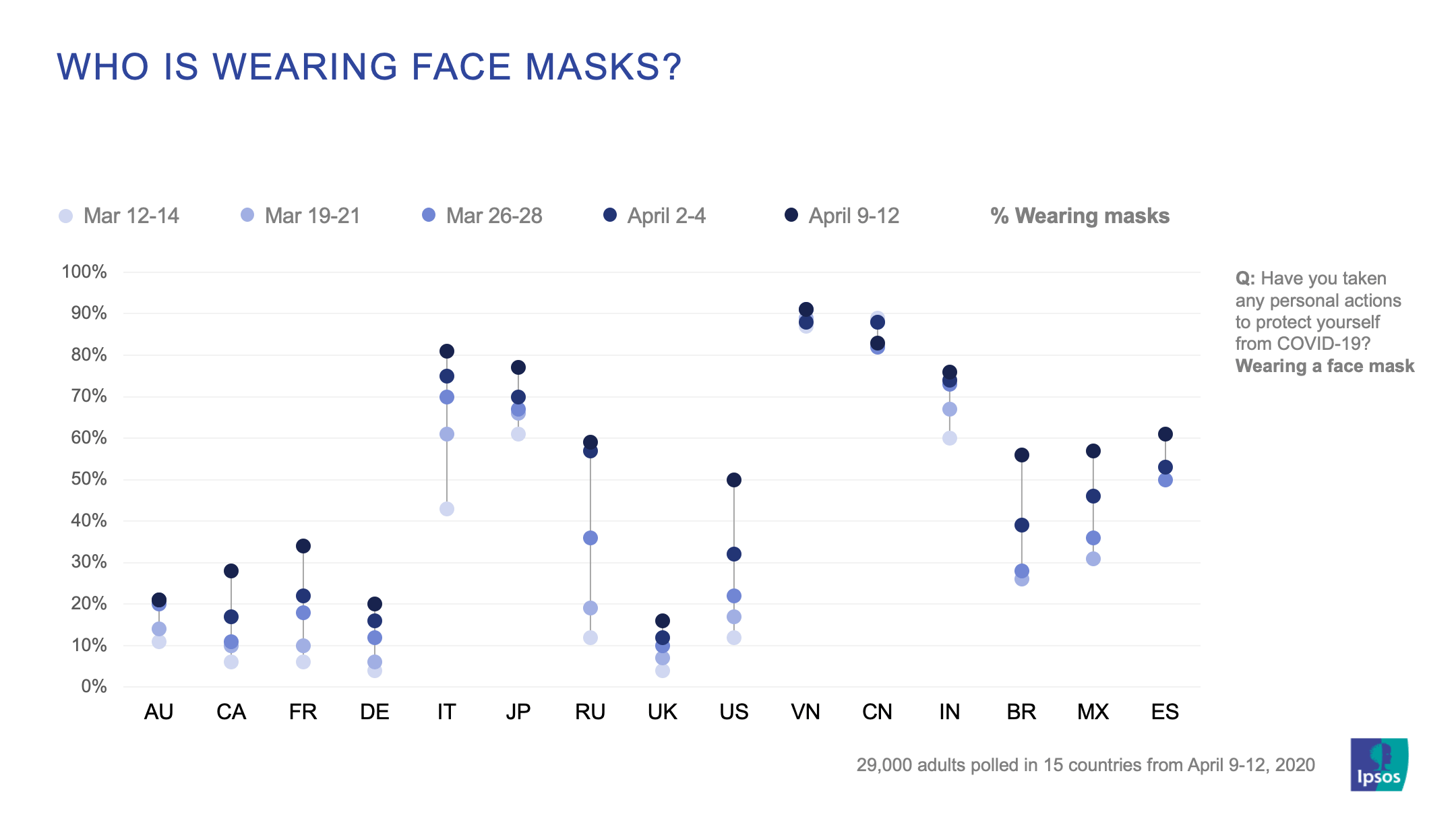
Who is wearing face masks? | Coronavirus pandemic | Global Advisor | Ipsos

Since March, Russia (+47 percentage points), the United States and Italy (+38) have seen the biggest jumps in the number of people who now say they are wearing a mask, followed by significant increases in Brazil (+30), France (+28) and Mexico (+26). China remains high with only a small decline (-6) on this measure since March 12 to 14.

A perceived draw back in wearing face masks in many countries is getting access to one. Nearly three in five people (57%) in Japan say they have heard masks are not available or are too expensive even if they wanted to wear one. This sentiment is also high in France (49%), Germany and Spain (45%).

In terms of expectations, people in Japan (58%) and Vietnam (55%) and hard-hit Italy (53%) expect others to wear a mask around them so they don’t get sick.

Meanwhile, respondents in Australia (46%) and the U.K. (41%) were most likely to say they did not see the value in wearing a face mask if they are not sick. This sentiment was lowest in Vietnam (7%), China and Spain (9%).
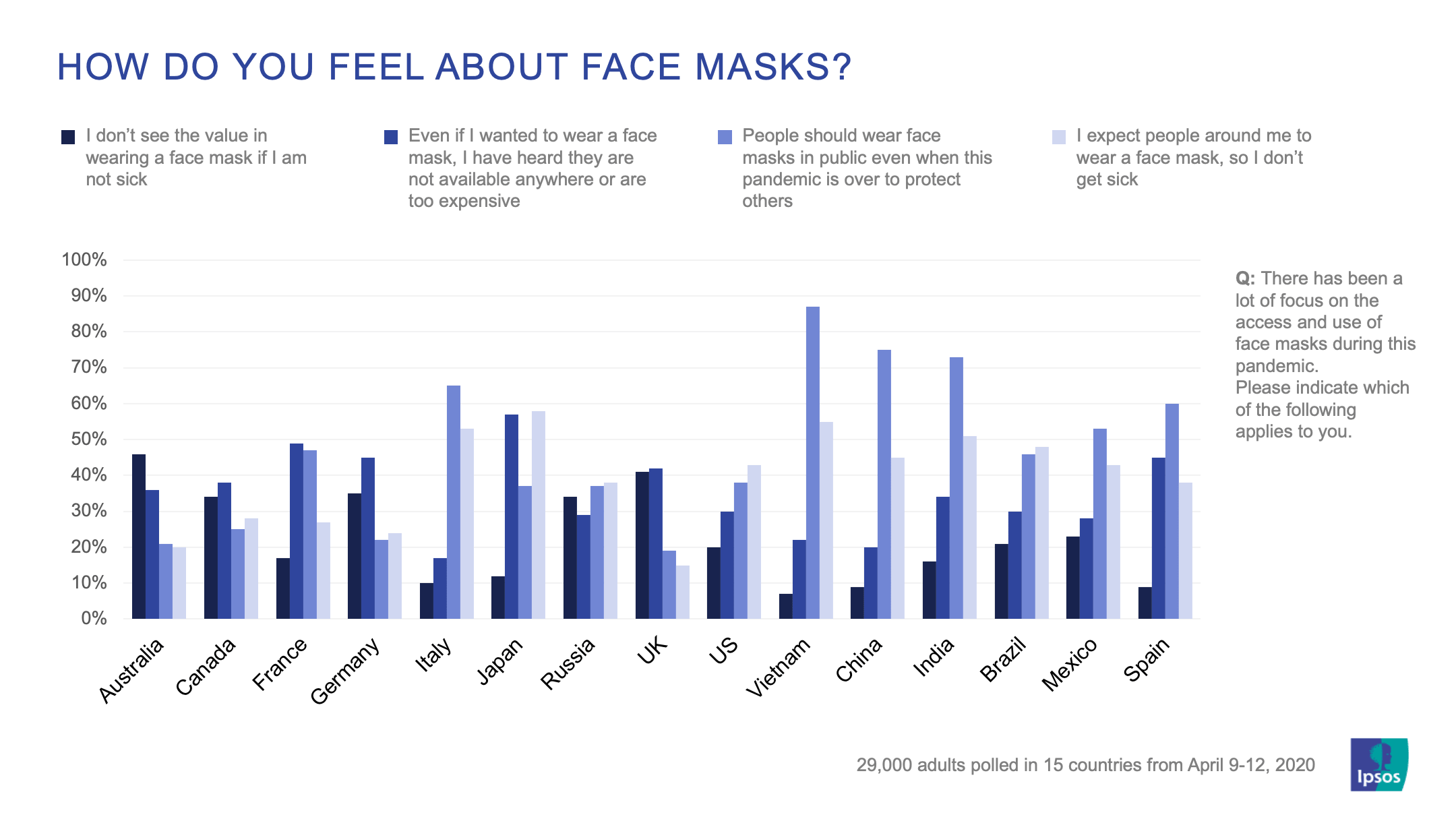
How do you feel about face masks? | Covid-19 | Global Advisor | Ipsos

These are the results of an Ipsos survey conducted April 9th to 12th , 2020 on the Global Advisor online platform among 28,000 adults aged 18-74 in Canada and the United States and 16-74 in Australia, Brazil, China, France, Germany, Italy, India, Japan, Mexico, Russia, Vietnam and the United Kingdom. Where available, tracking results from previous studies, conducted through March and selected results from February are referenced by date.

Ähnliche Inhalte

  • Welche Themen beschäftigen die Deutschen derzeit am meisten? Laut einer aktuellen Ipsos-Umfrage nehmen seit dem Ausbruch des Iran-Kriegs die Sorgen vor steigenden Preisen und militärischen Konflikten zu. Migration und Kriminalität rücken dagegen in den Hintergrund.
    Krieg/Terrorismus Pressemitteilung

    Stimmung der Deutschen auf dem Tiefpunkt, Sorge vor Krieg und Inflation nimmt deutlich zu

    Ein Jahr nach Amtsantritt der schwarz-roten Bundesregierung sehen 82 Prozent der Deutschen das Land auf dem falschen Kurs – drei Prozentpunkte mehr als im Vormonat. Die Lage der Nation wird damit so pessimistisch eingeschätzt wie selten zuvor. Lediglich nach dem Bruch der Ampelkoalition im Februar 2025 war die Stimmung noch etwas schlechter: Damals lag der Anteil der Zuversichtlichen bei 17 Prozent, aktuell bei 18 Prozent. Auch die wirtschaftliche Lage wird zunehmend kritisch bewertet: Nur noch 22 Prozent der Deutschen halten sie für gut – ein Rückgang um 7 Prozentpunkte gegenüber dem Vormonat.
  • Wie stehen die Menschen zum Klimawandel und zu steigenden Energiepreisen? Laut einer aktuellen Ipsos-Studie zum Tag der Erde nimmt die Klimamüdigkeit weltweit zu, während das Thema Bezahlbarkeit in den Vordergrund rückt.
    Klimawandel Pressemitteilung

    Tag der Erde: Jeder Zweite vertraut nicht auf Klimaplan der Bundesregierung

    Pünktlich zum Tag der Erde (Earth Day) am 22. April zeigen die Ergebnisse einer aktuellen Ipsos-Studie in 31 Ländern ein beunruhigendes Bild: Die Klimamüdigkeit ist weltweit auf dem Vormarsch. Zwar stimmen weltweit 61 Prozent der Befragten der Aussage zu, dass Untätigkeit beim Klimaschutz künftige Generationen im Stich lässt, doch in allen 26 Ländern, in denen Ipsos seit 2021 fortlaufend Daten erhebt, ist die Zustimmung rückläufig. Deutschland bildet dabei keine Ausnahme.
  • Politische Meinungslage in Deutschland | Ipsos

    Politische Meinungslage in Deutschland – Januar bis April 2026

    Erfahren Sie mehr über die aktuelle politische Meinungslage in Deutschland. Ipsos teilt regelmäßig Erkenntnisse zu Wahlabsichten, Parteibindung & mehr!