Recovery for Labour and Conservatives in Scotland as Burnham rated most popular leader
- The SNP lead General Election voting intentions on 33%, down 4 points since March.
- Labour are up by 8 points on 24%, with a clear lead over both the Conservatives (on 16%, up 5 points) and Reform UK (on 13%, down 3 points).
- Andy Burnham is the only political leader asked about to receive a positive net satisfaction rating from the Scottish public (of +4), while First Minister John Swinney’s ratings have declined (net satisfaction -19, a -5.5 swing since March).
- Kemi Badenoch has seen an upturn in her ratings in Scotland, with a net satisfaction rating of -19 (+10 swing).
Our headline estimate of General Election voting intention is:
- SNP: 33% (-4 points compared with Ipsos’ previous poll taken 26th – 31st March)
- Labour: 24% (+8)
- Conservatives: 16% (+5)
- Reform UK: 13% (-3)
- Scottish Greens: 6% (-3)
- Liberal Democrats: 5% (-3)
- Restore Britain: 3% (+1)
- Other: 1%
Labour have improved their share of voting intentions by 8 points compared with Ipsos’ previous poll in March. The Conservatives are on 16%, an increase of 5 points since March. That puts the party ahead of Reform UK, whose share has declined by 3 points to 13%. The Scottish Greens and Liberal Democrats are on 6% and 5%, a fall of 3 points for each party compared with March, while Restore Britain are on 3%.
Emily Gray, Managing Director of Ipsos in Scotland, commented:
Labour and the Conservatives will be heartened by these new results, which show clear signs of recovery for both parties in Scotland. Andy Burnham’s personal popularity is evident and he leads John Swinney on most leadership attributes, although he still has work to do to persuade the public that he really ‘gets’ Scotland. Meanwhile Kemi Badenoch’s personal ratings in Scotland have improved considerably since March, although she still receives a negative satisfaction rating from the public overall.
Our headline estimate of Scottish Parliament constituency voting intention is:
- SNP: 40% (+2 points compared with May 2026 Scottish Parliament election result)
- Labour: 18% (-1)
- Conservatives: 15% (+3)
- Reform UK: 12% (-4)
- Liberal Democrats: 7% (-4)
- Scottish Green Party: 6% (+4 points, reflecting that the Greens only stood in 6 constituencies in May)
- Other: 2% (+1)
Our headline estimate of Scottish Parliament regional list voting intention is:
- SNP: 28% (+1 point)
- Scottish Green Party: 19% (+5)
- Labour: 16% (no change)
- Conservatives: 13% (+1)
- Reform UK: 12% (-5)
- Liberal Democrats: 9% (no change)
- Other: 3% (-2)
Emily Gray, Managing Director of Ipsos in Scotland, commented:
This new poll makes mixed reading for the SNP. While the party has a clear lead in General Election and Holyrood voting intentions, John Swinney’s personal ratings have fallen. And although the Scottish public remain divided on the party’s raison d’être, independence, the issue is currently quite low on the public’s agenda, not even featuring in their top 10 issues facing Scotland.
Leaders
Andy Burnham is the only political leader asked about in the poll to receive a positive net satisfaction rating from the public: 43% are satisfied with him and 39% dissatisfied, giving a net rating of +4. He is especially popular among Labour supporters (80% satisfied, 12% dissatisfied), but also positively rated by around half of SNP supporters: 49% are satisfied with him while 35% are dissatisfied.
First Minister John Swinney’s ratings have declined compared with Ipsos’ previous poll in late March. Over half of Scots (53%) are dissatisfied with him, up 5 points since March, while 34% are satisfied, down 6 points.
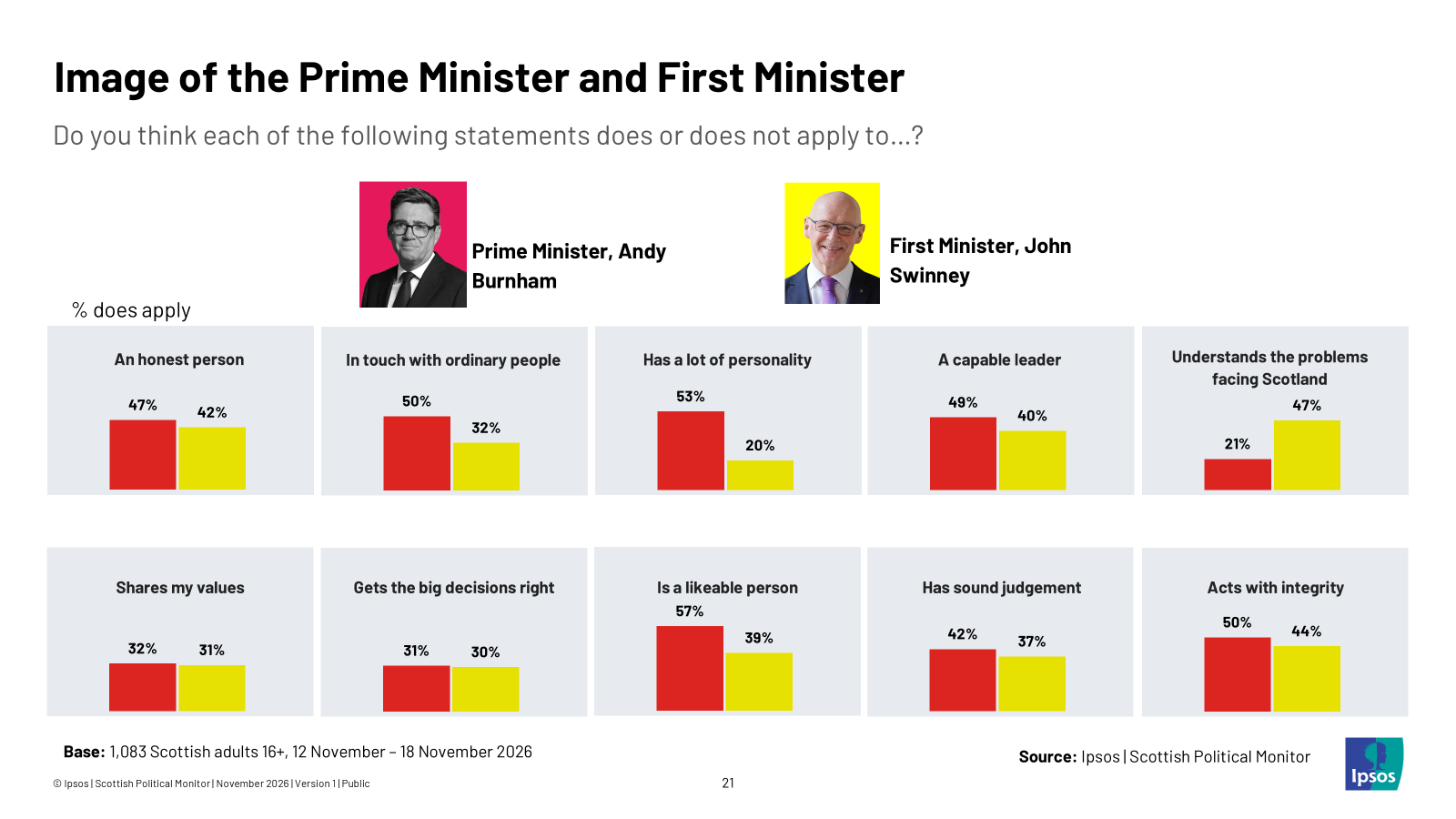
Burnham outperforms Swinney on most leadership attributes asked about in the poll. He leads on being a likeable person (57%, ahead of Swinney on 39%), having a lot of personality (53%, ahead of Swinney on 20%), being in touch with ordinary people (50%, against 32% for Swinney), acting with integrity (50%, against 44% for Swinney) and being a capable leader (49%, against 40% for Swinney). However, more than twice as many Scots say Swinney understands the problems facing Scotland (47%) as say Burnham does (21%). Indeed, three in five Scots (59%) disagree that Burnham understands the problems facing Scotland.
Two in five of the public don’t know enough about Scottish Labour’s new leader Michael Marra to rate him. Marra receives a negative net satisfaction rating from the public overall, of -22, although that is a slight improvement on his predecessor Anas Sarwar’s rating of -27 in March.
Meanwhile UK Conservative Party leader Kemi Badenoch has seen an upswing in her ratings: 28% are satisfied and 47% dissatisfied with the way she is doing her job, giving a net rating of -19, which represents a swing of +10 since March.
Issues facing Scotland
Healthcare/the NHS is seen as the top issue facing Scotland (55%), followed by inflation/the rising cost of living (46%), immigration (29%), energy policy (25%), crime and anti-social behaviour, and the economy (both 23%). While Scottish independence/devolution does not feature in the 10 most important issues facing Scotland (coming 12th), it is the third most important issue for SNP supporters (38%). Immigration remains the top issue for Reform UK supporters (80%).
Attitudes to independence and a second referendum
The Scottish public remain divided on the constitutional question, with 50% of those likely to vote either Yes or No in an immediate referendum saying they would vote Yes and 50% that they would vote No.
Under half (45%) of Scots support having another referendum on Scottish independence within this parliament (in the next 5 years), with 23% saying one should be held further into the future and 27% saying there should never be another referendum. Fewer than two in five (37%) expect there will be another referendum on Scottish independence in this parliament, while 40% think one will be held further into the future and 13% think there will never be another referendum.
Technical notes:
- Ipsos interviewed a representative probability sample of 1,083 adults aged 16+ across Scotland, via the Ipsos UK KnowledgePanel. Data was collected online between 12th and 18th November 2026.
- Panel members are recruited via random probability sampling, by sending letters to randomly selected addresses, which invites them to join an online panel. This approach means every household in the UK had a known and non-zero chance of being selected to join the KnowledgePanel. Those who are digitally excluded are provided with a tablet and free, restricted data connection. A sample of 2,189 panellists aged 16+ in Scotland were invited to take part in the survey. The sample was stratified by age, qualifications and vote at the 2024 general election. The achieved sample was weighted in two stages:
- Design weights were applied to correct for the unequal probabilities of a person being selected for a survey, notably residents in smaller households have a higher chance of being selected.
- Calibration weights were applied through rim weighting to correct for differential non-response. Data was weighted to the adult population profile on age and gender, Scottish Parliament region, ethnicity, qualifications, work status and work sector (public sector/other), social grade, area deprivation, and newspaper readership (print and digital). Population targets were obtained from the 2022 Census, ONS population estimates and other large-scale probability surveys.
- All polls are subject to a wide range of potential sources of error. On the basis of the historical record of the polls at recent general elections, there is a 9 in 10 chance that the true value of a party’s support lies within 4 points of the estimates provided by this poll, and a 2 in 3 chance that they lie within 2 points. This is especially important to keep in mind when calculating party lead figures.
- Where results do not sum to 100%, this may be due to computer rounding, multiple responses, or the exclusion of “don’t know” categories.