
Scots split over impact of independence on Scotland’s economy
- Confidence in the UK’s economy among the Scottish public has dropped further as the cost of living crisis deepens – 80% of Scots expect the general economic condition of the UK to worsen in the next 12 months, compared to 73% in February 2022.
- When it comes to Scotland’s economic prospects, the public are also pessimistic - 73% expect Scotland’s general economic condition to get worse over the year ahead, compared to 68% earlier this year.
- Scots are divided over whether independence would make Scotland’s economy better or worse off - 43% expect that it would be better off, but just as many expect that it would be worse off (43%). In England, Wales and Northern Ireland, people are more likely to say that independence would make Scotland’s economy worse off.
- In all four nations, people are more likely to think the economies of the rest of the Union would be worse off (37%) than better off (20%) if Scotland became independent, and Scots are even more convinced that the remaining UK economies would be worse off (45%).
Economic outlook
New findings from Ipsos’s UK KnowledgePanel survey show that both the Scottish and UK publics are increasingly gloomy about our economic prospects as the cost of living crisis deepens. Across the UK, 76% think the general economic condition of the UK will get worse in the next 12 months, which is a nine-point increase since February 2022 (67%). Just 10% say it will get better, compared to 15% earlier this year. Expectations are even more pessimistic in Scotland, where 80% expect the UK’s economy to get worse in the next year.
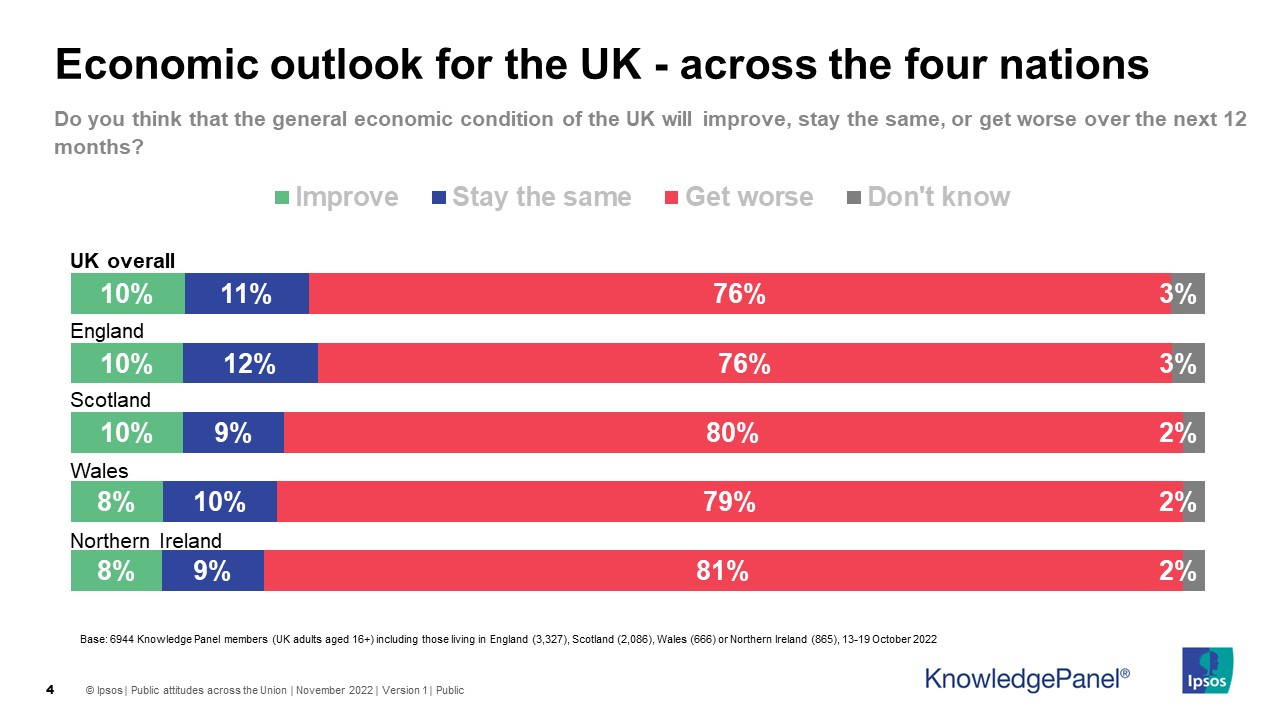
While Scots are slightly more positive about Scotland’s economic prospects than the UK’s overall, the majority (73%) still expect the economic condition of Scotland to worsen over the next year and just 8% think things will improve.
Economic impact of Scottish independence
If Scotland were to leave the UK and become an independent country, there is an even split between those in Scotland who think the Scottish economy would be better off (43%) and those who think it would be worse off (43%). In other parts of the UK, people are more likely to say that Scotland’s economy would be worse off than better off: more than half (58%) of those living in England say Scotland’s economy would worsen compared to 50% in Wales and 45% in Northern Ireland.

In all four nations, people are more likely to say that the economies of the rest of the Union would be worse off than better off if Scotland was to leave the UK and become an independent country. Scots feel the strongest about this, with 45% saying the rest of the UK would be worse off compared to 37% of the UK overall.
Future of the Union
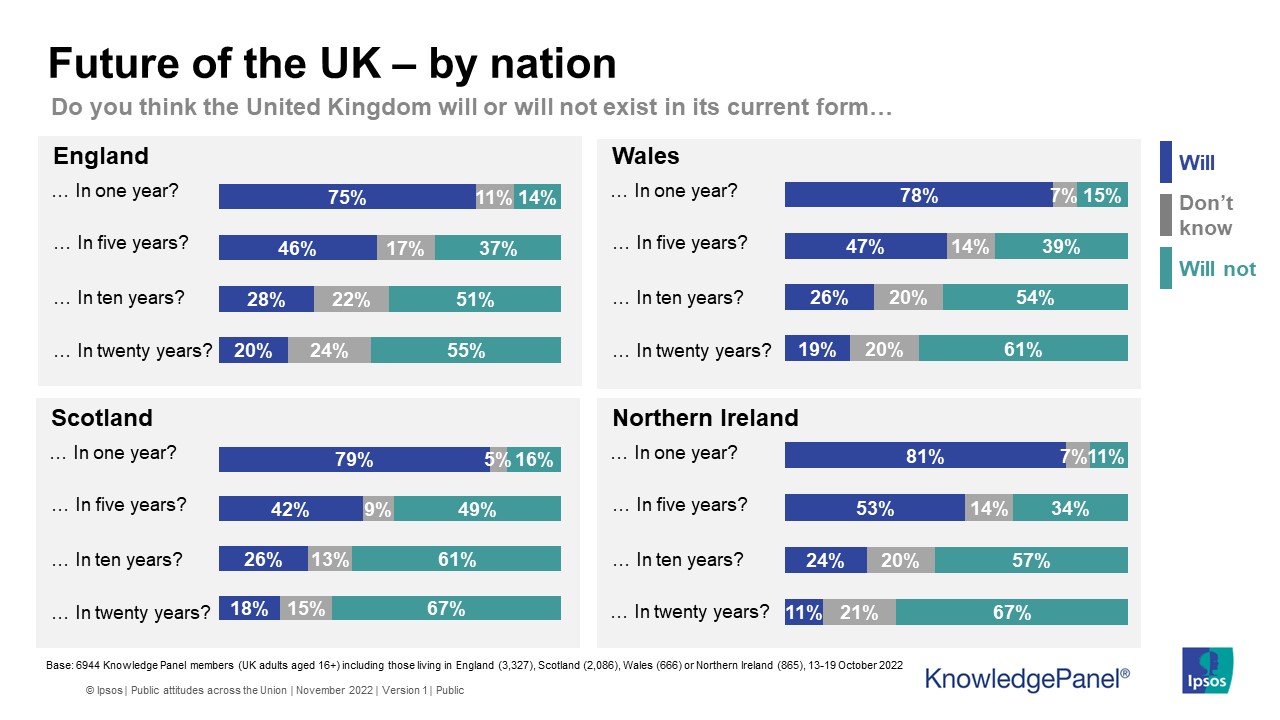
Overall, a majority of the UK public do not anticipate the Union’s imminent demise, with 76% expecting that the UK will still exist in one year’s time. There is less certainty about the UK’s future in 5 years’ time, with 46% saying that the UK will exist in its current form and 38% saying it won’t. Fewer now say that the UK will exist in its current form in 5 years’ time than was the case in February 2022, when the majority (51%) expected the Union to remain while a third (33%) expected it not to exist in its current form in 5 years’ time.
The shift in opinion is relatively small and has occurred against the backdrop of an economic crisis and a period of fluctuation in UK politics, but if it continues it may point to diminishing confidence in the future of the Union.
In the longer term, the majority expect that the UK will not exist in its current form in the next 10 years (52%) or the next 20 years (57%), while 28% say it will remain in 10 years and a fifth (20%) say it will still be in place in 20 years.
The Scottish public are more likely to expect the breakup of the Union within 10 years (61%) or 20 years (67%) than the UK public overall are.
Over half of the UK public (53%) would prefer Scotland to vote against leaving the UK if there was to be a second independence referendum. Just under a fifth (18%) would prefer Scotland to vote in favour of independence and over a quarter (26%) say they wouldn’t mind either way.
Emily Gray, Managing Director of Ipsos Scotland, said:
Economic and currency arguments are among the most important factors that shape people’s views on whether Scotland should become independent or stay in the Union. These results show that neither pro-independence or pro-Union campaigners enjoy an advantage on this issue at present in the eyes of the public, with Scots divided on whether Scotland would be better or worse off economically if the country was independent. With the cost of living crisis deepening, most people expect gloomy economic times ahead, and the measures that governments at both Holyrood and Westminster set out over the coming months to help weather the crises may well shift public views on Scotland’s economic future further.
Technical note
- This data has been collected by Ipsos’s UK KnowledgePanel, a random probability panel which provides gold standard insights into the UK population, by providing bigger sample sizes via the most rigorous research methods
- Ipsos interviewed a representative sample of 6,944 people over 16 in the UK (including 3,327 in England, 2,086 in Scotland, 865 in Northern Ireland, and 666 in Wales).
- Interviews were conducted online from 13th to 19th October 2022.
- Data are weighted to ensure the survey results are as representative of the population of the UK as possible. Two members per household are allowed to register on the KnowledgePanel, so we employed a design weight to correct for unequal probabilities of selection of household members. Calibration weights have also been applied using the latest population statistics. England, Wales, Scotland and Northern Ireland are each weighted separately while an additional weight has been created for the UK to account for any over or undersampling within each of these countries.


