
Going The Extra Mile: A Case Study
How do Auto Consumers Shop?
The automotive marketplace has evolved considerably in the past decade. After years of tightening their belts, Americans are once again ready to open their wallets. But as they prepare to spend their hard earned dollars - particularly on big-ticket items such as vehicles - it is a very different shopping experience than it was several years ago. We have access to vast amounts of information, as well as a proliferation of devices and platforms on which it can be accessed. And while "always on" connectivity has increased the opportunity for brands to connect with consumers, it brings new challenges with it too, including a near-endless flow of content in the marketplace and various sources of information. Given this landscape, how do marketers and OEM's communicate the right message, in the right place, at the right time?
Ipsos MediaCT wanted a deeper understanding of the car buying experience. Fortunately, the same forces responsible for creating today's troves of information can provide us with data-driven insights into consumer behavior. Working in collaboration with AutoTrader.com, we conducted extensive research to help marketers understand patterns in the car buying process, looking specifically at the devices being used, location of interactions and the digital path to purchase.
We ended up with a 360-degree view of the car buying experience, and new knowledge for automotive marketers that will inform the development of more effective and targeted marketing strategies.
Automotive Shopping in a Multi-Screen World
Our screens have truly become part of our lives. We can now interact with content whenever we wish, whether on the go or in the comfort of our home. Our research shows that many consumers are taking a multi-device path to purchase for automobiles - shopping across an array of platforms and screens. While the PC is the primary device used when it comes to car shopping, just under a quarter (23%) of U.S. car shoppers leverage two or more devices for their research and shopping activities. As mobile technology continues to dominate the marketplace, this multi-device trend is one we can expect to soon become the norm.
What is the lesson here? Simply put, do not focus on one device solely. With multiple screens being used, optimization on smartphones and tablets should be a priority.
Multi-Device Usage Brings Many Benefits
How do different devices affect the customer purchase journey?
We know that a quarter of consumers are shopping with multiple devices. And for good reason! According to our research, the overwhelming majority of consumers agree that multi-device usage has dramatically impacted their perceptions of the car-shopping experience.
It enhances: 80% of shoppers tell us that multi-device usage enhances the vehicle shopping process.
It increases knowledge: 78% of shoppers think multi-device usage has increased their automobile knowledge.
It empowers: 78% of shoppers think multi-device usage empowered them when shopping for a vehicle.
It increases efficiencies: 57% of shoppers think multi-device usage shortened the purchase process.
Locations of Car Shopping Interactions
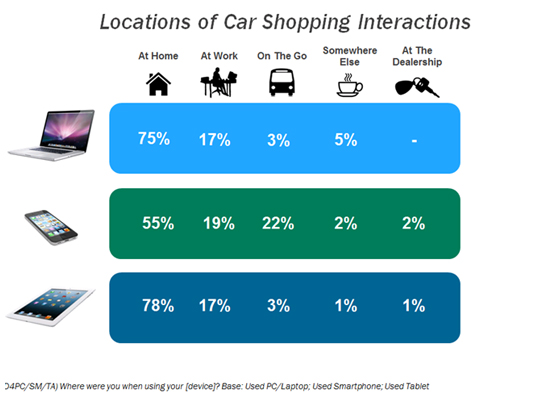
As consumers employ several different devices to shop, they can also do so wherever they choose.
As one would expect, the majority of car shopping interactions occur at home. Interestingly, a slightly higher percentage of tablet owners will choose to use that device at home (78%) compared to their PC (75%). The number of consumers who use mobile devices at home is also fairly significant, with just over half of owners (55%) indicating they do so. No doubt, it is critical for brands to provide a seamless experience for consumers to learn about cars, read reviews, view images and videos, all via their mobile devices.
It is also interesting to note that consumers aren't necessarily going to the dealerships to `kick the tires' anymore. They can now tap into a wealth of data and customer reviews, so there's little need to research during in-person dealer visits. In fact, only 2% of car shoppers used their smartphones and 1% used their tablets at the dealership, indicating that virtually all of online car shopping interactions occur outside of the dealership.
Reasons for Using Devices for Car Shopping Activities
Each device brings its own unique advantages to the car-buying process. In our study, we explored the reasons for using a device for shopping activities across PC's, smartphones and tablets. Overall, the data reveals that screen size and convenience play a fairly significant role in device selection.
PC's. When it comes to PC's, most indicate they use this device due to its larger screen (61%), the ability to access multiple sites (44%), the keyboard (41%) and because of its functionality (41%).
Smartphones. Smartphone users select their device because it is already on (51%), convenience (47%) and because they have no access to a tablet or PC (47%).
Tablets. Tablet users were most likely to use their device because it was already on (48%), larger screen (39%), convenience (35%) and more comfortable (34%).
How Devices are used for Research
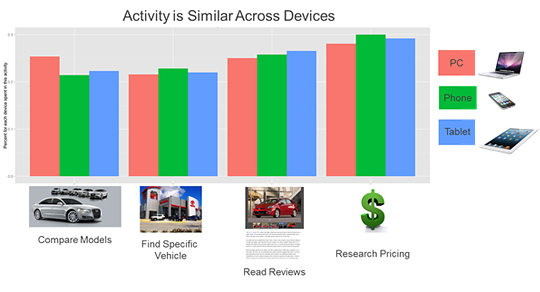
In our study, we found that shopping activity remains fairly consistent across devices. While PCs lead as the device of choice when comparing models (likely due to the larger screen), tablets are most popular for reading reviews, and smartphones are best used for finding a specific vehicle and researching pricing.
Device Usage and Time to Buy
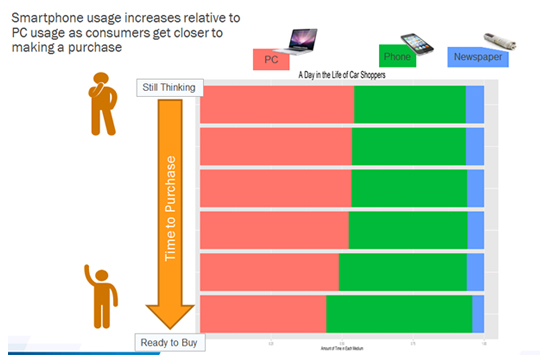
The chart below looks at a day in the life of car shoppers. Overall, we see that smartphone usage increases relative to PC usage as consumers get closer to making a purchase.
Adding the Behavioral Component
Our analysis also draws on behavioral data collected directly from customers' mobile devices, allowing us to analyze sequences of website visits and app use to uncover some of the paths that consumers take at various points in the car-buying process. With panelists opting-in to download a tracking app onto their smartphone, we then collected information about how, when and where those panelists are using their phones. The collected data includes information such as URLs visited, apps installed and used, physical location during each use, or time and data stamps.
For this part of the study, Ipsos MediaCT drew on data collected from 767 panelists from September 3rd to October 27th, 2014. We found that 4% of the tracked population was observed to have engaged in some type of car-shopping activity during this time.
Car-Related Smartphone Activity by Time of Day
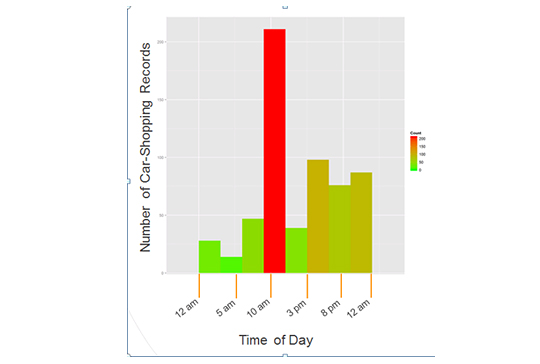
By analyzing the timestamps associated with each record in our data, we can detect peak times for car-related smartphone activity, helping marketers to get their messages out at the right moment.
The data indicates that car shopping activity on smartphones peaks around lunchtime, and shows another peak in the evening. Late at night and early in the morning are the least likely times for car-related activity.
The Path to Purchase - Online Retail (Non-Automotive)
The digital age continues to change the path to purchase for car buyers. And today, the online path to purchase is as diverse as ever.
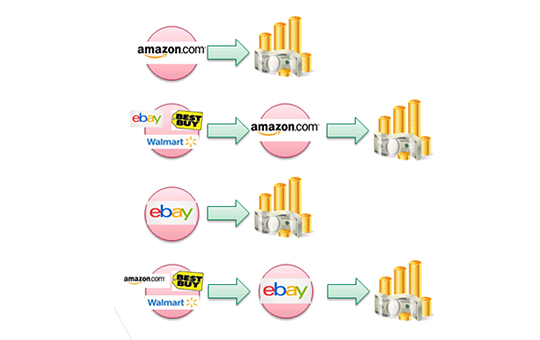
So what did our panelists do on their mobile devices before making an online purchase?
18% only visit Amazon and make their final purchase there. 22% make their final purchase at Amazon after visiting other online retailers. 9% only visit eBay and make their final purchase there. 13% make their final purchase at eBay after visiting other online retailers.
The Purchase Journey - Offline Purchases such as Autos
The tracked search and browsing history of one user over a 23-day period shows two main features:
- Search terms get more specific as the search progresses
- The websites being visited become more closely associated with an actual purchase as the search progresses.
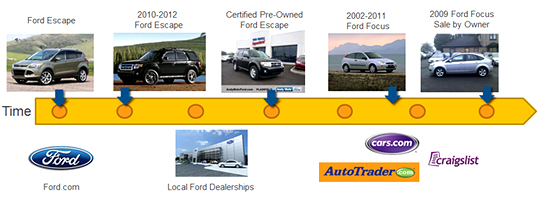
Data is based on the use of a sequence mining technique that looks for patterns in app and URL usage to identify and count all possible sequences involving 4 online Automotive retailers.
To fully grasp the opportunities available, car manufacturers and dealers need to truly understand the behaviors of their audiences. Insights into the devices car buyers use, where and how they research, and the time of day that they are most likely to shop can help marketers determine the best message to deliver and ultimately, get miles ahead of their competition.
![[WEBINAR] How winning brands are making themselves essential in a tight economy](/sites/default/files/styles/list_item_image/public/ct/publication/2026-09/thumbnail-templates%20demo_3.png?itok=0YmowUKN)

