
The Super Bowl still has our attention – especially with younger Americans
Even a pandemic can’t stop the Super Bowl, and new data from Ipsos shows that a majority of Americans are still paying attention to the big game – even as they’re divided on whether fans should be allowed in the stadium, and what topics brands should focus on in their all-important ads.
Despite a marquee matchup between Tom Brady, one of the greatest players in the history of the league, and Patrick Mahomes, a young star who could be his successor, only half of Americans (52%) say they’re as interested or more interested in the game than they were last year.
- 16% of Americans say they’re more excited about the Super Bowl than they were last year, and 36% say they’re just as excited as they were last year. Another 36% say they’re less excited than they were last year.
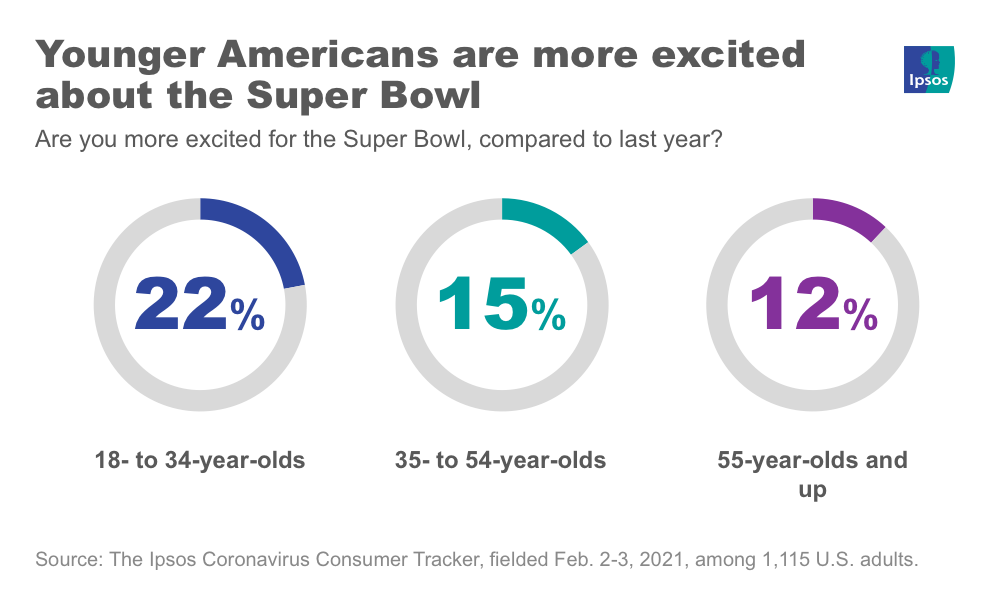
- Men and young adults 18-34 are more likely to say they are more excited about the Super Bowl – 21% and 22%, respectively
- Excitement has grown only slightly since we first asked in October, when 12% said they were more excited than they were last year, 29% said they were as excited and 41% said they were less excited.
Advertising remains a crucial part of the spectacle of the Super Bowl, despite the pandemic that has shaped the last year for Americans and people around the world. While some major advertisers say they’re sitting out, there’s still a substantial amount of interest from the public.
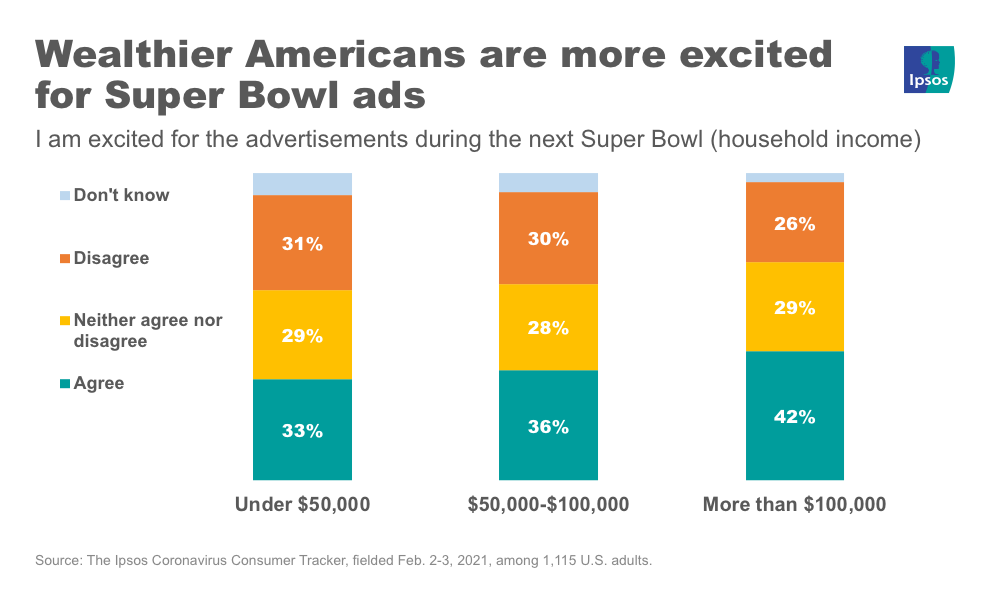
- 37% of Americans say they’re excited for advertisements during the Super Bowl. 29% disagree and 29% don’t feel strongly either way.
- Younger Americans are more likely to be excited – 45% of 18- to 34-year-olds are excited, compared to 38% of 35- to 54-year-olds and 29% of Americans 55 or older.
- Wealthier Americans are more interested, as well – 42% of Americans in households that make more than $100,000 a year, compared to 36% of those making $50,000 to $100,000 and 33% of those making less than $50,000.
- When it comes to the content of those ads, Americans seemingly acknowledge different advertisers may take different approaches. 57% expect ads to acknowledge the pandemic, while 56% also expect ads to focus on topics besides the pandemic.
Holding the Super Bowl in the middle of the pandemic is, of course, still somewhat controversial after a nearly a year of social distancing requirements and in many places, outright bans on large gatherings. Raymond James Stadium in Tampa, which will host the game, is allowing fans into the stadium, but at less than 40% of its total capacity – and roughly a third of the fans who do attend will be vaccinated healthcare workers. But many Americans are unhappy with the decision.
- 41% of Americans said in-person fans should not be allowed at the Super Bowl, while 29% said fans should be allowed.
- Women were more likely than men to say fans should not be allowed – 47% of women, compared to 36% of men.
- 56% of Democrats say fans should not be allowed, compared to only 29% of Republicans and 37% of independents.
- A small subset of Americans felt so strongly about fans being at the Super Bowl that they would boycott the game if the stadium was empty: 14% of Americans said they wouldn’t watch the game at all if in-person fans weren’t allowed.
We'll have to wait to see how this pans out on the field, in TV ratings, and for advertisers – though Ipsos will work to quickly answer the last question in real time. While some are focused on the game, Ipsos will be at work on our annual analysis of how consumers react to Super Bowl ads – normally an in-person event that we're taking remote for this year. Check back on Ipsos.com Monday to see what we discover.
![[WEBINAR] AI in Higher Education: How AI Is Reshaping Teaching and Learning](/sites/default/files/styles/list_item_image/public/ct/event/2026-10/How%20AI%20Is%20Reshaping%20Teaching%20and%20Learning.png?itok=XYdLaI-4)

![[WEBINAR] Winning B2B Buyers: AI Gets You Considered; Trust Gets You Selected](/sites/default/files/styles/list_item_image/public/ct/event/2026-10/Winning%20B2B%20Buyers%20AI%20Gets%20You%20Considered%20Trust%20Gets%20You%20Selected.png?itok=Q4kElwY2)