
Unhealthy Foods: Is Intervention the Answer?
The challenges emerging today as a result of excessive junk food, poor diets, and malnutrition are increasingly gaining attention on a global scale, with obesity - or "globesity" - becoming a common and costly issue in many countries. In the U.S. alone, it is estimated that more than a third (34.9% or 78.6 million) of all adults are obese, while one-in-five (17%) youth are already being categorized as such1.
Earlier this summer (July 24 - August 7, 2015), Ipsos conducted an online study across 22 countries worldwide, asking adults to share their opinions and perceptions towards different types and levels of government intervention on unhealthy foods. Findings show that while American opinions vary greatly depending on the degree of government intervention, one thing is consistent: attitudes on this issue among adults in the U.S. differ greatly from attitudes in most other countries when it comes to their acceptance and support of government intervention. This divergence between U.S. and global public opinion is a finding that holds across a range of types of intervention at the federal level, from taxation to education to healthcare.
Looking at the least invasive degree of government intervention, "information," the study shows that more than eight-in-ten (85%) adults across all countries agree that government should provide information to people on how to eat more healthily - although in the U.S., this figure drops to 78% (ahead only of France at 75%). And while a majority of Americans further support the notion that government should provide incentives such as money off vouchers for healthy foods to encourage people to eat better (66%), compared to other nations, the U.S. once again is at the least interventionist end of the spectrum among the comparative set.
Support for government intervention decreases significantly when asking about policies focused on the use of price mechanisms, with less than a third of Americans surveyed saying that they support the notion of government introducing laws to make it more expensive to eat unhealthy foods (31%), while even fewer support the notion of government introducing laws that ban unhealthy foods altogether (28%).
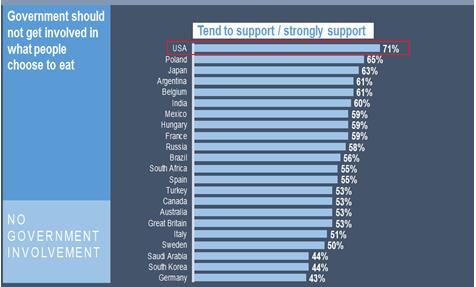
Given the comparatively low support for intervention among the U.S. population compared to most other countries when it comes to many types of intervention, it comes as no surprise that the U.S. ranks first when it comes to support for the notion that government should not get involved in what people choose to eat at all.
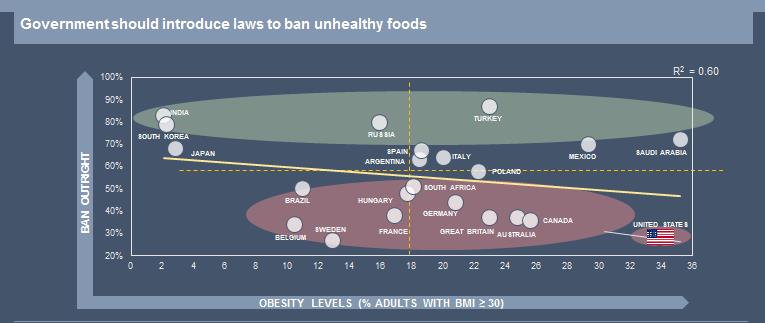
Measuring the opinions of government banning unhealthy foods against obesity levels in the different countries included in the survey shows that the prevalence of obesity does not appear at all related to the support for introducing such laws. As shown in the chart below, countries with higher obesity rates, including the United States, are among the lower tier when it comes to supporting the notion of a government ban on unhealthy foods.
So what is the bottom line?
Although the challenges and concerns emanating as a result of obesity in the U.S. remain persistent, there is a clear lack of support from the American population when it comes to government aid and intervention here. While Americans generally welcome more information on how to eat healthy, and incentives to encourage them to do so, the question remains whether or not they will be able to use this information or incentives and take action on their own. Resistance to government intervention on this issue is highest in the economic context, when it comes to controls on the price of unhealthy foods or banning these items altogether.


![[WEBINAR] Ipsos Global Trends 2026: The U.S. Edition](/sites/default/files/styles/list_item_image/public/ct/event/2026-09/thumbnail-gt-26.png?itok=AbsiS6xk)
![[WEBINAR] Know America at 250: Public Opinion Update](/sites/default/files/styles/list_item_image/public/ct/event/2026-09/250_0.png?itok=zfBpfzIn)