What Will The American Pantry Look Like Post-Pandemic?
During the pandemic, some of the changes Ipsos has observed via ethnography and quantitative surveys include:
- Being at home more for work and school, resulting in multi-functional use of space and increasing the amount of goods needed on hand.
- Shopping online more often (50%) to avoid store trips.
- Stocking up on paper products, cleaning supplies and staples, due to lack of product availability or reduced ability to get to the store, leading to storage of greater quantities in unusual spots.
- Cooking at home more often, sometimes for entertainment, other times out of necessity.
- And, puppuccinos: getting a cup of whipped cream for your dog during the coffee drive-thru run.
Qualitative or ethnographic research ensures that consumers guide us to what has changed, and that we pick up on the unanticipated developments. Having determined how the landscape has changed, we can also use quantitative (behavioral science) research to show the prevalence of these new behaviors.
Download our latest paper as we take stock of the changes impacting consumer’s pantry choices now, and post-pandemic.
WHAT WILL THE AMERICAN PANTRY LOOK LIKE POST-PANDEMIC?
Ipsos leverages behavioral science to identify which consumer trends are likely to fade away—buying in bulk, for example—or likely to stick.
The acquisition and storage of food and household goods has been a roller coaster ride for American families the past year. Initially, consumers worried about empty shelves, then stockpiled to avoid stores. The need to have food on hand increased as more family members spent time at home. Some changed where and how often they shopped. Now, one year into the pandemic, there are clues in the current environment that can shed light on what the future holds. Ipsos believes brands need to go beyond focusing on which storage behaviors have changed this past year and consider the larger ecosystem that drives behavior. This knowledge enables us to help clients best use their resources to drive brand growth going forward. The first and most critical question: So which of these changed shopping and storage behaviors are likely to stick once the pandemic is over? We answer this question using a simple, yet powerful, 2-step approach. First, we ground ourselves in understanding what has changed. Qualitative or ethnographic research ensures that consumers guide us to what has changed, and that we pick up on the unanticipated developments. For example, who knew people would be taking their dogs on their coffee drive-thru runs for a puppuccino (a cup of whipped cream)? Having determined how the landscape has changed, we can also use quantitative research to show the prevalence of these new behaviors. During the pandemic, some of the changes we’ve observed via ethnography and quantitative surveys include:
- Being at home more for work and school, resulting in multi-functional use of space and increasing the amount of goods needed on hand.
- Shopping online more often (50%) to avoid store trips.
- Stocking up on paper products, cleaning supplies and staples, due to lack of product availability or reduced ability to get to the store, leading to storage of greater quantities in unusual spots.
- Cooking at home more often, sometimes for entertainment, other times out of necessity.
- And, of course, puppuccinos.
While knowing what has changed is important, some changes will fade away with the pandemic. In our second step, we lever-age behavioral science and the Ipsos Habits Framework to identify which behavioral changes are most likely to last. Habits are automatic behaviors that form based on a cue behavior reward process. Our cell phone buzzes (cue), we look at it (behavior) and connect with our friends (rewards). From this vantage point, the key to understanding behavioral stickiness is not the behaviors themselves, but the cues and rewards that are linked. Simply stated, behaviors that have cues and rewards that remain relevant as the world changes are most likely to stick. To help us better identify relevant elements, we have dimensionalized the different types of cue, barriers, and rewards that exist.
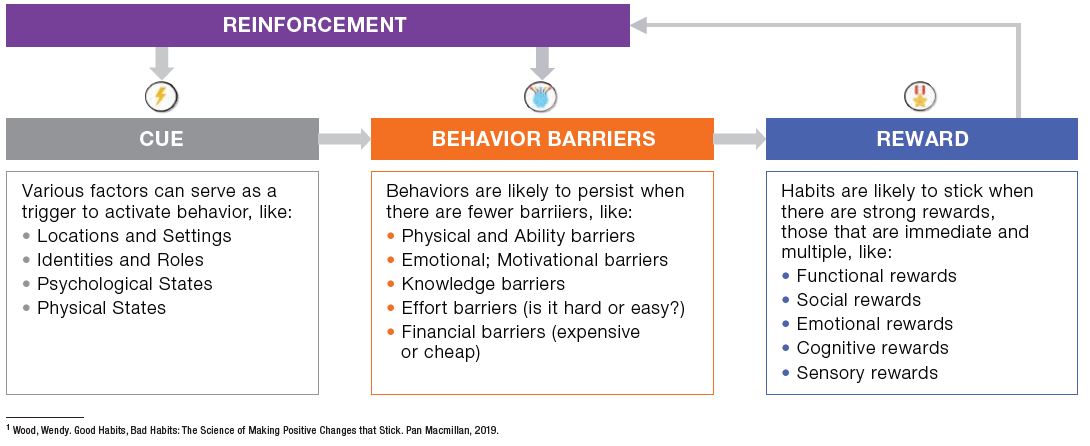
Here are some relevant examples of this in action:
- Working from home: Many are discovering rewards to working from home — like saving time or money, while also breaking down perceived barriers— such as reduced productivity or connectivity. Thus, as barriers have been removed and strong rewards elicited, it is likely that there will be more home office days in the future, requiring more food and staples versus pre-pandemic.
- Remote learning: While adults may be advocating to continue to work from home, their kids are more likely to go back to school. Our ethnographic research showed struggles to online school including isolation and learning difficulties, and 37% of parents said they’ve increased their attention to their child’s homework versus pre-pandemic. With the presence of strong negative rewards, we would not expect the behavior to continue once barriers to alternatives are lifted.
- Shopping online: Few things accelerated at the rate of online shopping, click-and-collect and delivery. For many, the barriers to this behavior were confidence that it would work and knowledge of how to do it. COVID forced many to trust and learn. In the end, people not only learned how to move online, but learned it worked well. Thus, barriers were removed and rewards amplified. Moreover, the cues for grocery shopping remain; consumers still need to eat. We assume that online shopping will not revert back to pre-COVID rates.
- Buying in bulk: Buying in bulk appears to be a short-term phenomenon. The cues that triggered this behavior— high scarcity and fear of running out—have subsided. Moreover, the rewards of this behavior have been minimal and, for some, negative —where do they put 100 rolls of toilet paper?Thus, we anticipate bulk paper product buying to revert to pre-COVID levels. In fact, we have already seen some Ipsos ethnography panelists stop this behavior.
- Cooking at home: This is perhaps the most complex, interesting and best example of the power of the Ipsos Habits Framework. On its face, cooking at home is a mixed bag; the cue of boredom or necessity (can’t go out) will go away. Some panelists, however, found rewards like enjoyment, identity, and bonding with family to be highly valued. Related, many people have developed skills and removed behavioral barriers to make cooking much less daunting. Don’t focus on how your brand is an easy solution or fills time. Highlight how it transform them into a cook (identity) or lets them bond with their children.
- Puppuccinos: While adorable, the trend to pack up our fur babies and hit the coffee drive-through to kill time will likely subside. But the desire to create that feeling of connection with your four-legged family members will not. Despite our expectation that this behavior will die down, using the habit lens shows us that the desired reward it created has legs (pun intended?). Thus, this more holistic approach not only helps brands identify which behaviors will stick, but which needs will as well.
As we start to see a light at the end of the COVID tunnel, brands can and should connect with consumers and plan now to secure their spot in the pantry of the future.