Empathy Awakened: The power of an empathetic organization
 In the midst of ongoing changes and constant adjustments, the right research can help to provide more reliable strategic direction, particularly in cases where many of the absolutes we had come to know have shifted and some of yesterday’s solutions have been rendered obsolete.
Researchers need to develop a strong sense of empathy to look underneath into the real-life experience and deeper motivations and emotions. Now is the time to rediscover the people we serve – who they are and who they are becoming, what drives them, what frustrates them, and how best to delight them by providing for their developing needs.
Applying an empathetic lens can transform an insight from a detached observation that produces predictable solutions to one that meets both a consumer’s functional and emotional needs. Effective empathy takes you out of your world and into the world of another to see and experience the tensions that inform relevant insights and decisive action.
Moreover, Ipsos surveys indicate a desire from consumers for businesses to demonstrate empathetic qualities and show an understanding of customers as people. This is especially the case among Millennials and Gen Z who say they are more likely to purchase something from a company that demonstrates a broader sense of empathy.
In this paper, we outline the importance and the benefits of creating a culture of empathy and introduce a four-step framework for developing an empathetic approach for business.
Hear April Jeffries discuss some of the key themes raised in her paper in this half-hour podcast.
INTRODUCTION
In the midst of ongoing changes and constant adjustments, the right research can help to provide more reliable strategic direction, particularly in cases where many of the absolutes we had come to know have shifted and some of yesterday’s solutions have been rendered obsolete.
Researchers need two key capabilities to begin to fully understand the changing world and the people in it: We need to stay at the forefront of how we harness the power of data and digitisation, leveraging all of the data available to identify changes in behavior and shifts in performance. But to better understand what’s behind the data, and peek at what is emerging, requires an additional step.
Empathy is essential. Not the purely emotional kind but one that includes purposeful action and delivery. Action without empathy is meaningless, and empathy without action is directionless and soft.
We need to develop a strong sense of Empathy to look underneath into the real-life experience and deeper motivations and emotions. In other words, to know the things people care about, the things that upset them, the things that touch them, the things that make them take notice, and why? Now is the time to rediscover the people we serve – who they are and who they are becoming, what drives them, what frustrates them, and how best to delight them by providing for their developing needs.
As a powerful tool for growing businesses, brands and organizations, empathy requires a complete circuit – from your head (the business question), to your heart (the people question), to your gut (intuitive understanding), and to your hands and feet (motivated action). In fact, empathy is anything but a passive emotional response to another’s circumstance. It is a powerful instrument for supporting each other and it is physically rooted in who we are.
Now is the time to rediscover the people we serve – who they are and who they are becoming, what drives them, what frustrates them, and how best to delight them by providing for their developing needs.
CASE STUDY: EMMA
Emma is a 32 year old African American female. Brands who seriously want to talk to her need to recognize and appreciate her unique challenges. Here is what the data tells us: there are 21.7 million black women in the US alone and they spend nearly nine times more than their non black counterparts on hair and beauty products1. Emma is willing to pay more for quality items than her non black counterparts, is more likely to purchase brands that support a cause she cares about and is 20% more likely to say she will pay extra for a product that is “consistent with the image she wants to convey”.
It does not take long to build a business case for capturing share within this target audience and, through appropriate data analysis, identifying where they are and what they are doing. In the past two years, due to the Covid 19 pandemic, Emma has changed, and we need to try to understand her like a best friend. To address her needs, she cannot be a stranger.
Empathy for a black woman’s hair care routine and needs requires an understanding of her “hairstory” and through a series of qualitative empathy based exercises, we realize it cannot be separated from her overall experience. This includes deep emotional anchors that constantly influence her, like experiences of racism, colorism, self esteem, self love, parenting, self expression, imposed definitions, and standards of beauty. And without the empathy required to understand those nuances, a brand can never adequately serve her. Her functional needs are specific, but we also found her emotional aspirations and barriers are completely different than her white counterparts. According to years of qualitative research, Emma’s hair is a political statement, an expression of social identity, and may even represent entrepreneurship and profitability in her community.
Emma’s story is an example of how applying an empathetic lens transforms an insight from a detached observation that will produce predictable solutions to one that meets not only her functional needs but also her emotional needs, making her feel heard, valued, and understood.
What started as an investigation of functional benefits of hair care products became a much deeper exercise. A reckoning that begged the exploration not only of product performance but also brand promise and authenticity, an avoidance of unintended offense, and renewed potential to gain her respect and loyalty.
Applying an empathetic lens transforms an insight from a detached observation that will produce predictable solutions to one that meets not only functional needs but also emotional needs.
APPLYING AN EMPATHETIC LENS
Empathy of this kind is developed on three levels:
- LISTEN
Deep listening and courageous conversations are the entry point to developing the empathetic lens. Allowing for silence, asking unscripted questions for free flowing conversation and deeper answers, and probing for examples and stories that illustrate what may be difficult to articulate are all ways to start peeling back the layers. Frequency and consistency builds connection and, with time, an intuitive gut will develop.
- OBSERVE
Principles of ethnography take observation into account and highlight the “say do” gap. Recognizing contradictions, noticing real versus claimed behaviors and beliefs, and perceiving social dynamic shifts in the presence of others are all critical in understanding real people in real life.
- EXPERIENCE
To the extent that we can genuinely live with the ideas, realities and limitations of others, we can get close to what it feels like to live someone else’s experience.
RETURN ON EMPATHY
An Ipsos poll conducted in May 2020 found that Americans saw it as more important (following the start of the pandemic) for businesses to demonstrate empathetic qualities and show an understanding of customers as people.2 The same study revealed nine in ten Americans continue to think that brands need to show empathy with actions and not just words, and 86% believe that showing empathy is critical to creating greater loyalty. The top five ways consumers say brands can be empathetic are: treating people with respect (52%), treating people like human beings (50%), listening to people (43%), caring about people (41%), and acknowledging when the brand is wrong (37%).
Corporate reputation that includes a broader sense of empathy – social justice or environmental commitments, for example are strong considerations for purchase decisions, especially among Millennials and Gen Z. In fact, 56% of Gen Z say they are more likely to purchase something from a company that took a stand on racial justice.
From the perspective of businesses themselves, a recent study found 84% of CEOs and 70% of employees believe empathy drives better business outcomes.4 They are sensing the need for their teams to be “closer to their audience”, recognizing it as fuel for innovation, and supporting the design of new products and services that address emerging needs and create new habits and behaviors.
Employees increasingly expect empathy in their workplaces and leaders see it positively linked to employee wellbeing, motivation, productivity, retention, engagement, team collaboration, reduced stress, increased morale, less burnout, and more inclusive attitudes at work.
BUILDING A CULTURE OF EMPATHY
Creating a culture of empathy within an organization where “connection with others beyond yourself” is a habit. It requires ongoing effort, is driven by agreed values, and is embedded within the daily workings of the organization. A genuine assessment of the organization will help to set appropriate goals for improvement. Simple questions using behavioral science as a foundation allow for the examination of the factors driving behavior and behavior change within an organization. These principles can not only show us the “why?” but also the “so what?” and the “what now?”.
- Motivation: How motivated is your organization to change behavior to a more consumer-centric commitment? Are the benefits widely recognized and translated to daily business language? Is there confidence around what it means and an opportunity for people to receive guidance and feedback without risk?
- Ability: Do your teams have the skill and capabilities to be more empathetic?
- Is it timely, relevant, experiential? Are there programs to help develop habits of empathy? Are they embedded in your daily routines?
- Processing: How much work does it take to be people-focused in your organization? How automatic is it for your teams to answer any strategic question with the people they serve in mind?
- Physical: Is the physical setting conducive to an “always on” representation of real people in real life?
- Social: Do the organizational norms and values support a human focus? Is empathy part of the values held by the organization?
The most effective empathy program addresses these questions and commits to an “always on” approach of consistent efforts.
Corporate reputation that includes a broader sense of empathy – social justice or environmental commitments, for example – are strong considerations for purchase decisions, especially among Millennials and Gen Z.
FOUR-STEP FRAMEWORK TO BUILDING AN EMPATHETIC ORGANIZATION
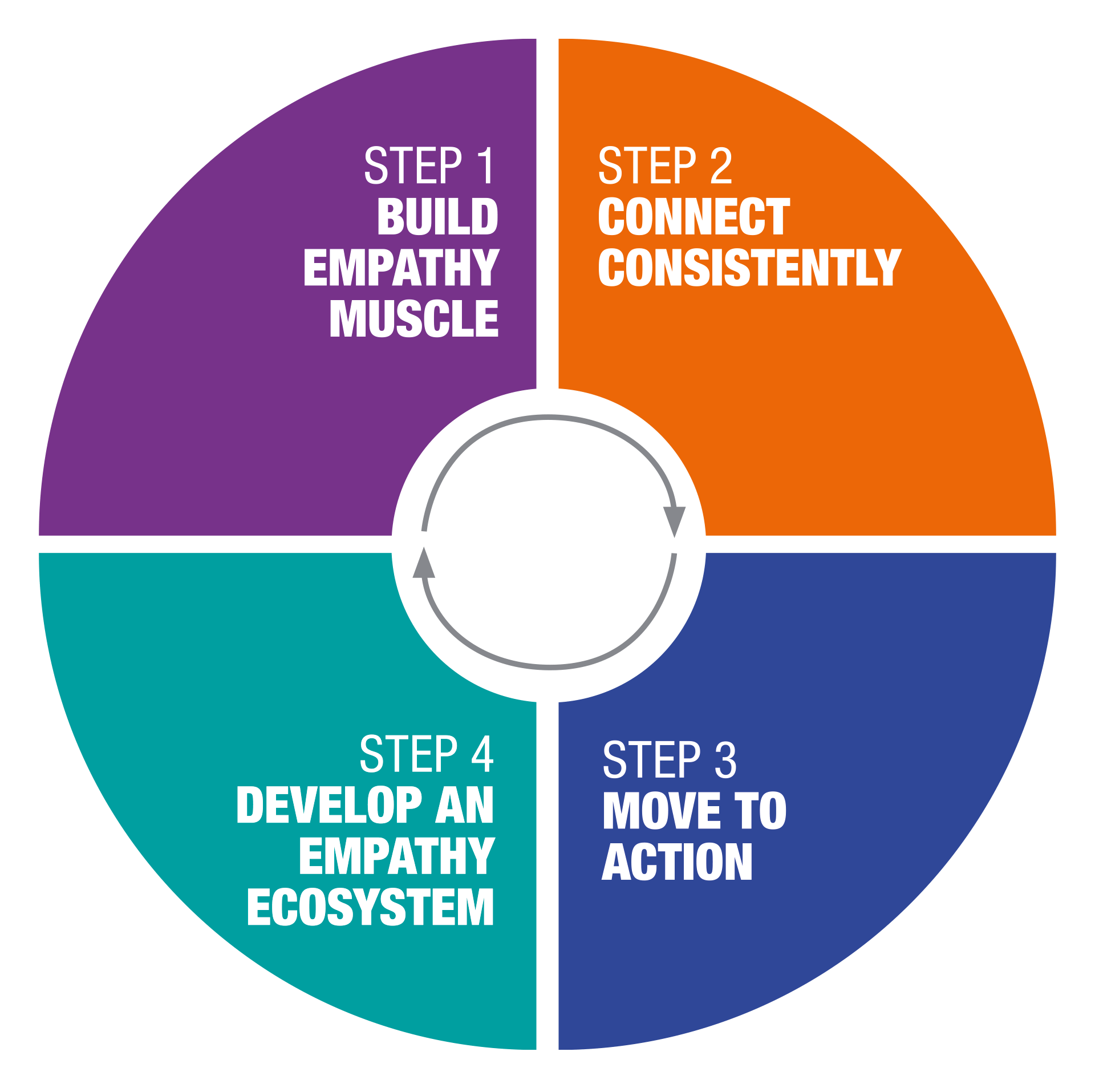
A holistic and ongoing approach is key. Empathy is not a one-time training or singular conversation. It requires strong intention and focus to move through to meaningful insights. The following four-step framework helps to build an empathetic organization:
STEP 1
BUILD EMPATHY MUSCLE
Keeping in mind that creating a culture is no small task, positioning it as a critical “movement” within an organization is key. This period of cultural shape-shifting starts with training to build the necessary skills to get the most out of conversations, observations and sensory experiences. Measure and track improvement over time.
STEP 2
CONNECT CONSISTENTLY
Empathy is far from a one-time engagement. Apply your empathy muscle to connect with real people, in real life, on a regular basis. Find the people who can best represent the target audience and decide on the ideal way to connect with them with the right frequency. We have learned so much about virtual connections and missed so much about face-to-face relationship building. Virtual interactions happen in natural environments, but you are limited in what you are allowed to see. On the other hand, in-person interactions provide broader observational opportunities but sometimes an extended engagement (i.e. week-long versus one day) or the ability to report during a less convenient time of day (i.e. late night) can reveal unexpected behaviors and emotions.
STEP 3
MOVE TO ACTION
Now is the time to do what you do best – add value! Bring the thinking, access and resources of your organization to the forefront and use them to address real problems. Convert empathy experiences into tensions and implications to be answered by business solutions. Create human-centric ideas backed up with a detailed plan for action.
STEP 4
DEVELOP AN EMPATHY ECOSYSTEM
Retaining learnings and enabling them to be shared throughout the business is key to getting maximum value from your program. Find ways to capture and retain knowledge to organize and make sense of the time you have spent. Tap into your organization’s knowledge management platform to manage digital assets and socialize what you have learned throughout the company. This will avoid repetitive learning and inspire a creative feedback loop through collaboration and collective knowledge.
CONCLUSION
Consider this empathy framework when applied to our initial example of Emma, the 32 year old African American woman, and her hair care routine. Rather than trying to force fit Emma’s experience into a general market brand, the best way to reach her may be through a new brand focused specifically on not just her functional needs but how her “hairstory” has impacted her total experience.
Being stuck in our limited worlds makes it easy to project our own feelings onto others and make leaps of faith that may or may not be appropriate. A plan rooted in empathy will
play out not only in innovation development and communication language and messaging, but in packaging design and colors, promotional focus, and decisions tied to the organization’s purpose including assessment of risk and community investment.
Effective empathy takes you out of your world and into the world of another to see and experience the tensions that inform relevant insights and decisive action.