

Can synthetic consumers help brands make better decisions?
For food brands, changing a beloved recipe is one of the riskiest decisions they can make.
Consumers may welcome innovation, but they also expect their favorite products to taste exactly as they remember. That was the challenge facing Barilla as it explored potential changes to its flagship Ragù alla Bolognese pasta sauce.
Success Creates New Questions
Product improvements can unlock growth, strengthen competitiveness, and better meet evolving consumer expectations. Yet, for established and iconic products, even small recipe, formulation, or ingredient changes can carry significant risk. The question:
Could the recipe be further improved without compromising the experience consumers loved?
The challenge is finding the right balance between meaningful innovation and preserving the qualities that made the product successful in the first place.
The Innovation Challenge
Traditionally, reducing this risk requires large-scale product testing. These studies often involve hundreds of consumers and can be costly, time-intensive, and difficult to execute at the speed demanded by modern innovation. They also require significant numbers of product samples to be produced.
As consumer expectations evolve and innovation cycles accelerate, brands face a growing challenge:
How can businesses make more efficient decisions without compromising the outcome?
The Augmented Approach

with Synthetic Data (2025)
To explore a more agile methodology, Ipsos and Barilla applied product testing with synthetic data.
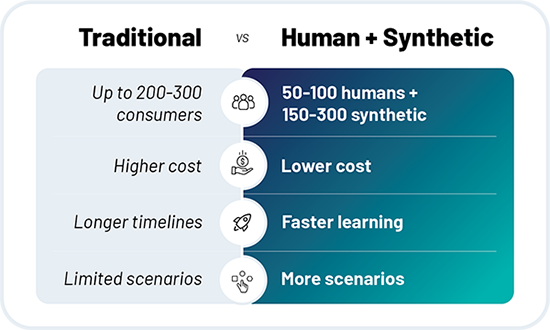
The approach uses a carefully recruited human seed sample and generates synthetic respondents to augment it.
The appropriate balance depends on decision risk: Ipsos guidance ranges from 50 human + 150 synthetic respondents for low-risk screening to at least 100 human respondents per product for high-risk final validation.
In the Barilla study, each cell was comprised of 100 human and 300 synthetic respondents.
The goal was not to replace consumers or create new independent ground truth. Instead, AI extended the analytical value of real consumer feedback, supporting deeper diagnostics and subgroup analysis while the human seed remained the foundation of the evidence.
From Validation to Impact
The results extended far beyond a single study.
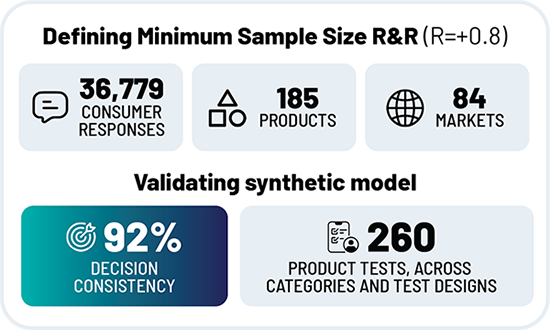
Across 260 product-testing validations, human-plus-synthetic augmented samples produced the same Action Standard business decision as independent all-human holdout samples in 92% of cases. In the Barilla case, the augmented evidence helped identify that neither prototype met the success criteria. The results supported a clear decision not to proceed with the recipe change. The risk was particularly important among Heavy Users.
The result was clear:
- Faster learning
- Greater diagnostic depth
- Confident decision-making
The Real Insight
To us, the most important finding was not the 92% decision consistency alone. In our view, it was what made that outcome possible.
This was not a study about synthetic data replacing human data.
It was a story about augmentation: combining real consumer feedback with AI to increase diagnostic depth, make subgroup patterns more analytically accessible, and accelerate learning.

What This Means for Insights Leaders
For organizations looking to innovate faster, the opportunity extends beyond efficiency.
What we’ve observed in our research is that human and synthetic approaches can help teams:
- Explore more possibilities
- Reduce testing costs
- Accelerate learning cycles
- Support more confident decisions, especially for key subgroups where the human seed provides adequate representation.
What we’ve found in our study is that synthetic data not only improves speed; it introduces a new model for scaling consumer understanding.
The Barilla example demonstrates that combining Human Intelligence and Artificial Intelligence within clear methodological guardrails, businesses can move faster while keeping real consumer experience at the center of decision-making.
A key principle underpins the approach: synthetic data should not be judged by whether it recreates every individual response, but by whether the augmented analysis supports the same prespecified business decision as a robust human benchmark.
Building the products that win
Whether you're exploring emerging trends, refining concepts, improving product performance, or curious about how synthetic data can transform your product development, Ipsos helps you make smarter product decisions with confidence.
Explore how Ipsos powers product development in 80+ markets through an award-winning suite of proprietary solutions designed to accelerate the path to product superiority.
Authors

- Philippe CoquelleGlobal Analytics & Insights, Barilla Group
![[Webinar] KEYS: The Frontiers of Brand Trust](/sites/default/files/styles/list_item_image/public/ct/event/2026-07/speaker-webinar-event-sound-audio-carousel.webp?itok=Dx11Mjmp)
![[Webinar] Global Voices of Experience 2026 - Ipsos](/sites/default/files/styles/list_item_image/public/ct/event/2026-02/global-voices-of-experience-carousel.webp?itok=BEAGdhsC)
