`Personal hooks' the key to tackling Scotland's digital divide
Explaining how the internet is relevant to people's personal hobbies and interests is key to tackling Scotland's digital divide, according to a new report by the Carnegie UK Trust and Ipsos.
Ipsos Scotland were commissioned by the Carnegie UK Trust to explore barriers to digital inclusion in Dumfries and Kirkcaldy. This built on previous work undertaken by the Carnegie UK Trust and Ipsos, which examined the digital divide in Glasgow in 2012.
Key findings
- Making the internet relevant to people's personal interests and hobbies is key to getting them online
- Communicating with friends and family is another a key factor in boosting digital participation - family and friends can also play a vital role in helping people learn digital skills
- Cost, skills and lack of interest remain major barriers to internet access
Douglas White, Head of Advocacy at the Trust said:
“The findings from this new research in Dumfries and Kirkcaldy support the results from our original Glasgow study. The key to tackling digital exclusion is starting with the person, not the technology, and understanding what they are interested in and how the internet might be of value and benefit to them.”
Mark Diffley, Research Director at Ipsos who carried out the research said:
“The internet is a social tool and the power that it offers in connecting friends and family is another important reason why people may choose to go online. At the same time, learning new digital skills can itself be a social process, and family members and friends can often help each other to get the most out of the internet.”
Infographic
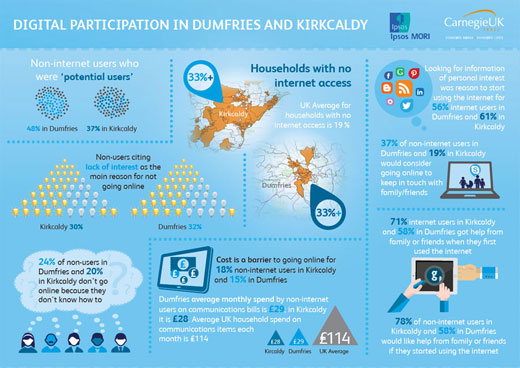
About the research The fieldwork was undertaken by Ipsos in March 2014. Ipsos carried out interviews with 402 participants, 200 in Dumfries and 202 in Kirkcaldy across nine days of fieldwork.