
AI Ads Are Good Enough — And That’s the Problem
AI-generated advertising has reached a point where most consumers can't tell it apart from human-made work. But does it have the same influence?
We put 20 ads (half human-created, half AI-generated) in front of 3,000 U.S. consumers using Ipsos Creative|Spark to find out. The results reveal a striking gap: while AI can produce credible, efficient creative work, it consistently underperforms on emotional engagement and struggles to drive business outcomes the same way that human-created ads can.
In this collaboration with Syracuse University's S.I. Newhouse School of Public Communications, we break down why AI is currently struggling to drive business outcomes and how brands can navigate the delicate balance between creative efficiency and strategic effectiveness.
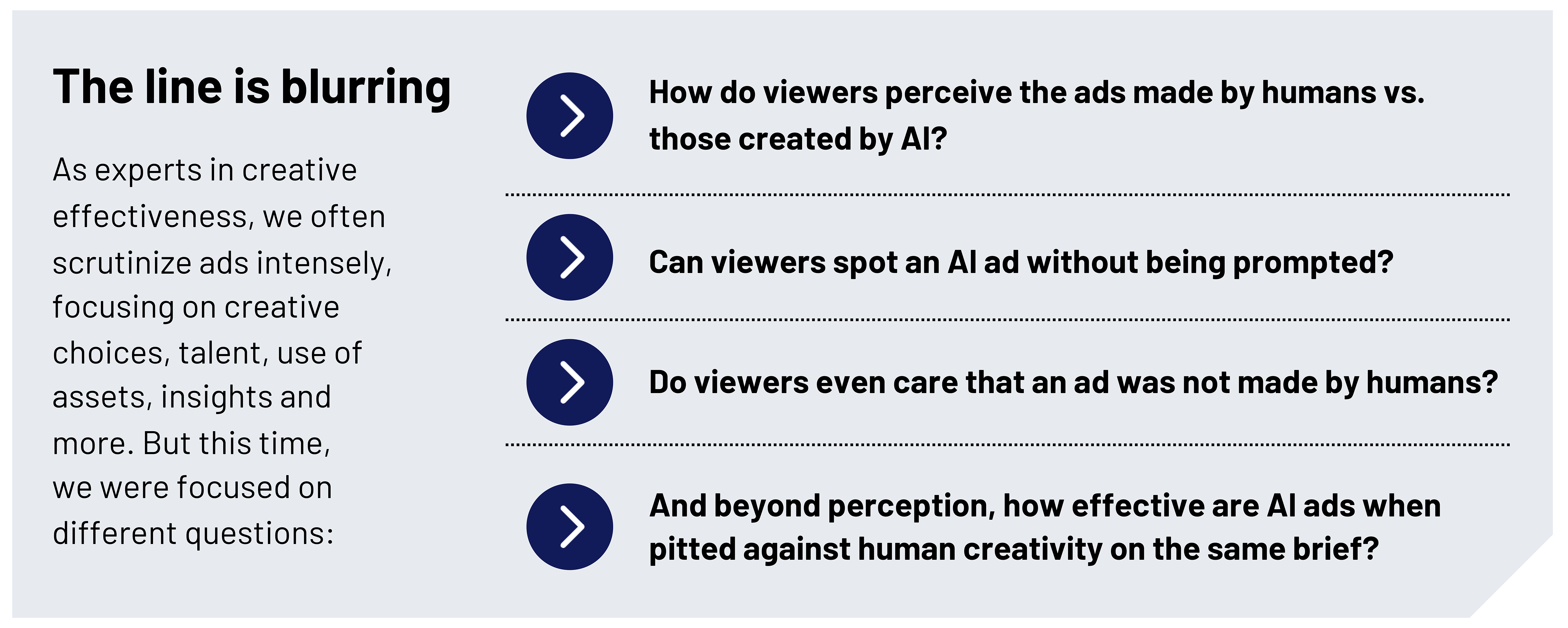
Signals from the classroom
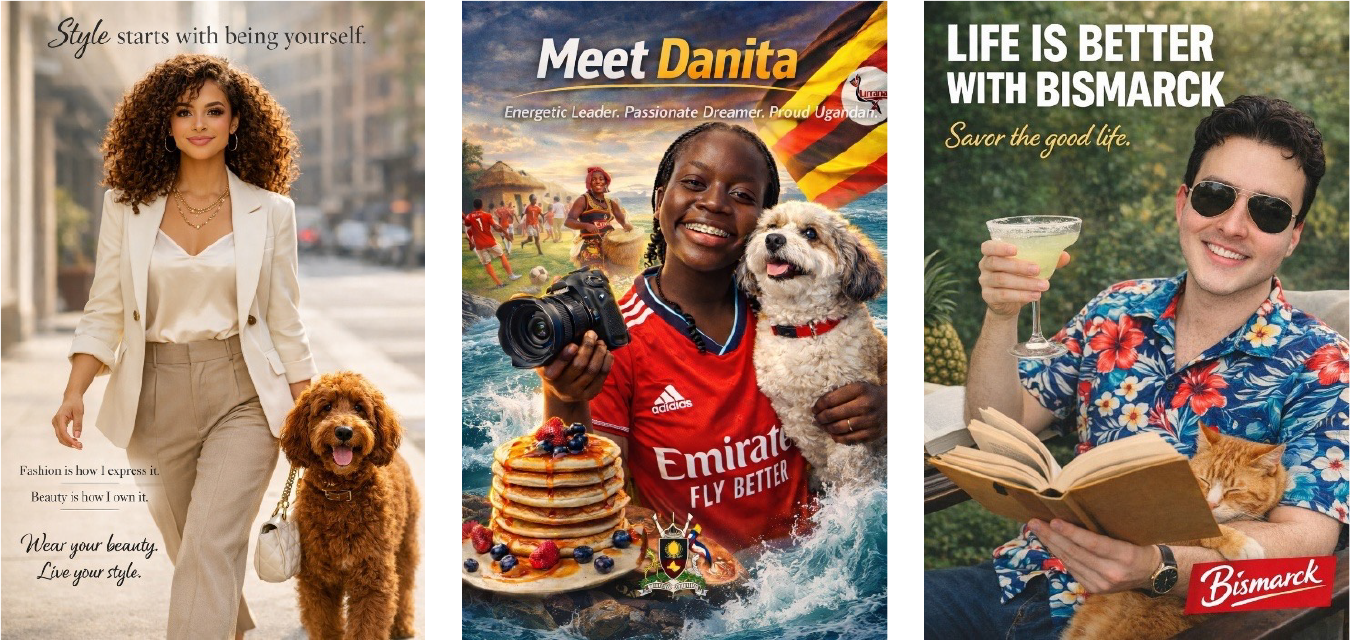
For the last three years, Professor Carrie Riby has run an experiment in her "Big Ideas in Advertising" course at Syracuse University's S.I. Newhouse School of Public Communications by asking her students to use AI to sell themselves. While initially it was a great way to learn about the students and their proficiency with AI, it quickly started to raise and intensify questions about the future of AI in the advertising profession.
By the time the fifth student presented their artificial creations, a pattern emerged. Even with clever prompting and reference photos to assist with AI-generated imagery, the students could not escape AI's tendency to flatten creativity into something predictable and uniform. When asked whether they'd display their work, not one student loved their AI creation enough to put it on their proverbial "refrigerator."
If the creators themselves are underwhelmed by their own AI output, why should we expect a consumer to give it a second glance?
AI doesn't invent. It synthesizes, drawing from everything in its training data — from award-winning campaigns to the most forgettable filler ever to run on the internet. Which had us begging the question: When using AI, will the result be an award-winning ad, or just run-of-the-mill creative that will exit a viewer's mind the second the next one hits their feeds?
This classroom insight was the premise for our study at Ipsos, and this truth is a keystone to understanding AI's role in the future of the advertising industry.
Figure: Syracuse University Student Work: 2026
Efficiency or effectiveness: Do we have to pick one?
It's no secret that the industry is haunted with many looming questions. Will AI replace creative agencies? Is there a place for creative directors in the future? The appeal of AI is obvious: faster production, lower costs, endless iteration. According to the Ipsos Consumer Tracker, 67% of U.S. adults agree that using AI in the workplace can save time and resources, yet only 41% believe the potential benefits of AI, such as increased efficiency and productivity, outweigh the potential job loss. So with what's at stake, another big question remains: Are we gaining efficiency at the expense of losing that critical audience connection?
Same brands. Same brief. One big catch.
To answer that question and more, we tested 20 ads from major brands across a range of industries with 3,000 respondents in the U.S. The catch? Half of the ads didn't use AI, while the other half were created entirely with AI.
In our study, we controlled the one critical piece to every successful advertising campaign: strategy. To do this, Professor Adam Peruta from Syracuse University took the original :30 ads and utilized Google's Gemini to deconstruct each one — reverse-engineering the creative brief that could have produced it. Gemini then used that brief to develop a concept for a new ad, delivered as a shot list. That shot list was fed directly into OpenAI's Sora 2 to generate the AI counterpart, resulting in a fully AI-produced spot with no human creative intervention.
Like all generative AI, video models are prone to inconsistencies and errors. In this study, some ads required multiple iterations before producing an output that met a reasonable bar and felt "good enough" for consumer testing. Taken on their own, the 10 final AI ads are credible. Many lean on functional information, some deploy distinctive brand assets, others reach for emotion or humor. The result is a set of ads that would blend easily into any real-world media environment.
Figure: Creative Brief Framework for AI Ad Generation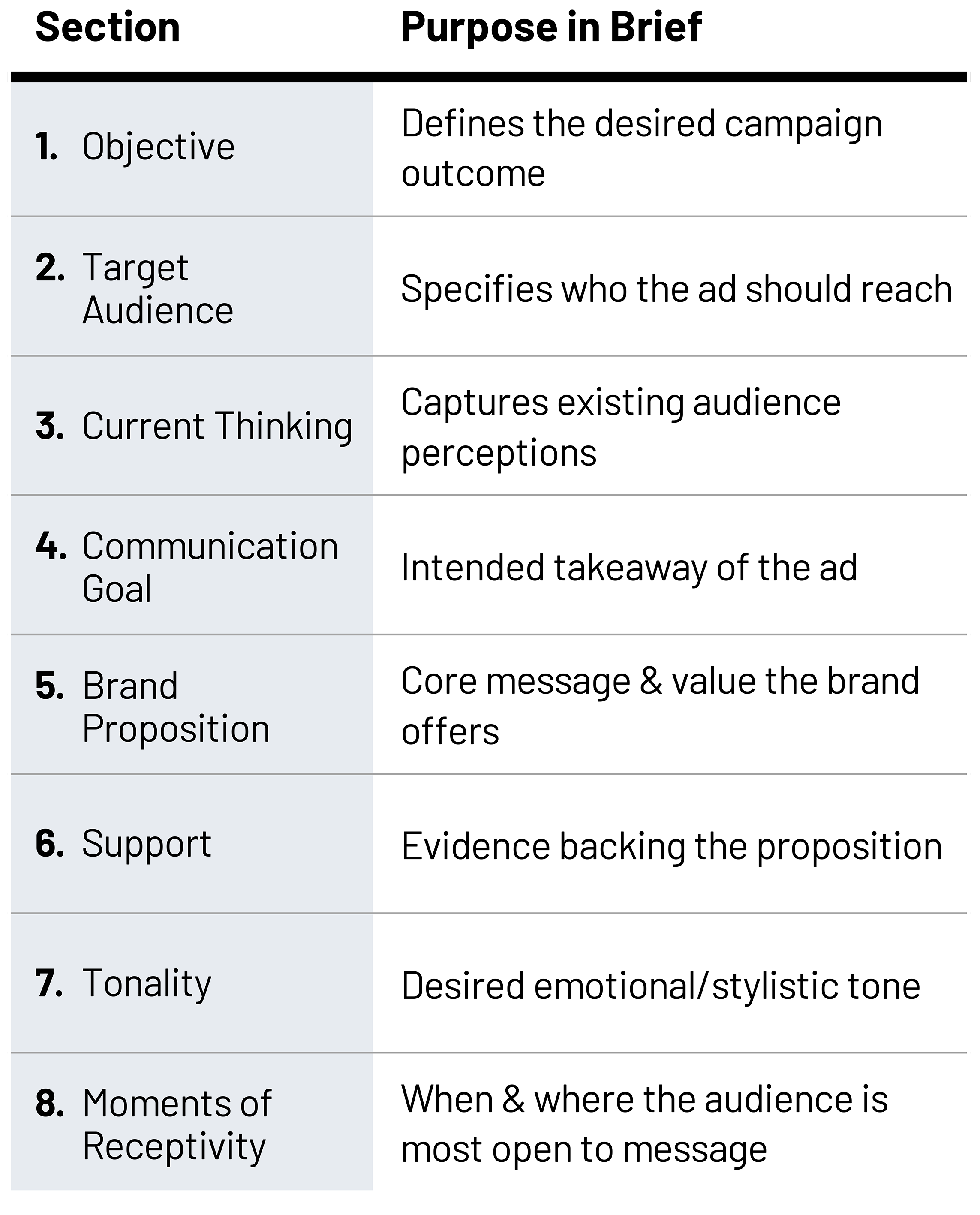 | Figure: Experimental Guardrails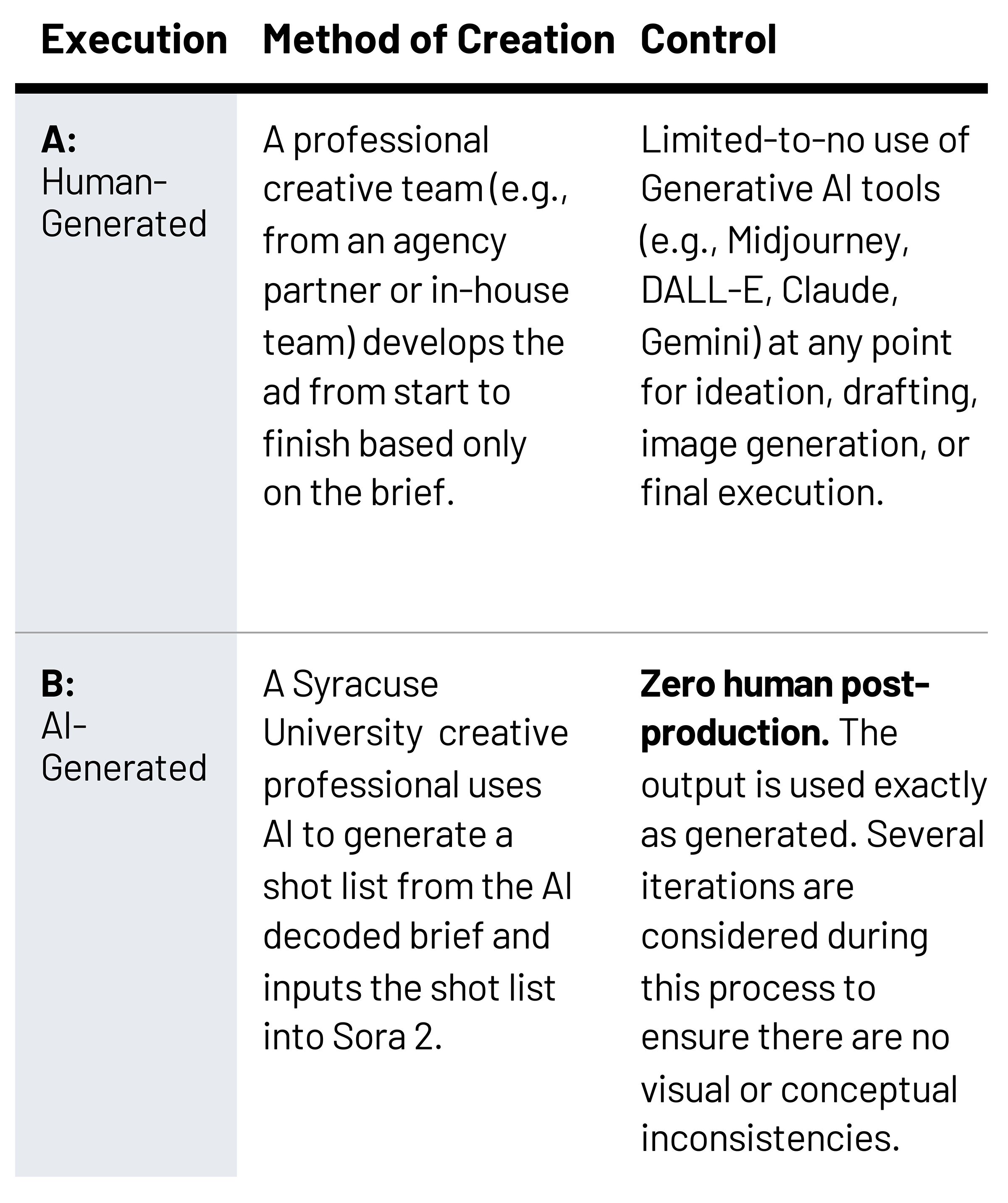 |
Perception and reality
With the full set of 20 ads ready for evaluation, we needed a testing approach that could capture not only perceptions and reactions, but also how effective these ads would be at delivering what matters: business outcomes.
To do this, we used Ipsos' ad assessment tool, Creative|Spark, where ads are shown to audiences in a distracted, high-stimulus environment, mimicking the real conditions under which consumers actually encounter advertising.
This approach allows us not only to hear what people think about the ads in a vacuum, but also to understand how impactful they would be in the real world.
Figure: AI "Failures"
Figure: AI "Passes"
How effective advertising works
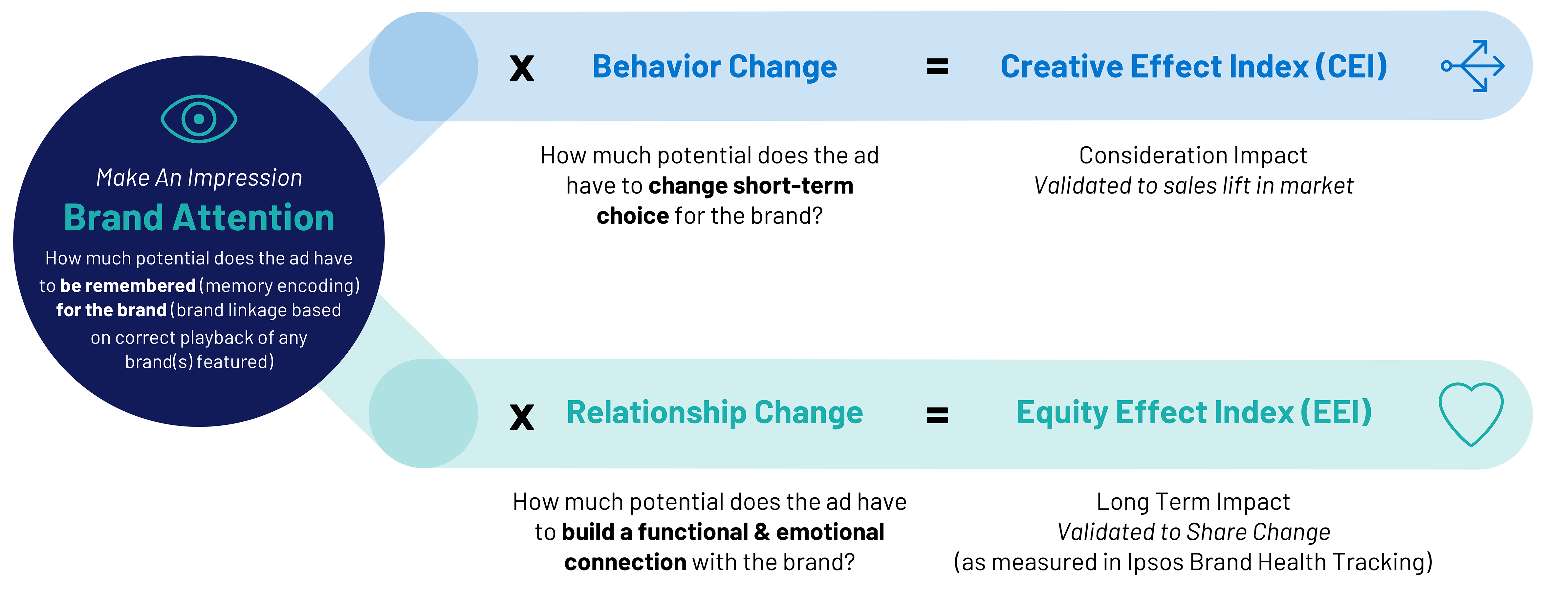
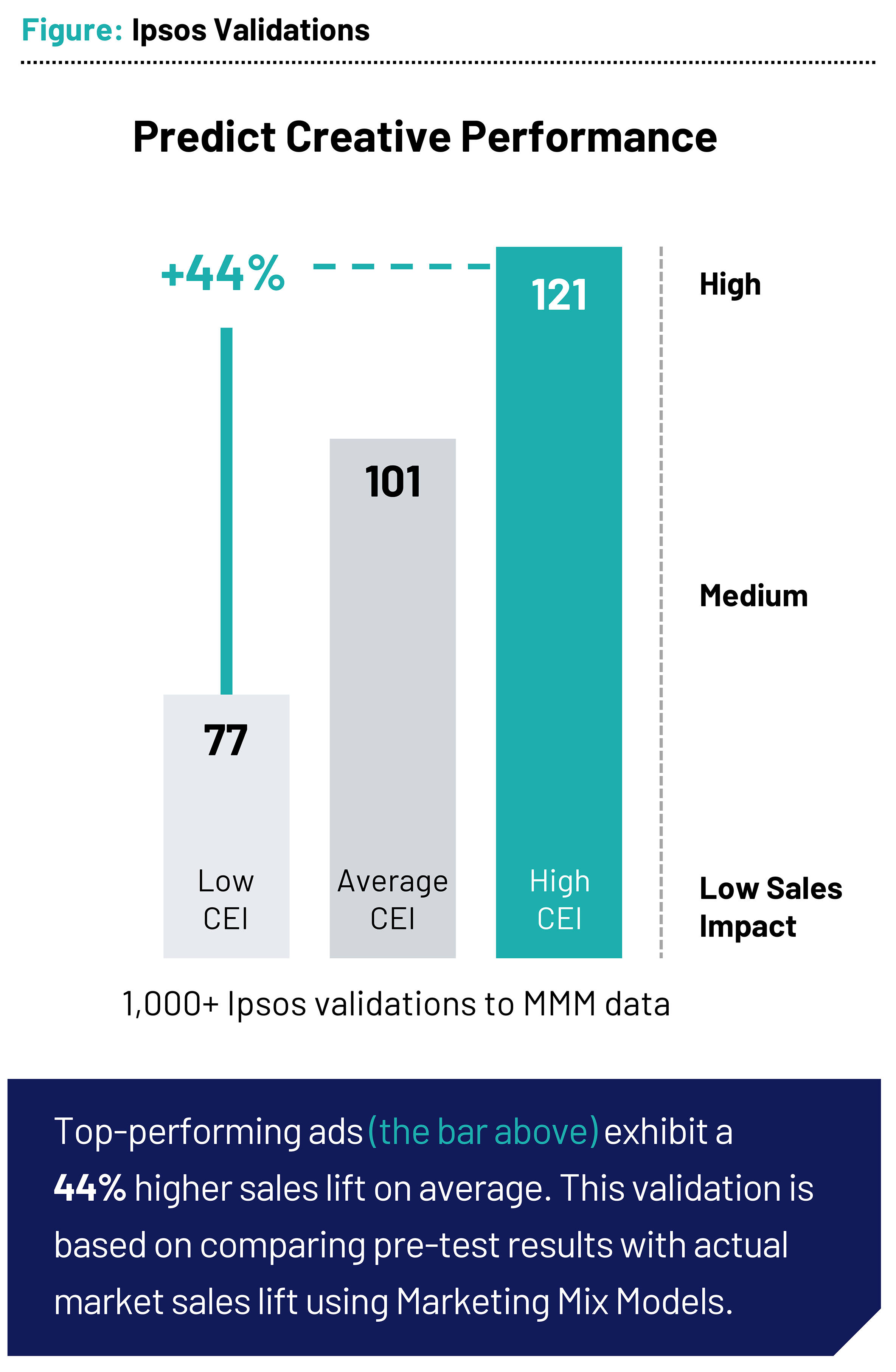
With Creative|Spark, we can measure effectiveness based on Ipsos' sales validated measures, allowing us to predict the impact of the ads on real world business outcomes:
- Creative Effect Index (CEI): captures an ad's ability to drive short-term sales impact.
- Equity Effect Index (EEI): measures its contribution to long-term brand health.
Creative|Spark delivers validated measures that matter for short and long-term impact. These metrics are used across Creative|Spark products (TV, Digital, and AI) for consistency, transferability, and ease of analysis.
MISFITS Mindset effectiveness framework
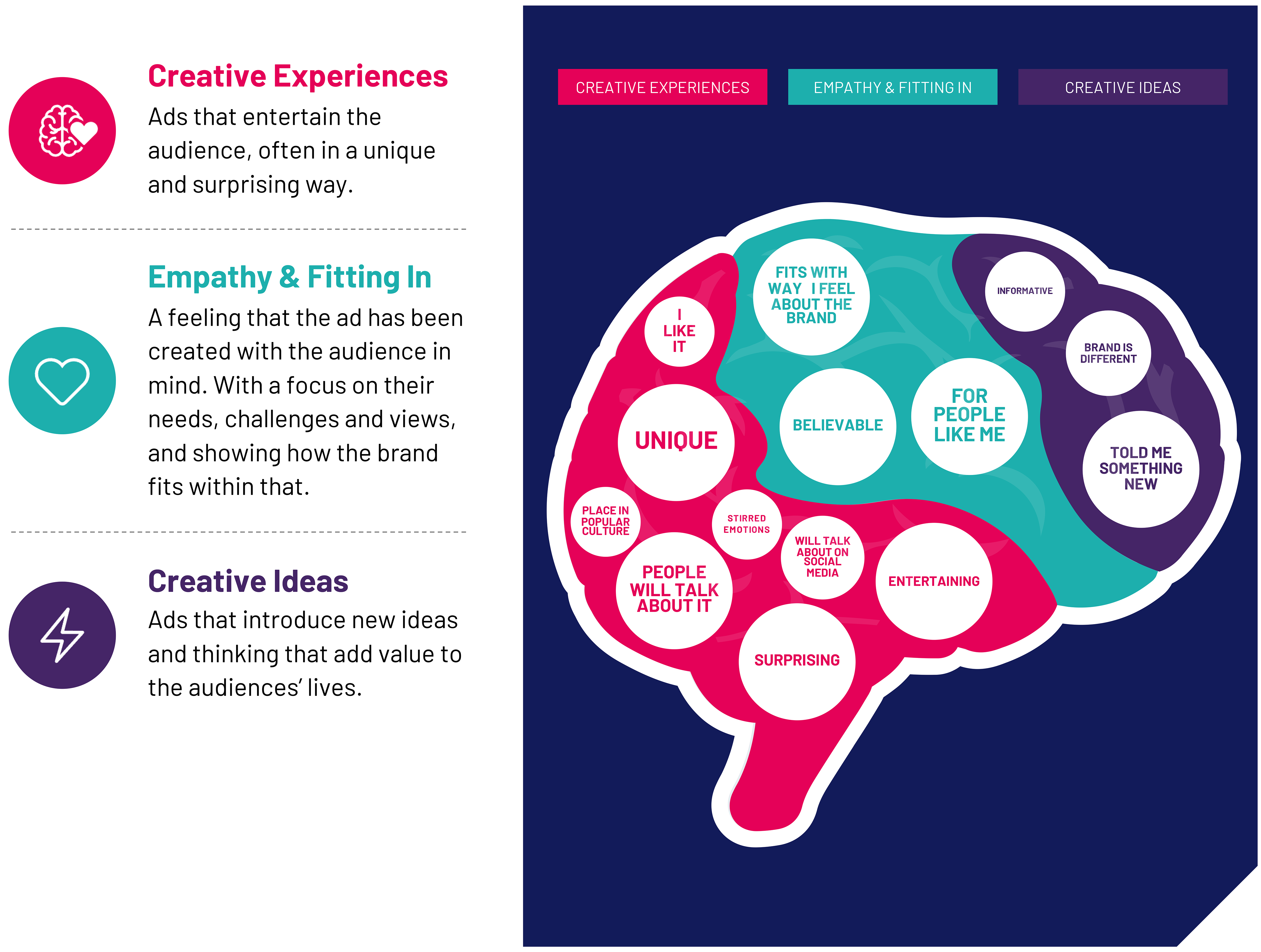
To answer these questions, we applied the Ipsos MISFITS Mindset framework, a proprietary Ipsos model developed independently of this study. MISFITS identifies three experiences that effective advertising typically delivers: Creative Experiences, Empathy & Fitting In, and Creative Ideas. When all three pillars are delivered by an ad, we see a 20% lift on creative effectiveness, making it a proven framework to evaluate the effectiveness of both human- and AI-created work.
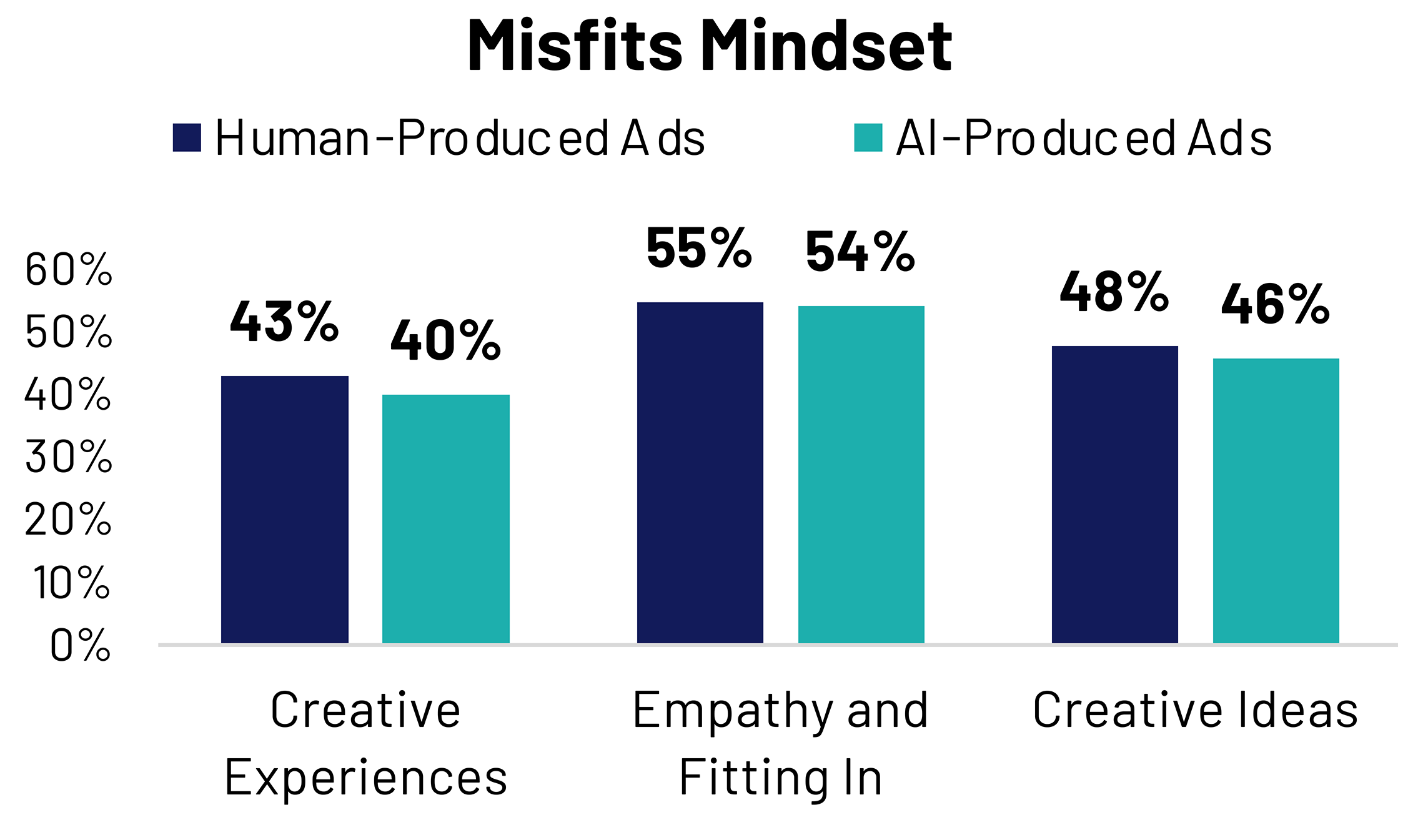
When MISFITS scores are rolled up across all 10 pairs of ads, the gap between human and AI perception is smaller than most would expect. Viewers perceive both as broadly comparable across Creative Experiences, Empathy, and Creative Ideas, with human-made ads showing modest advantages throughout.
Figure: Misfit Experiences
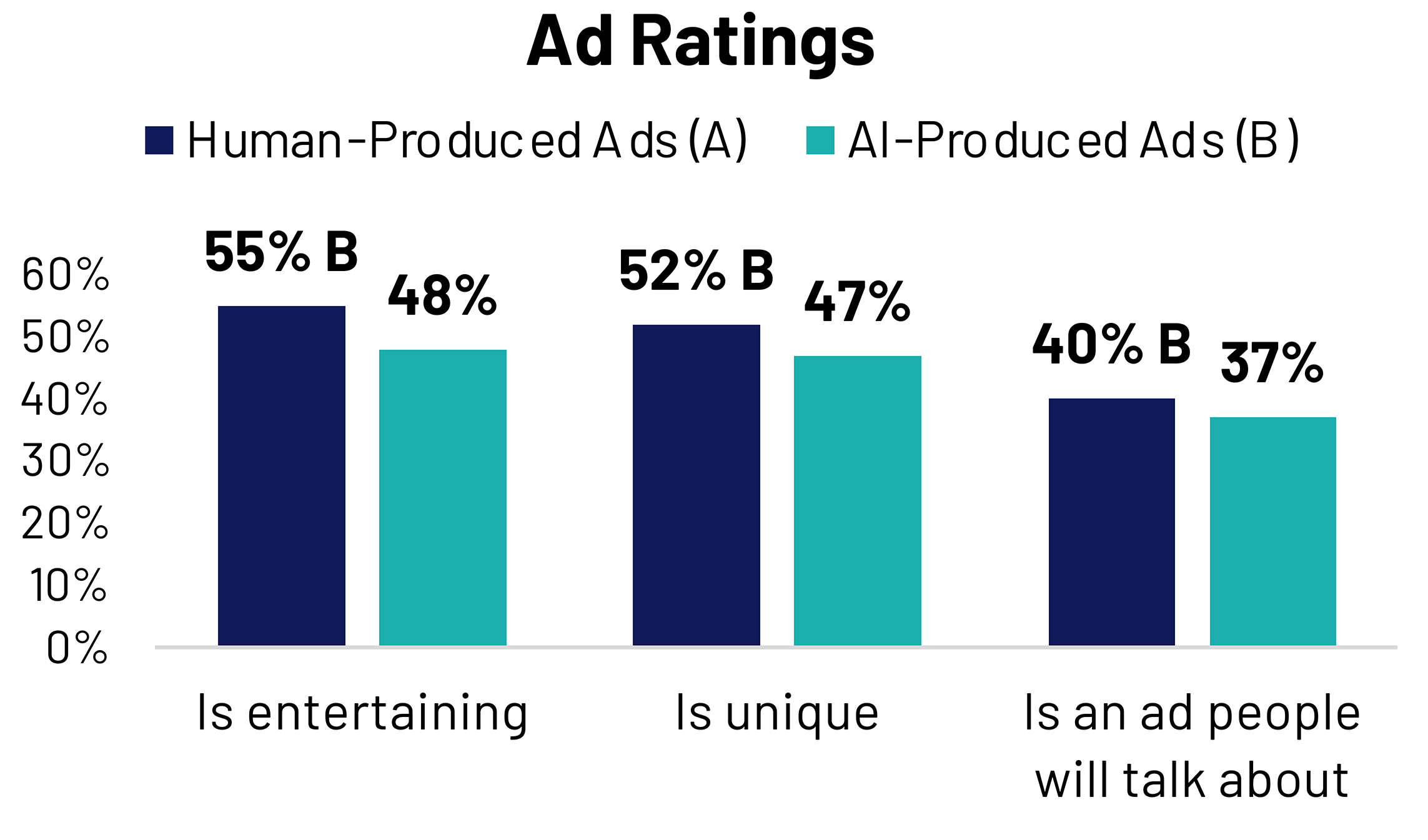
The most notable difference: human-produced ads are more entertaining, more unique, and more talkable. This is especially important as we know within the Creative Experiences pillar, these specifically provide some of the largest advantages when it comes to memorability gains.
Figure: Creative Experience Subset
Only 25% of AI ad viewers were at least somewhat confident the spot was AI-made, while 40% of all viewers were uncertain either way. This points to an uncomfortable truth: viewers are not equipped to detect AI in advertising, which raises harder questions about transparency, trust, and what authenticity means in this context.
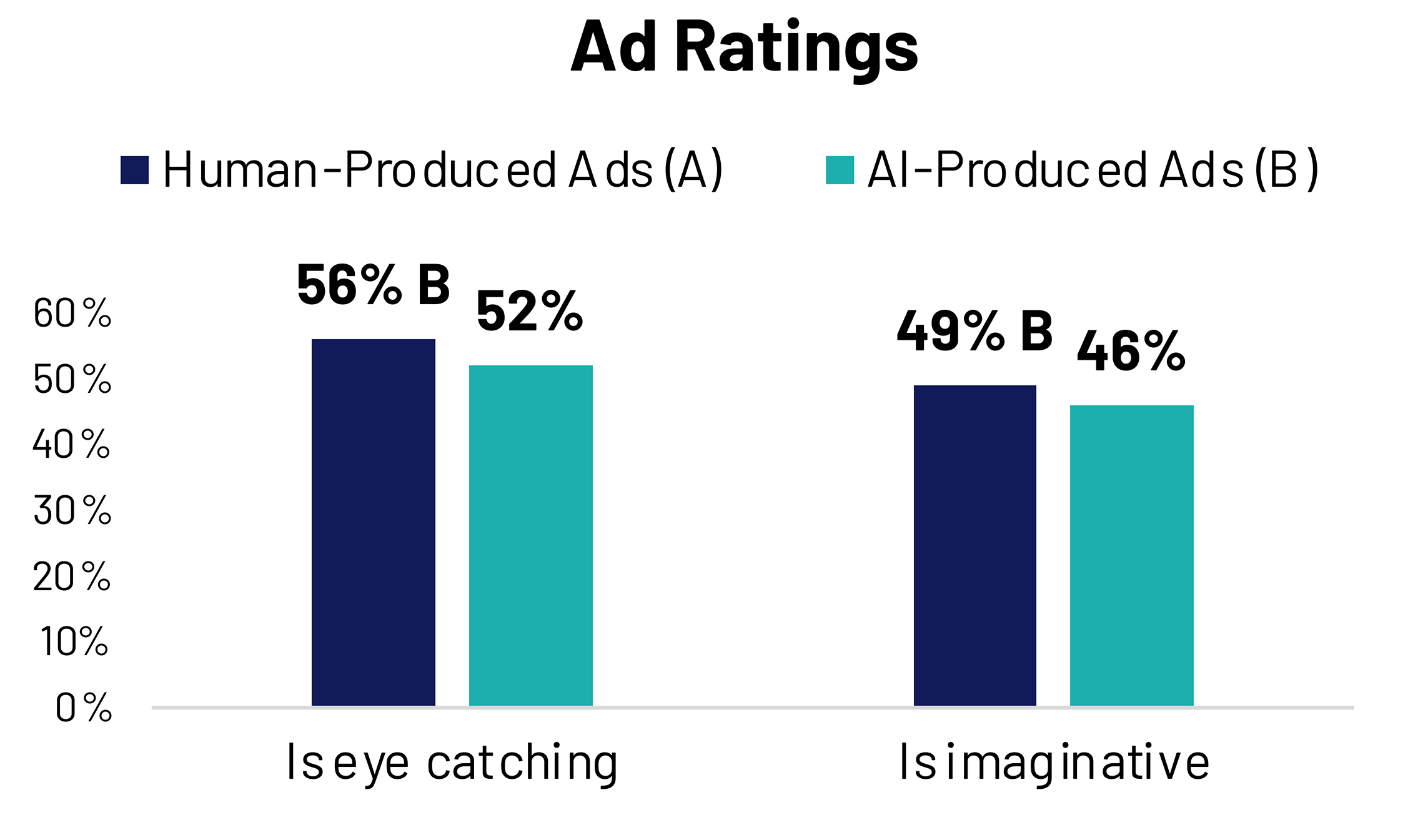
Yet something registers beneath the surface. Even without identifying the AI ads, viewers still rated the human-made work as more eye-catching and imaginative — a subconscious signal that human creativity, even when it goes unnamed, is noticed.
Figure: Ad Ratings
While AI can produce work that is credible and largely indistinguishable to most viewers, credible is not the same as compelling. AI draws from what already exists. It can replicate the conventions of advertising, but it struggles to transcend them. The top-performing human ads don't follow the script — they break it. And that capacity for the unexpected, for the creative leap that produces the work people actually remember, remains a distinctly human advantage. This transcendence is the secret sauce of advertising, as ads that break category conventions are over 20% more likely to command Brand Attention.
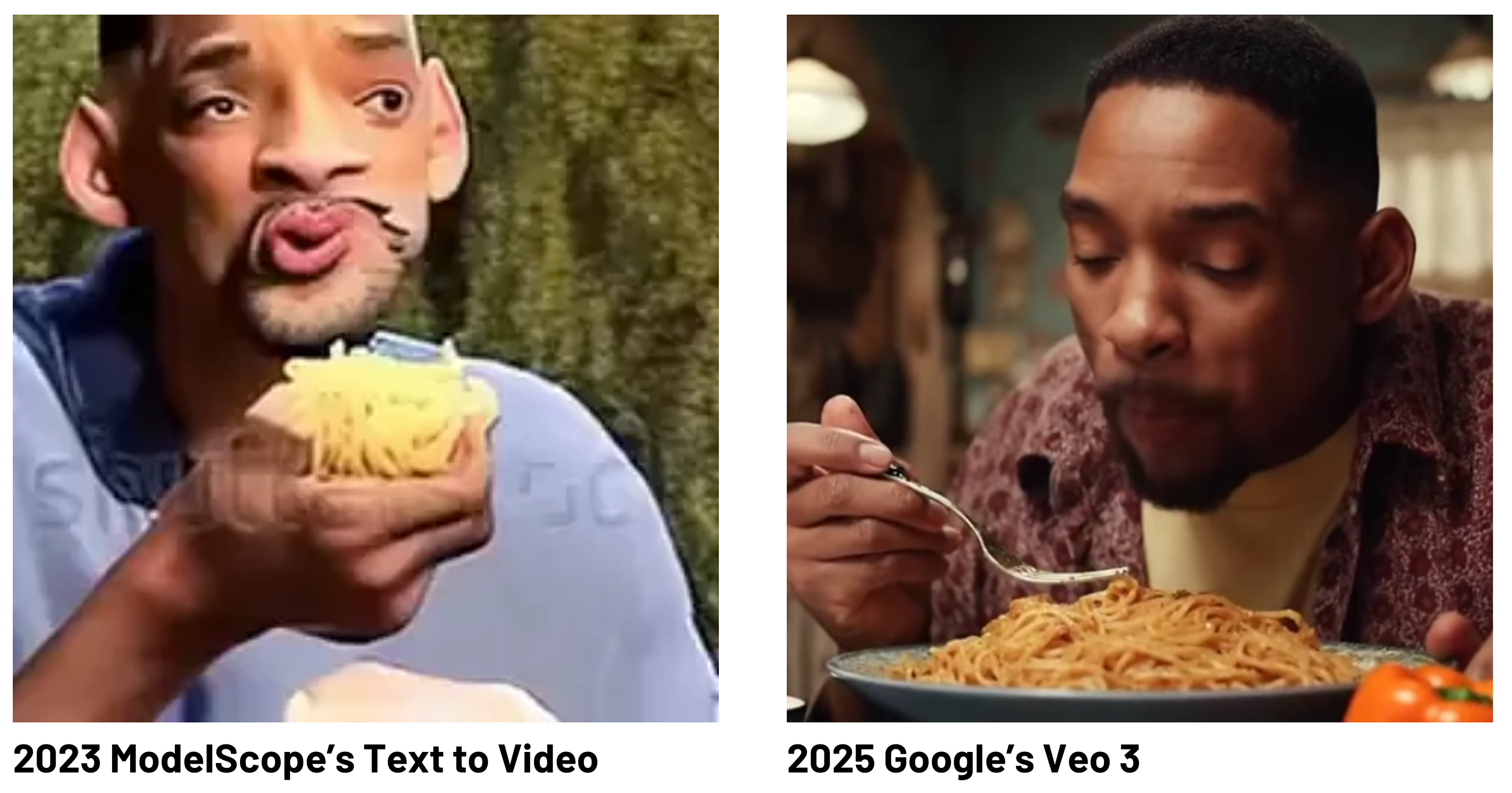
It would be naive to assume this gap won't continue to narrow as technology advances. Nothing helps paint this picture more than the informal Turing Test in the generative AI community: Will Smith eating spaghetti. This has served as a benchmark to evaluate the rapid progression of video models and the "then vs. now" speaks volumes.
Figure: Will Smith Spaghetti Test
If consumers can't tell the difference, why not leave it to the machine?
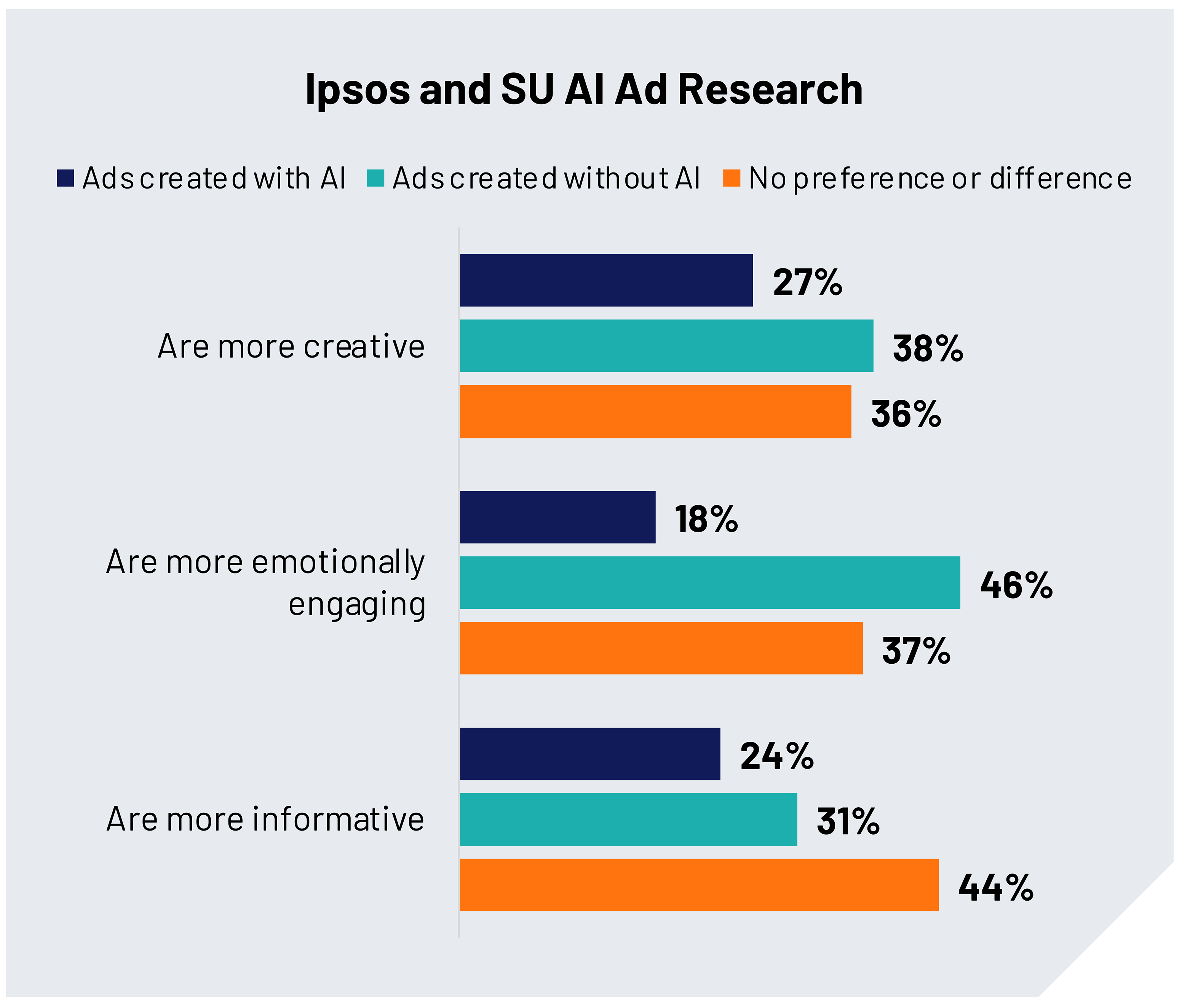
If AI is continually evolving and most viewers can't detect it anyway, why shouldn't brands simply hand over creative control to the machine? The data offers a clear answer. Although never definitively told whether the ad they viewed was AI or human produced, when asked to compare the two directly, consumers find AI advertising less creative, less emotionally engaging, and less informative.
Transparency and authenticity are intertwined
Despite continually blurred lines in pure eye tests, this sentiment proves that risk remains, and brands need to be both cautious and responsible. Brands caught using AI without disclosure have faced swift vocal backlash from the informed minority with the reach to make it matter.
These situations put long-term brand impact and trust at risk. At the end of the day, people want transparency, with 79% saying that companies using AI should have to disclose that use. Ethics around AI use are, and will likely continue to be, a real area that needs addressing by brands. At the time of publishing, there are ongoing developments in the disclosure discussion, including platforms pushing standards, the Interactive Advertising Bureau (IAB) releasing guidelines, states enacting laws, and more.
Effectiveness is paramount
So, we've talked a lot about perceptions, but what about actual business impact? Here, we see an effectiveness gap reveal itself. On average, the human-made ads are 14% stronger on short-term effectiveness (Creative Effect Index) and 17% stronger on long-term effectiveness (Equity Effect Index).
The findings here are consistent with another Ipsos report: MISFITS and the Machine. This tells us that right now, AI can make ads that are just "good enough." The work performs, but not at the level that would create a game-changing impact and competitive edge for the advertiser.
Figure: HI v AI CEI and EEI Score
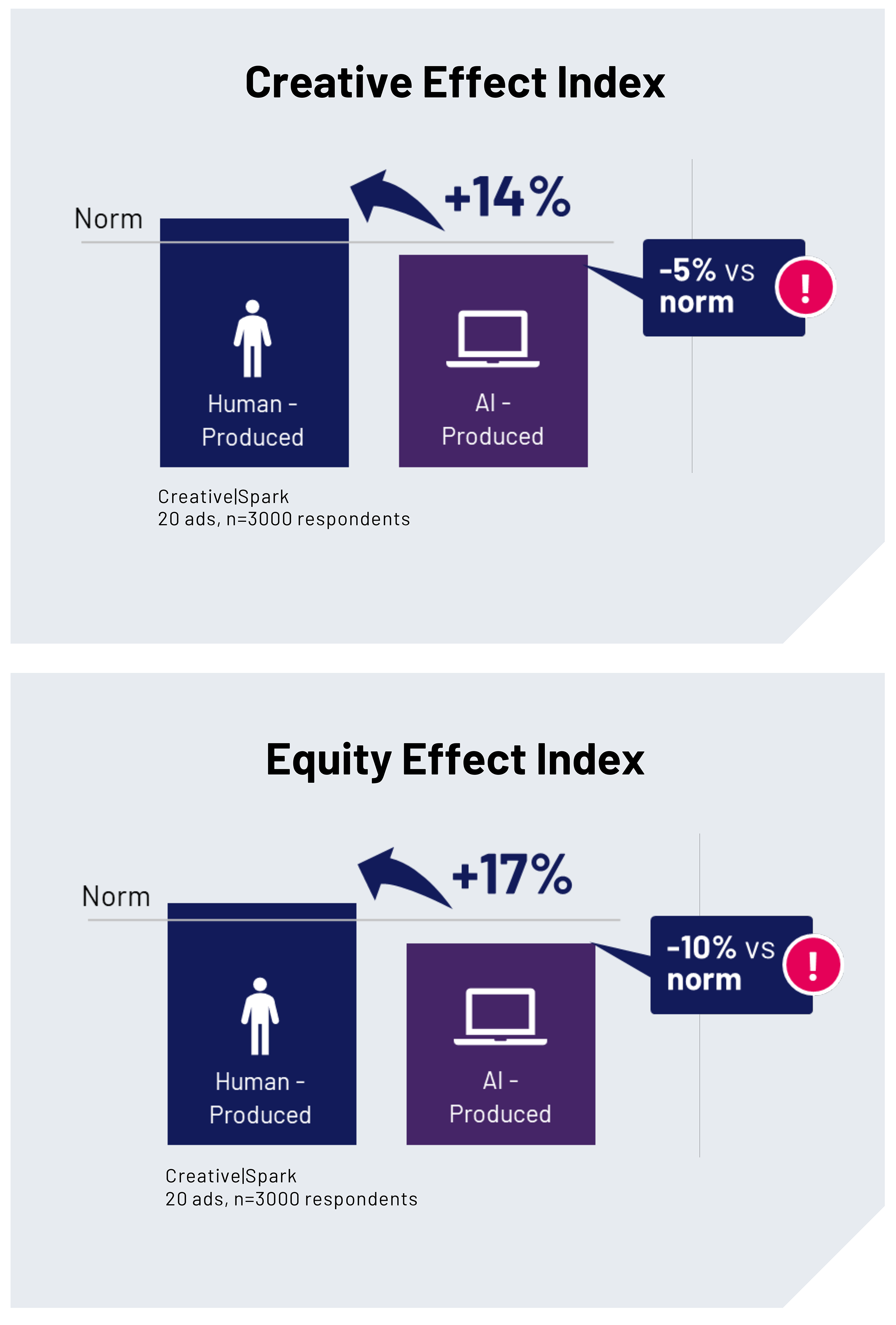
This is not to say that AI failed to create any effective ads. However, AI certainly can, and did, create some effective advertising. On average, AI ads were less effective than those made by humans. When we isolate the strongest AI-made performers, a trend emerges: The most effective AI-created ads tend to be product-driven, direct, and drawing on creative containers that the brands have used over time.
Take for example the AI-created ads for Febreze and Herbal Essences.
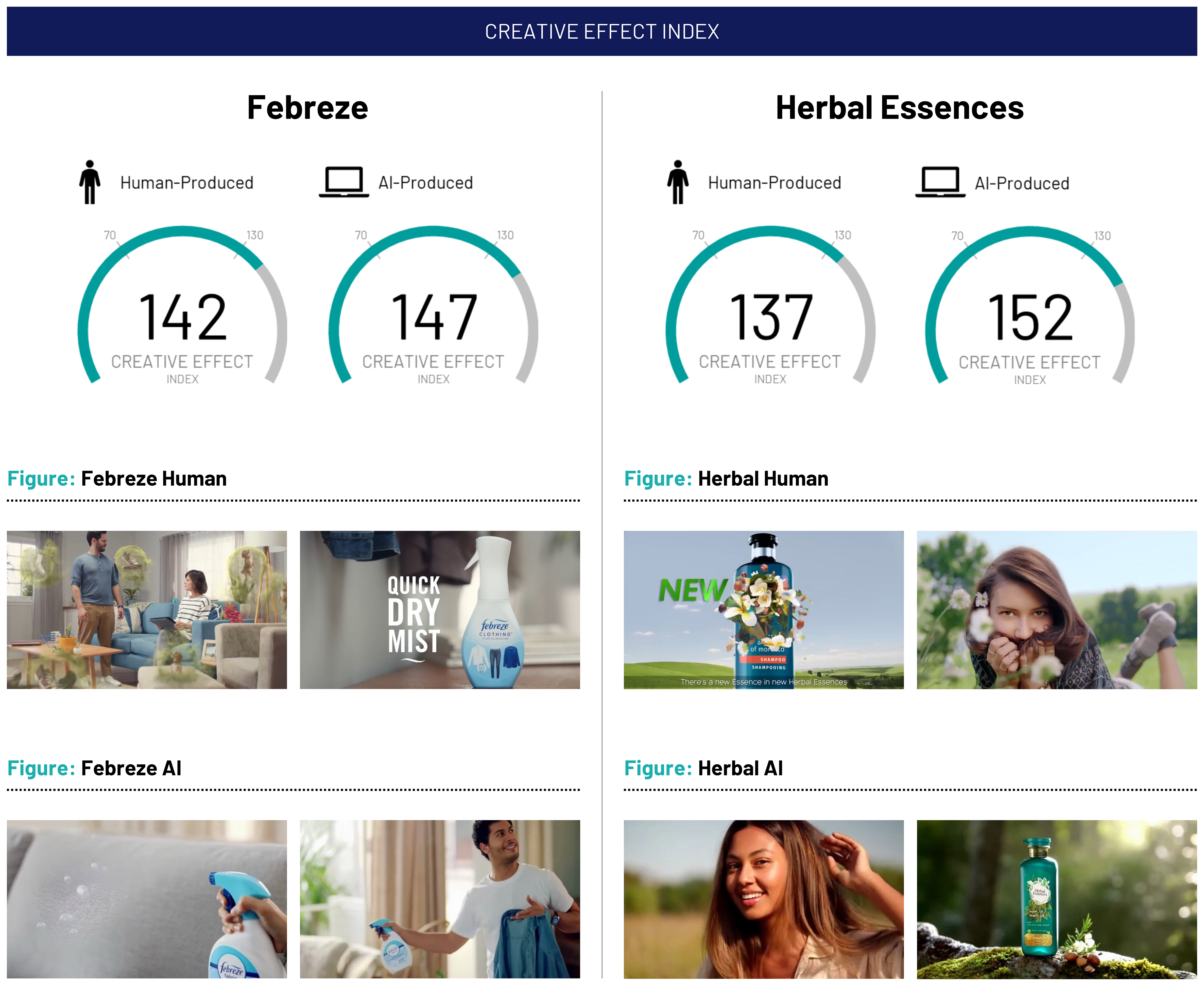
These spots perform largely because the creative direction itself is straightforward: a clear problem, a clear solution, and a clear reason to believe. This kind of functional storytelling is the oldest form of advertising, which means AI has a deep well of examples to draw from and a familiar structure to work with.
A bot story, poorly told: Why AI struggles with narrative
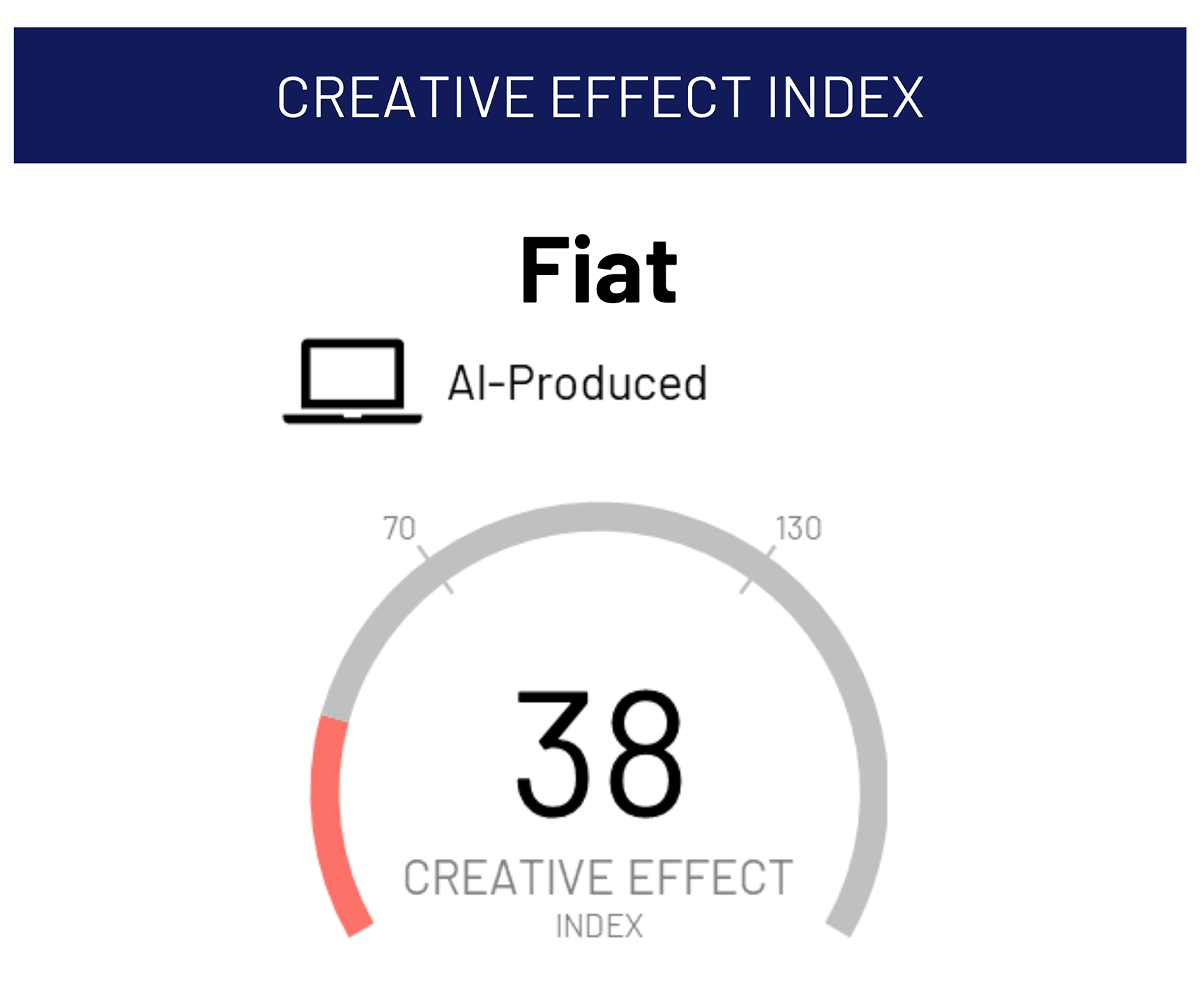
While leading with function was effective for AI, when the direction asked for something more — such as a creative leap, emotion, or a point of view — it fell short. The Fiat ad is a useful case in point.
Here is how the model was instructed to approach the tone of the ad:
Energetic, defiant, and confident with a playful, rebellious edge. The tone should be high-impact, utilizing dramatic sound design, quick cuts, and a pulsing, assertive soundtrack to create a sense of action and excitement. The humor should be subtle and derived from the over-the-top contrast between 'scientific testing' and real-world behavior.
The ask is something ambitious, but the ad falls short as one of the least emotionally stirring ads of the set. In the latest Ipsos report, MISFITS Stories, research found that only 49% of ads used storytelling, despite being a critical driver of effectiveness. However, in our study, AI chose the approach even less frequently — only 30% of the time. In the Fiat ad, there is an attempt at storytelling, but it misses the mark.

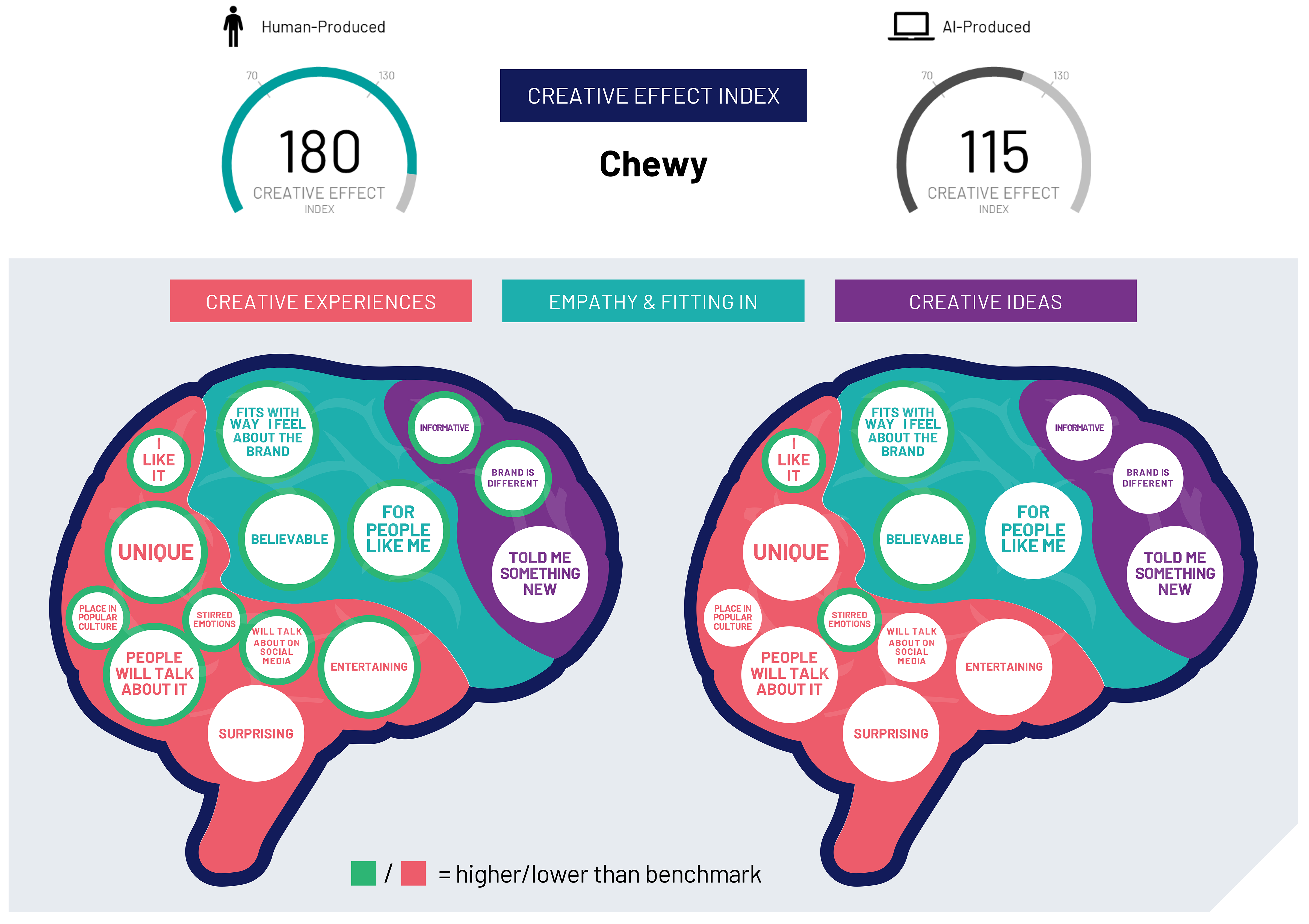
Among the 20 ads tested in this experiment, one stands apart. The human-made Chewy holiday ad is believable, emotional, and a heartwarming tale. The ad is authentically built around a real human tension that the brand is uniquely positioned to address. This authenticity and genuine human creativity with storytelling results in the most effective ad in the creative set. The AI ad, however, lacks some of the emotion and humanity here. While still average, without that human touch, the brand could miss out on an exceptional ad.

The importance of a good brief
No matter who (or what) created the ads, one element consistently shows up in the strongest work: a solid brief that is rooted in a resonant human truth. A brief sets the stage for messaging, tonality, and most importantly creative inspiration. A good strategy is the foundation to creating successful briefs and in turn a good brief is the cornerstone to impactful advertising.
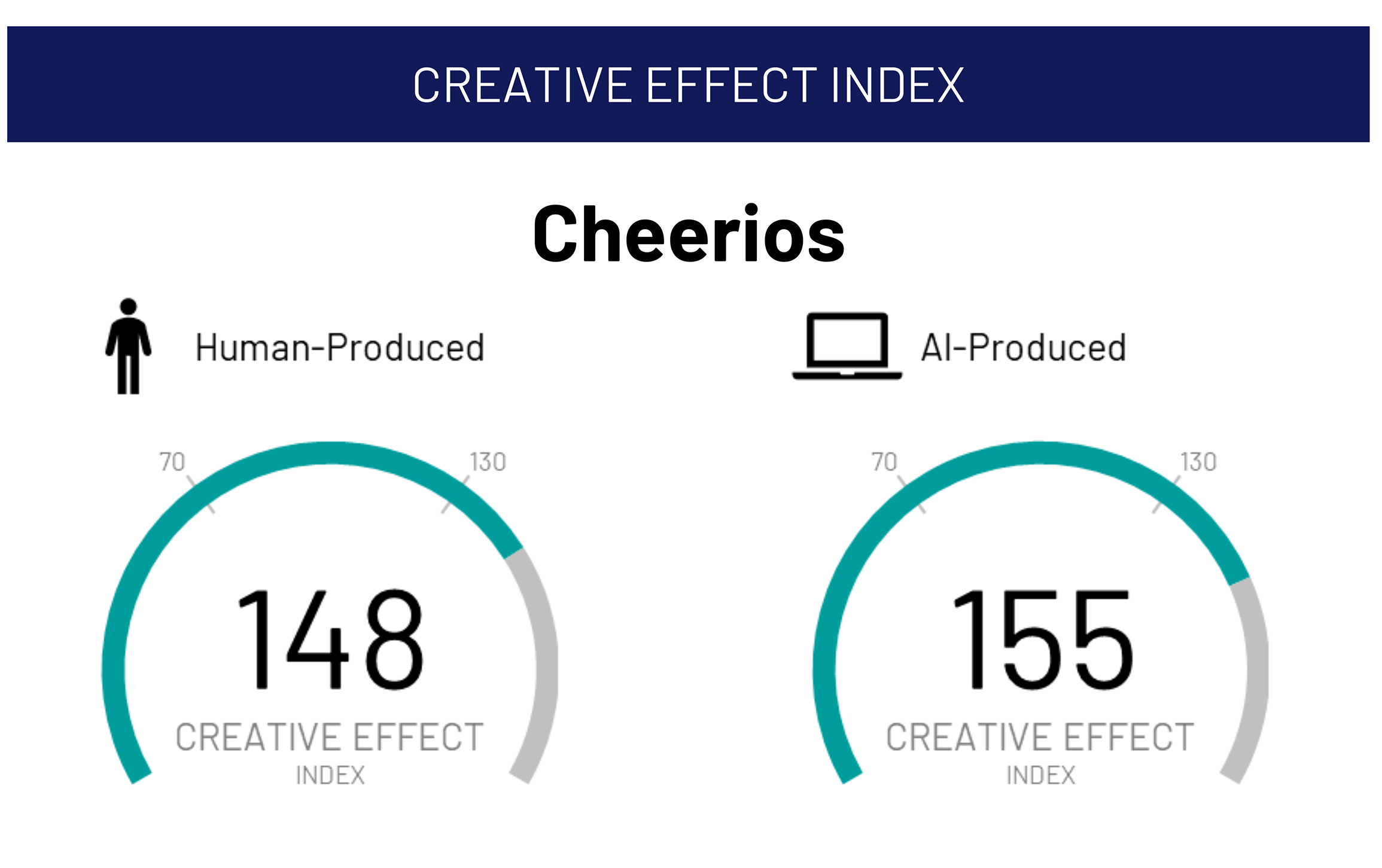
The briefs presented in this research run the gamut of depth, but the one that sticks out among the field as deeply human, empathetic, and creates an authentic brand opportunity belonged to Cheerios. The proposition is clear for the brand, and most of all, it is human:
"Cheerios helps keep your heart healthy, so you can be there for the ones who need you most."
It comes as no surprise that these two ads resulted in the highest aggregated effectiveness across the 10 brands. Both the human and AI-produced ads fall into the top of the Ipsos database. The differentiator? This clear and empathetic insight that allows AI to close the gap.
Good enough is not enough
For marketers, advertising is not only a way to deliver a return on their investment, but also a way to create a short and long-term competitive edge in the marketplace. In a world where the average consumer is inundated with advertising, "good enough" just doesn't cut it.
Truth is, AI never took that full leap for creativity in a way that was successful, while humans take this leap in ways that a machine may just not (yet) be able to replicate.
HI + AI: Faster, Better, Cheaper and Effective. Pick Four.
It's human nature to lean into decision-making that is safe and familiar, so are we headed to a place where we create and consume advertising that is "just good enough"?
As this research demonstrates, consumers cannot reliably tell the difference between AI and human generated ads. Yet when the brief calls for highly creative or emotional brand building work, AI struggles to independently deliver effectively. AI may be closing the perceptual gap, but it still has work to do on the effectiveness gap — the gap where hearts and minds drive better business outcomes.
The future is not human versus machine. It is humans and machines working together, along with human intelligence, current cultural context, and audience empathy & listening. Faster, better and cheaper may be important drivers in a world that is moving at the speed of light, but successful marketers should not sacrifice what truly moves the needle for the brand: effective creativity.
...humans and machines working together...
Key Takeaways and Implications
- Don't settle for "good enough." While AI has an important supplemental role to play in modern campaign strategy and execution, it is not a replacement for the human-led creativity, novelty, and empathetic storytelling needed to deliver a competitive edge today.
- There's no substitute for a strong brief. Creative outputs are only as good as the strength of their inputs. Marketers should invest upfront in understanding their audience and validating resonant human insights to fuel their campaigns, regardless of the tools used to develop and deploy them.
- The importance of trust and transparency will continue to grow. With viewers increasingly finding it difficult to identify what was created with AI or not, transparency and the disclosure of AI's role in content creation remain a concern for consumers and risk for brands alike.
- The future is brightest with HI + AI. Embed hybrid workflows for campaign development and deployment that keep humans in the loop. Lean more on AI-led creative for lower funnel product work, variations and scale, while keeping humans at the center of brand storytelling narratives and emotive assets.
- Create feedback loops with your audience. The intended target of our campaigns is the ultimate arbitrator of creative effectiveness. Invest in systems and tools that create feedback loops to optimize and validate the effectiveness of AI-created media.
Authors
Adam Peruta
Associate Professor and Program Director, Advanced Media Management, M.S.
S.I. Newhouse School of Public Communications at Syracuse University
Carrie Riby
Professor of Practice
S.I. Newhouse School of Public Communications at Syracuse University
Nate Cummings
Director, Creative Excellence — Ipsos U.S.
Nate Pascale
Research Analyst, Creative Excellence — Ipsos U.S.

![[WEBINAR] TOAST 2026: Under Pressure - Fewer, Fragmented, Fought-For](/sites/default/files/styles/list_item_image/public/ct/event/2026-07/thumbnail-templates_1_0.png?itok=MxL-wPJW)
