
Americans’ views of generative AI are evolving: More ‘fake’ and ‘soulless,’ less ‘futuristic’
The Ipsos Consumer Tracker asks Americans questions about culture, the economy and the forces that shape our lives. Here's one thing we learned this week.
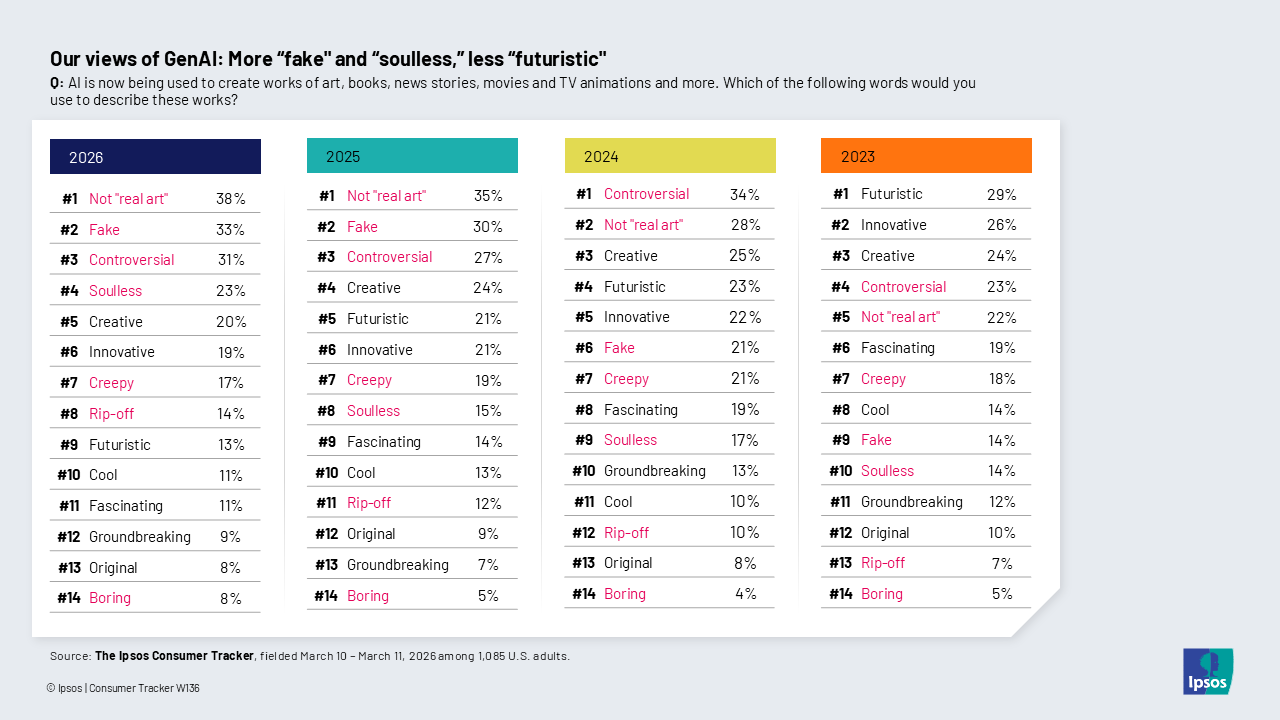
Why we asked: Three years ago, Ipsos was one of the first researchers, if not the first, to field a survey question drafted largely by generative AI. It worked reasonably well, so later we asked ChatGPT to give us a list of words people might use to describe works created with AI. It gave us a very decent list, but we had to refine the prompt so it would also give us some negative words. We could sense the AI hanging its head and complying… “OK,” we imagined it saying, “I guess people could think AI works are ‘fake.’”
What we found: When we first asked this in 2023, ChatGPT was new and cool and everyone was talking about it. Now there are more models, they’re more advanced and everyone is still talking about them. But that conversation has shifted. In that first wave, ChatGPT was right to be bullish. The top words people chose were all positive: “Futuristic,” “Innovative” and “Creative” topped the list.
Then these things proliferated, and conversation started up about how the LLMs were trained, and how their use could take jobs from human creative types. By year two, “Controversial” and “Not ‘real art’” topped the list.
Now in year four of asking, we see those terms (and “Fake” and “Soulless”) crowding the top of the list as “Futuristic” falls further down the charts. Younger Americans (18-34) seem to have a complicated relationship with these technologies. They are less likely to say it’s “Fake” than older Americans. However, they are more likely to say it’s “Cool” but also more likely to say it’s “Soulless” and “Boring.”
More insights from this wave of the Ipsos Consumer Tracker:
Most Americans agree the government should regulate AI, but party splits emerge on how
Almost all Americans think gas prices have gone up and will get worse
Gas prices aren’t hurting Americans’ summer plans … yet
Despite the hype, most don’t plan to watch any NCAA March Madness
Storage, privacy and a preference for brick-and-mortar are the biggest barriers for retail apps
The Ipsos Care-o-Meter: What does America know about vs. what does America care about?