
Grocery Shopping Path-to-Purchase
While we generally gravitate towards what is simple and efficient, there is mounting evidence that we are moving in the opposite direction when it comes to grocery shopping. Namely, we are more likely to shop at more than one store. Multiple stores as a matter of fact. At Ipsos, as part of our commitment to understanding shopper behavior, we conducted a national survey to understand how people shop for groceries. We find that shopping for groceries at only one store is the exception rather than the rule. We note that when shoppers have more than one store in their repertoire set, the stores are likely to be complementary (different stores are viewed as stronger in certain categories) rather than substitutable (competing based on price). We find also that fresh foods such as meat and vegetables, while non-glamorous in the world of market research, are key "destination" products that determine whether a shopper will go to a particular store. Finally, there is also evidence that consumers shop at different types of stores in their repertoire set in a predictable sequence. These findings have important implications for retailers and also for the manufacturers that distribute products through them.
Foraging in multiple locations
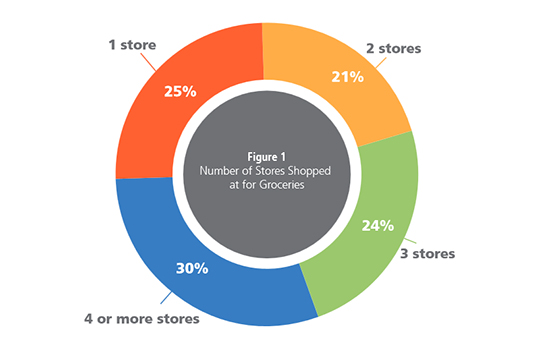
To lay the foundation for the remaining findings in this study, we start by examining the number of grocery stores that people shop at. As seen from Figure 1, only a quarter of the population shop at one grocery store. In other words, shoppers who shop at only one grocery store are in the minority. 45% of grocery shoppers shop at two or three grocery stores and the remaining 30% shop at four or more stores for groceries.
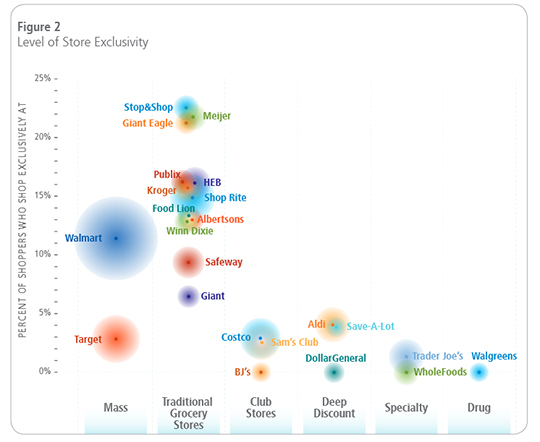
However, not all stores are equally "susceptible" to this multi-store phenomenon. There appear to be some retailers that are more likely to be the only store that a consumer shops at for groceries. Examining Figure 2, it is clear that the traditional grocery stores (2nd vertical "column" of bubbles from the left) vary in their level of exclusivity - defined as being the only store that a consumer shops at for groceries. Stop and Shop, for example, has a higher "exclusivity" score than "Giant". Understanding why some stores are better at fulfilling all of a shoppers' needs than others will help retailers compete better. Of course, what contributes to a retailer's exclusivity may also be due to a geographic location that has fewer competitors.
It should be noted that the Club Stores (e.g., Costco), Deep Discount Stores (e.g., Aldi), Specialty stores (e.g., Trader's Joe) and Drug Stores (Walgreens) are all low in exclusivity. So, while these more specialized store formats have taken away sales from traditional grocery stores, the findings here tell us that these specialized stores are by no means used as primary grocery stores.
Our finding that people shop at more than one store for their groceries has been found in other studies as well. What is not as clear, however, are the reasons people are shopping at more than one store. Is it because shoppers are simply "jumping" from store to store because of promotions and differences in pricing, or is there something more to it than just simple price comparisons?
Complementary or Substitutable Stores
From our data, we find evidence that shoppers are viewing each store in their repertoire as complementary. We start by looking at the items that people are buying from each store in their repertoire set. Figure 3 is interpreted by looking at the distance between retailers and grocery items. The closer a food item is located to a retailer on the chart below, the greater the likelihood that the food is purchased from that retailer.
Looking at Figure 3, it is clear that certain purchases are clustered at certain stores. For example, shoppers are more likely to purchase coffee and water from Club Stores like Costco and Sam's Club. Shoppers are more likely to purchase wine from Trader Joe's, and bakery items from Whole Foods. The findings from this analysis suggest that shoppers are shopping at multiple stores because they perceive some stores as better at some categories. Presumably, the larger packs of bottled water and coffee that Club Stores sell are a better value for consumers as these are food items consumed regularly and, hence, used up quickly. The usage of cage-free eggs, natural butters and unbleached flour in Whole Foods bakeries creates an offering that is unique to Whole Foods and, presumably, superior in quality.
Download the entire Point of View, including detailed charts and graphs, by clicking here.

![[WEBINAR] TOAST 2026: Under Pressure - Fewer, Fragmented, Fought-For](/sites/default/files/styles/list_item_image/public/ct/event/2026-07/thumbnail-templates_1_0.png?itok=MxL-wPJW)
