What the music industry has that politics doesn’t
Much of the internet and the wider world it seems is buzzing about one woman. She is not elected and does not make policy. Yet, earlier this morning, her fandom briefly caused a streaming platform to crash.
Yes, we are talking about Taylor Swift’s release of “Midnights," her new album. Earlier this week, we even released a poll with the Wall Street Journal in honor of the occasion. The shared excitement, anticipation, and stir around the new album is a testament to how music can unite us.
Given the focus, attention, and fanfare from the public around the country-singer-turned-pop-superstar, we are spending some time this week looking at entertainment, politics, and the staying power music has with us. Below are five charts unpacking all of that and more.
- Entertainment trumps politics. When it comes to clout, celebrities trounce politicians and political figures on social media. Even the most controversial, Twitter-heavy political figure, like former President Trump, squeak into the top 10 most followed accounts worldwide. Other celebrities, like Taylor Swift, beat out world leaders, like Prime Minister Modi of India, who was elected to the largest democracy on the planet. Musicians, entertainers, and athletes can bring people together and develop a following like few other figures can in our divided times.

- Music’s majority. Only a plurality of Americans, two in five, tune into political news at least once a day. Music listening, though, wins hours of listening time per week for just about everyone. Political news is niche; music is not.

- More than music. Most use music to connect to their mental health, identity, friends, family, culture, and religion. Music’s centrality in people’s lives translates into a lucrative industry. In 2021 alone, the global music industry brought in $26.1 billion in revenue. BTS and Taylor Swift were the two top-selling artists that year. The emotional pull is what keeps people coming back for more.

- Generational taste. That emotional pull doesn’t begin and end with each new generation. People’s taste and formative-music listening years stay with them throughout life. When asked what decade produced the best music, without fail, nearly every generation thinks the best musical decade happened when they were young.

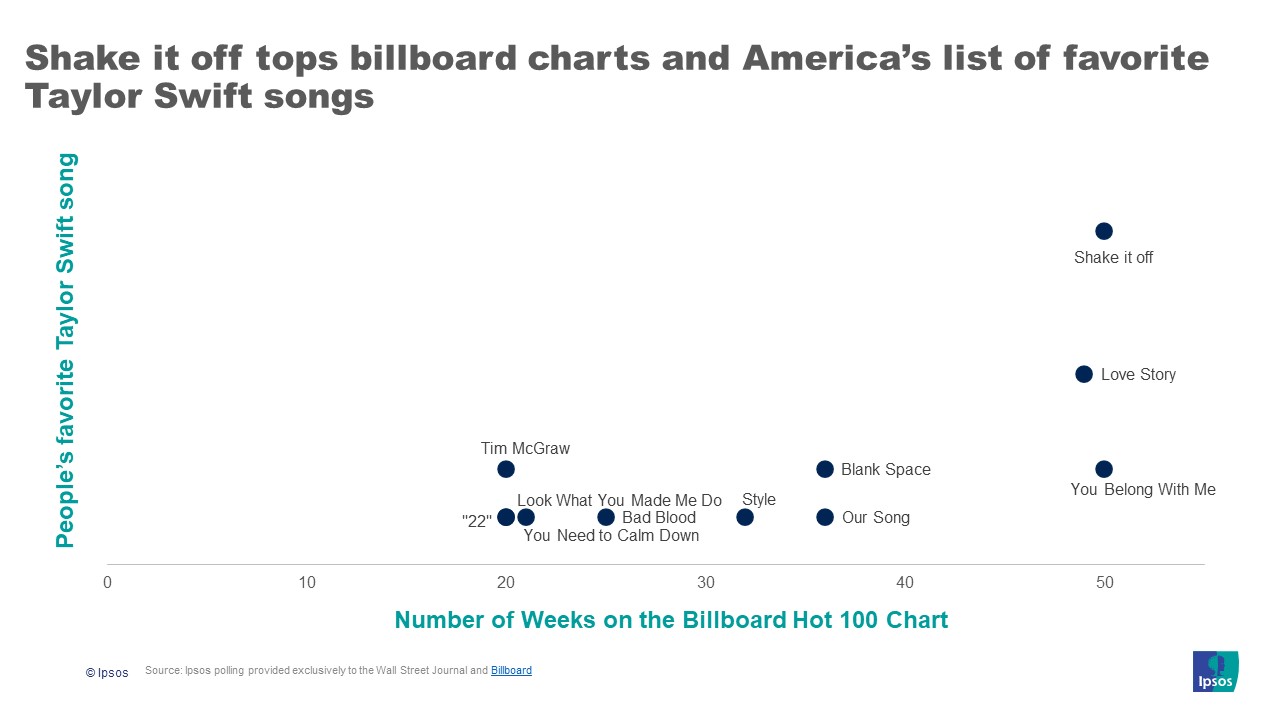
- Won’t shake it off. That generational staying power bodes well for Taylor Swift. Many of her songs spend weeks on the Billboard Hot 100 chart. Unsurprisingly, America’s top two favorite Taylor Swift songs also happen to be the songs that have sat on the Hot 100 chart for the longest stretch of time. The more you listen to it, the more you like it.
Music, and the people who play it, have enormous sway on our culture. They reach more people than many politicians (and political news, for that matter). The influence music has on the public is no big mystery; music binds people together and helps them form their sense of self and community. It brings people together like few things can in our hyper-partisan times.
Those tastes and musical preferences also stay with us, which is to say, Taylor Swift and her fans will likely be with us for a while too!