Shelter in Place: How companies can ease customers’ housing anxiety
One year after COVID-19 descended upon the U.S., many Americans still struggle with questions such as “will my finances get me through this?” and “will I be able to pay my rent or mortgage?”
Nearly 44% of Americans reported negative feelings towards their personal finances in light of COVID-19, according to a recent Ipsos U.S. syndicated community study. Additionally, 1 in 6 (17%) have missed a rent /mortgage payment themselves and/or know someone else who has.
Download our paper featuring verbatims from our social community members highlighting the economic stress Americans feel about housing, the government’s response and opportunities for brands to relieve the situation.
“I wish every business would work with charities to build/refurbish homes for low income families.” – IPSOS COMMUNITY MEMBER
“Some wealthy companies such as Google and Facebook could fund and build affordable housing as part of their charitable contributions.” – IPSOS COMMUNITY MEMBER
SHELTER IN PLACE: HOW COMPANIES CAN EASE CUSTOMERS’ HOUSING ANXIETY
Americans’ worries about missed rent or mortgage payments are an opportunity for companies to step in and build trust.
One year after COVID-19 descended upon the U.S., many Americans still struggle with questions such as “will my finances get me through this?” and “will I be able to pay my rent or mortgage?” Nearly 44% of Americans reported negative feelings towards their personal finances in light of COVID-19, according to a recent Ipsos U.S. syndicated community study.1 Additionally, 1 in 6 (17%) have missed a rent/mortgage payment themselves and/or know someone else who has. Here is a deeper look at the economic stress Americans feel about housing, the govern-ment’s response and opportunities for brands to relieve the situation.
1. PEOPLE EXPECT MORE FROM THE GOVERNMENT; STIMULUS CHECKS TOP OF MIND
Americans are tired of struggling and are expressing their worries on social media. People want help and lasting change from lawmakers. Over the past year, conversations on housing often coincided with heated discussions about stimulus packages —peaking the week of October 5, when former President Donald Trump halted and restarted stimulus talks with Congress.
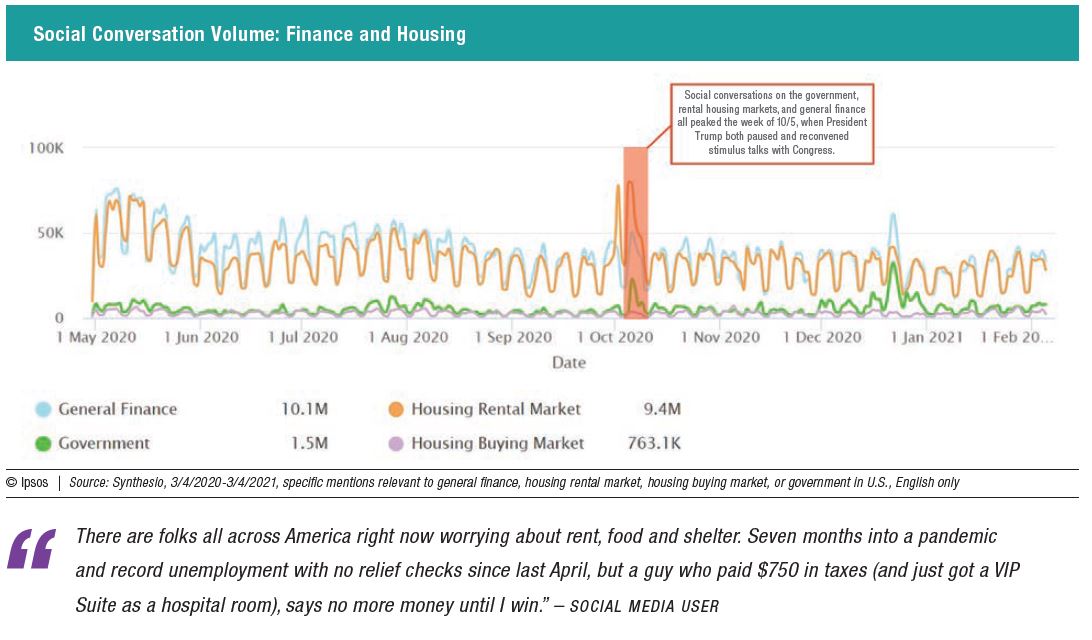
Most people are unaware of or unhappy with how federal and state officials have handled the housing crisis. They appreciate eviction moratoriums and stimulus payments, but feel more needs to be done, especially to offset mounting debt from back rent.
In the short term, Americans want the government to continue eviction moratoriums, freeze mortgage payments for those struggling and provide more stimulus.
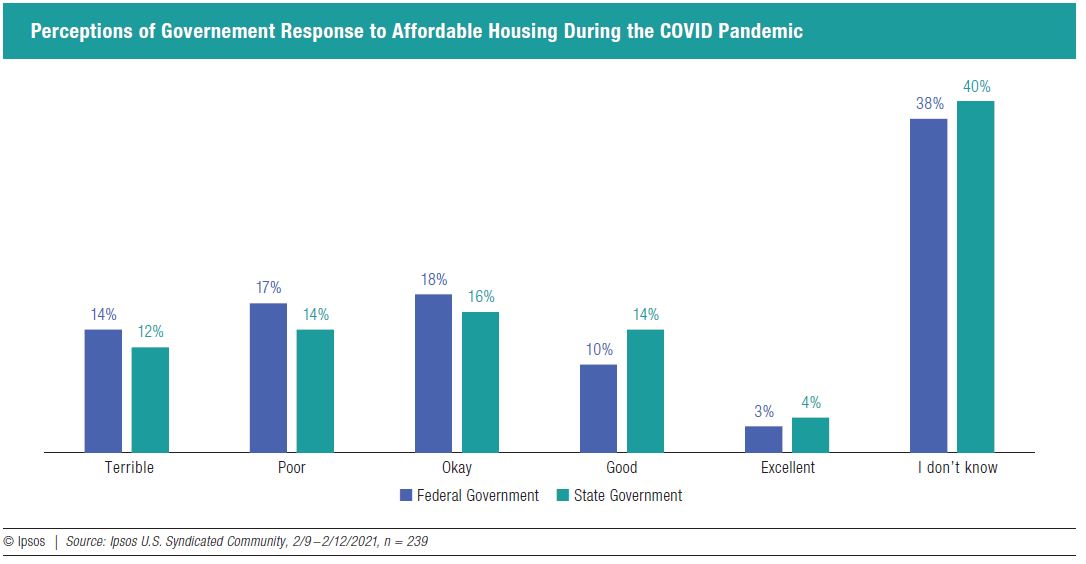
In the long term, Americans want the government to scrap back rent and overdue mortgage payments and incentivize private groups to build more affordable/mixed income housing.
2. PEOPLE PRIORITIZE NEEDS OVER WANTS
Although negative feelings towards personal finances were more pronounced among households earning lower incomes, the vast majority of people (76%) still found affordable housing to be an important issue. Many called out housing as a basic human need, saying no one should have to decide between paying a rent or mortgage and purchasing basic necessities.
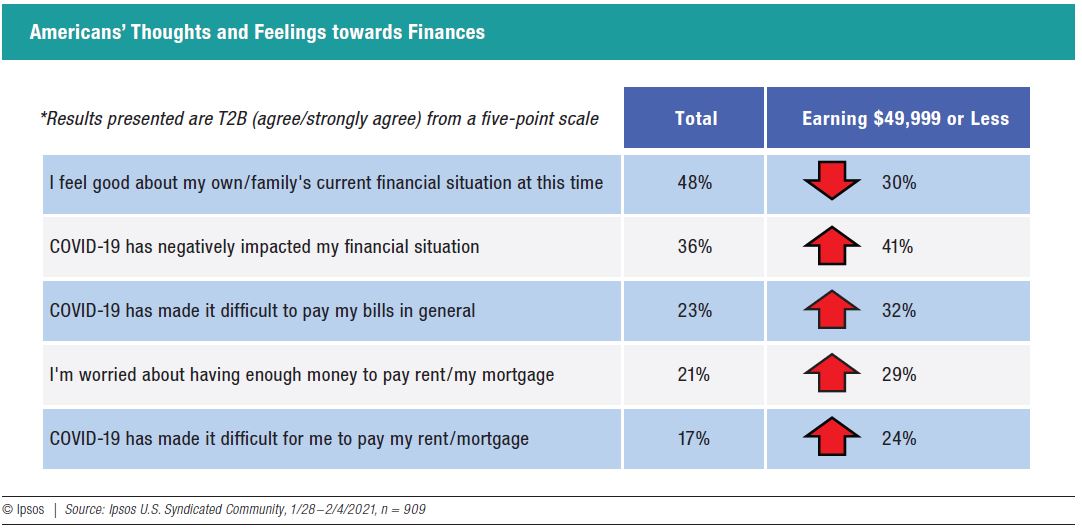
Most people who know someone or have experienced not being able to make a rent/mortgage payment were unable to do so because of a reduction in available work hours—an experience causing heavy stress and embarrassment. But Americans who haven’t missed a payment are also making concessions to keep the lights on — cutting out non-essentials like new clothes, entertainment, dining out and travel.
3. INSTITUTIONS CAN PARTNER, SUPPORT AND EDUCATE
When asked to name brands or financial institutions actively helping with affordable housing challenges, Americans chose large banks like Chase and Bank of America due to their willingness to help those behind on debt. At the same time, many consumers were cynical —recalling the 2007 housing crisis and noting that banks sometimes seem to care more about their shareholders than everyday people. However, many consumers also feel that financial institutions can support and educate the general public in the following ways:
- Provide low-interest loans
- Incentivize builders to construct affordable housing options
- Postpone mortgage payments or forgive overdue mortgage payments
- Provide financial literacy education programs
- Create financial support funds
Americans also long to see financial institutions and brands partner with charities like Habitat for Humanity, putting money towards solving problems and pulling people together in a lasting way.
The fear and anxiety of the present moment are an opportunity for brands to show understanding and leadership. Companies who can take steps to help Americans —whether it’s financial firms providing low-interest loans, builders taking incentives to construct affordable housing, or something else —will not just be providing immediate economic benefits to consumers —they’ll build trust in their brand for the long term.
![[WEBINAR] Here’s how Influential audiences differ across segments](/sites/default/files/styles/list_item_image/public/ct/event/2026-04/thumbnail-templates_1.png?itok=8UDJ-jMz)