
Majority (67%) of global citizens support the closing of their borders as few (33%) believe Covid-19 is contained
A majority of global citizens support border closures in an effort to combat COVID-19, as relatively few believe the coronavirus is contained, according to new Ipsos polling conducted on behalf of the Halifax International Security Forum. The poll of over 21,000 people in 28 countries reveals that most global citizens are supportive of turning more insular in order to fight the virus at home.
Two in three (67%) agree (30% strongly/38% somewhat) that their country should close their borders and not allow anyone in or out until the Coronavirus of COVID-19 is proven to be contained. Those most likely to support the closure of their borders include Malaysia (92%), Australia (83%), Canada (82%), Chile (82%), Peru (81%) and South Africa (78%). Two in three (67%) Americans support the closure of their borders. Some country’s residents (mostly in Europe) are much less likely to agree with the closure of their borders, including those in the Netherlands (44%), Sweden (47%), Germany (50%), Belgium (52%) and Hungary (56%) and Poland (57%).
That support for border closures is so strong is likely a function of the fact that relatively few believe that COVID-19 is contained. Just one in three (33%) global citizens agrees (7% strongly/26% somewhat) that the Coronavirus or COVID-19 outbreak has been contained and will soon be over. Those in Malaysia (71%), Saudi Arabia (69%), India (68%), China (58%) and Russia (52%) are most likely to believe that the virus is largely contained, while those in Great Britain (17%), Spain (18%), Japan (19%), Belgium (20%), Canada (21%), France (21%), Chile (21%) and Australia (21%) are much less likely to believe it has been contained. One quarter (27%) of Americans believe COVID-19 has been contained and will soon be over.
Given the difficult economic issues in their country today, eight in ten (78%) global citizens agrees (33% strongly/45% somewhat) that their country needs to focus less on the world and more at home, up 5 points since last year. Those in Russia (89%, +4), Turkey (88%, +17), Colombia (88%, +2) and South Africa (86%, +4) are most inclined to hold this position, while those in Germany (65%, +4), Sweden (66%, no change), Italy (67%, +2) and the Netherlands (69%, +13) are less likely to believe their country should do this.
New Zealand Gets Tops Marks on COVID-19 Response; US Earns a Failing Grade
Global citizens were asked to assess whether or not certain countries or organizations have shown good leadership in dealing with the COVID-19 pandemic. New Zealand earns top marks from global citizens, with 74% believing that New Zealand has demonstrated good leadership. However, only 22% believe the same can be said about how the United States has dealt with the pandemic. The chart below shows the proportion of citizens who believe that each country/organization tested has shown good leadership.
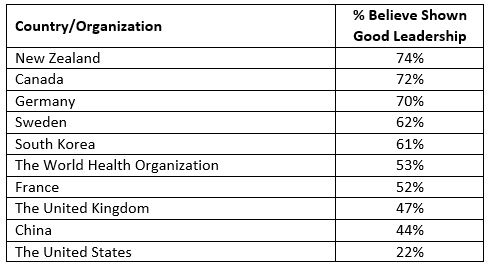 The United States is clearly lagging the field, and even only 39% of Americans believe that the US has shown leadership through its COVID-19 response. The only entity that Americans judge harsher is China (32%), and Americans believe that Canada’s response (84%) has shown the most leadership.
Opinions about the WHO and whether it has shown good leadership in its response to the pandemic are mixed. Those most inclined to believe the WHO has shown leadership include Malaysia (84%), South Africa (72%), Sweden (68%), Mexico (68%) and Brazil (65%). Those least likely to believe the WHO has shown good leadership include Japan (27%), South Korea (28%), Peru (32%), Chile (52%), Poland (52%), Italy (52%) and Spain (52%).


