AI skepticism is still high, and ads could hurt trust even more
The Ipsos Consumer Tracker asks Americans questions about culture, the economy and the forces that shape our lives. Here's one thing we learned this week.
Why we asked: Conversations around AI are interesting these days. Adoption and usage are important, and we have data on that. Barriers are also important, and we have data on that below. AI’s role in floating GDP and the stock market are also important, and there’s plenty of data on that if you Google…
Here’s a thing I think about a lot. I was around for the dawning of the internet era. You might recall there was a bubble. You might recall it burst. If you don’t, you can Google that, too.
But two things happened: The internet came through it all even more important than ever to our lives. And new companies were born from the ashes of the economic ruin some of us had to live through. I digress, but this seemed a good moment to add some data to some trend lines we’ve been building over the modern AI era.
What we found: First, familiarity with AI remains divided between higher familiarity with the younger folks, who are more likely users (either by desire or because it’s being prescribed at work) and lower familiarity with the older generations, who also happen to be the ones more likely to be making decisions about it in their companies. Nearly half of young adults (49% of those aged 18-34) say they are "very familiar" with the concept of AI, compared to just 15% of those aged 55 and older.
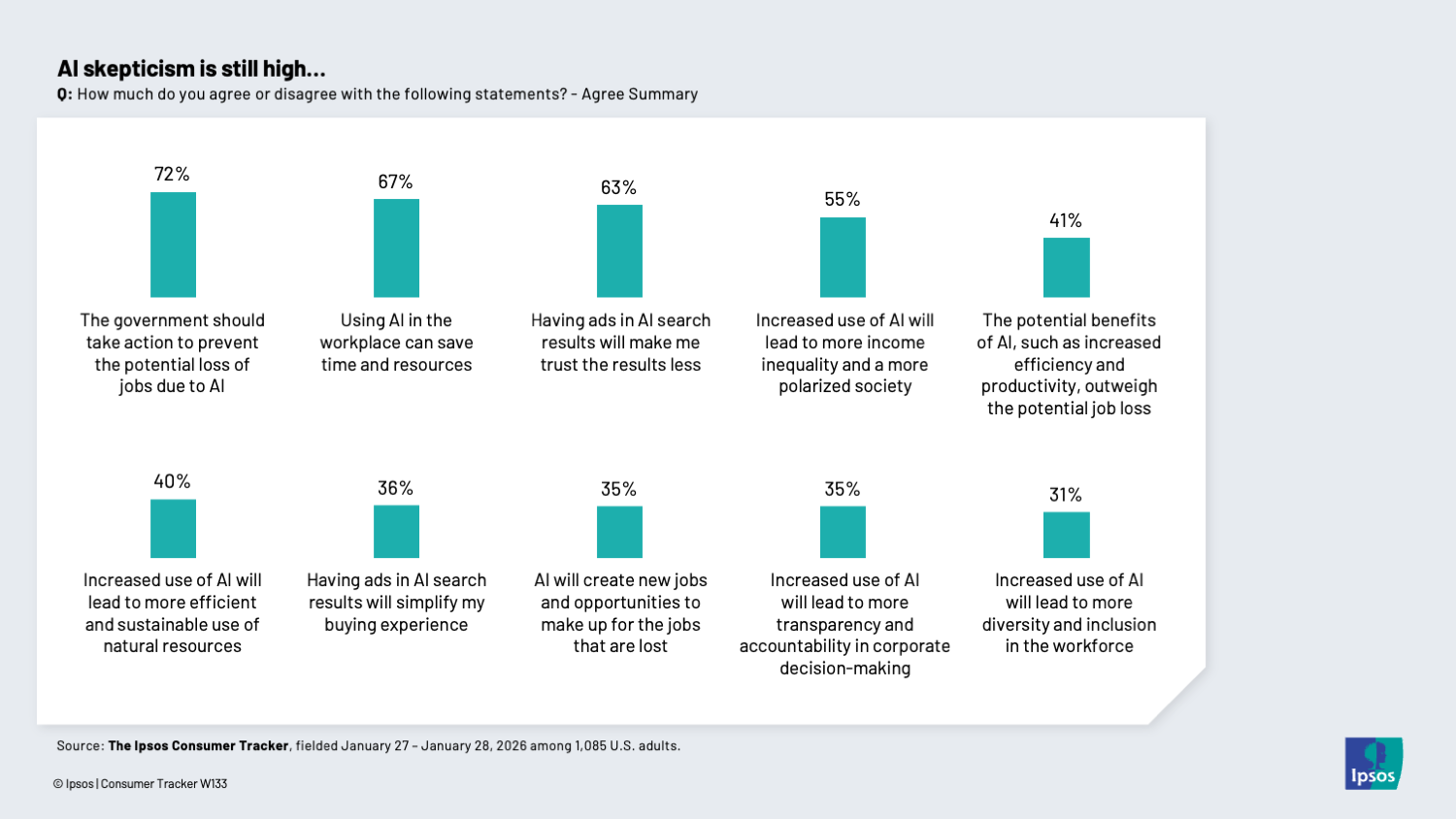
In terms of attitudes, it’s been an oddly long time since we asked this particular battery (August 2023!), but in that time there’s been a big jump (from 55% to 67%) in people who think AI can save time at in the workplace, which jibes with all the headlines about employers urging or forcing AI usage. But it also aligns with our third annual Our Life with AI study Ipsos conducts globally for Google, which shows that people’s top motivation is now research and learning, not more entertainment-focused applications. In other words, AI is moving from a toy to a tool.
That said, skepticism remains. Only four in ten think the potential productivity gains outweigh the potential job loss, and fewer (35%) think more jobs will be created than lost. Almost three in four think the government should take action to prevent job loss from AI.
And, as OpenAI starts turning to sponsored results, putting paid placement in the ChatGPT responses, two in three (63%) think ads will make them trust the results less while just one in three (36%) think it will simplify their shopping experiences.
And now, more than half think increased AI use will lead to more inequality and polarization, up 9 points from when we asked in 2023.
The U.S. has generally been an outlier among other countries in our continued skepticism. Perhaps due to lack of trust, or more saturation in the news of AI leaders saying the technology will take away people’s jobs.
Usage, meanwhile, remains mostly flat since we last asked in September. A little over half have used an AI search and same for chat program. Not surprisingly, the younger cohorts over-index. In a new question, one in four employed folks have used an AI note taker (h/t my teenage son who asked me to ask that).
More insights from this wave of the Ipsos Consumer Tracker:
Lack of need and lack of trust are still barriers for AI adoption
A partisan split has opened in the need for government to play a role in AI regulation
Americans think we’re handy. Here’s why that could be handy
One in three don’t plan to celebrate Valentine’s day
Quality and desire lead in reasons Americans will splurge on a purchase
The Ipsos Vibe Check: Here's how Americans feel about the government this week
The Ipsos Care-o-Meter: What does America know about vs. what does America care about?