
What makes a new product succeed
If an innovation has superior performance, attractive packaging, and adequate marketing support, it should succeed – right? While these are necessary conditions, they are not sufficient. Innovations must first displace the existing solution – and this depends on whether consumers are willing to change from their status quo and switch brands.
The success of your new product depends not just on how good it is but also on how strongly people are attached to their existing solution:
- People stay with an existing solution for different reasons. Persuading consumers to leave their existing solution will require a multitude of strategies
- There are psychological costs to leaving one’s existing solution; help consumers overcome them
- People sometimes stay with an existing solution simply because it’s good enough; that doesn’t mean they are not willing to try something new, but you will need to put your new product into their hands as they are not motivated to seek out alternatives
- Most of us shop like zombies, purchasing what we usually do without much thought. You will need to disrupt that automaticity for people to purchase your new product
- When testing new innovations, have consumers evaluate them in the context of their existing solutions
Read on to learn more about Ipsos’ validation framework, SWITCH.
MOST INNOVATIONS FAIL, EVEN GREAT ONES
We tend to be a rational bunch. We assume, rightfully so, that if an innovation has superior performance, attractive packaging, and adequate marketing support, it should succeed. While these are necessary conditions, they are not sufficient. There is a missing piece in the list of aforementioned factors. For an innovation to succeed, it must first displace the existing solution. Most new products do not fulfill a completely new need. In most cases, there are products either in the same or other product categories that are already meeting consumers’ needs. Only 5% of new product concepts in Ipsos’ global concept testing database are breakthrough ideas.
To unseat an incumbent is no easy feat. Much of our behavior is repetitive. Our weekly and weekend routines follow predictable patterns: we consume the same food and beverages weekly, we buy the same products repeatedly without much conscious awareness. Many terms such as “status quo bias”, “consumer inertia” and “habits” have been used to describe our predisposition towards repetitive behavior. While these terms have slightly different meanings, they all share the common theme that change is difficult. This resistance to change is independent of a new product’s qualities. Even if your new product is superior, people may not buy your new product because of this tendency to stick with the status quo.
In other words, it’s not only about the innovation. It’s also about whether consumers are willing to change from the status quo. For a new product to succeed, it needs to first unseat the incumbent, the existing product. In this paper, we share a framework that captures the forces that contribute to this resistance to change. We also make recommendations on how to overcome them.
INTRODUCING THE SWITCH FRAMEWORK
The research on why change is difficult has been abundant but diverse. At Ipsos, we unify these different areas of research by summarizing key concepts within a single framework: SWITCH. The name reflects the need for consumers to switch away from an existing product before adopting a new one. Although our focus in this paper is on how consumers’ resistance to change impacts new product adoption, the framework applies to brand switching as well. Switching brands often means switching to a new brand. The dynamics of adopting a new product and switching brands overlap considerably.
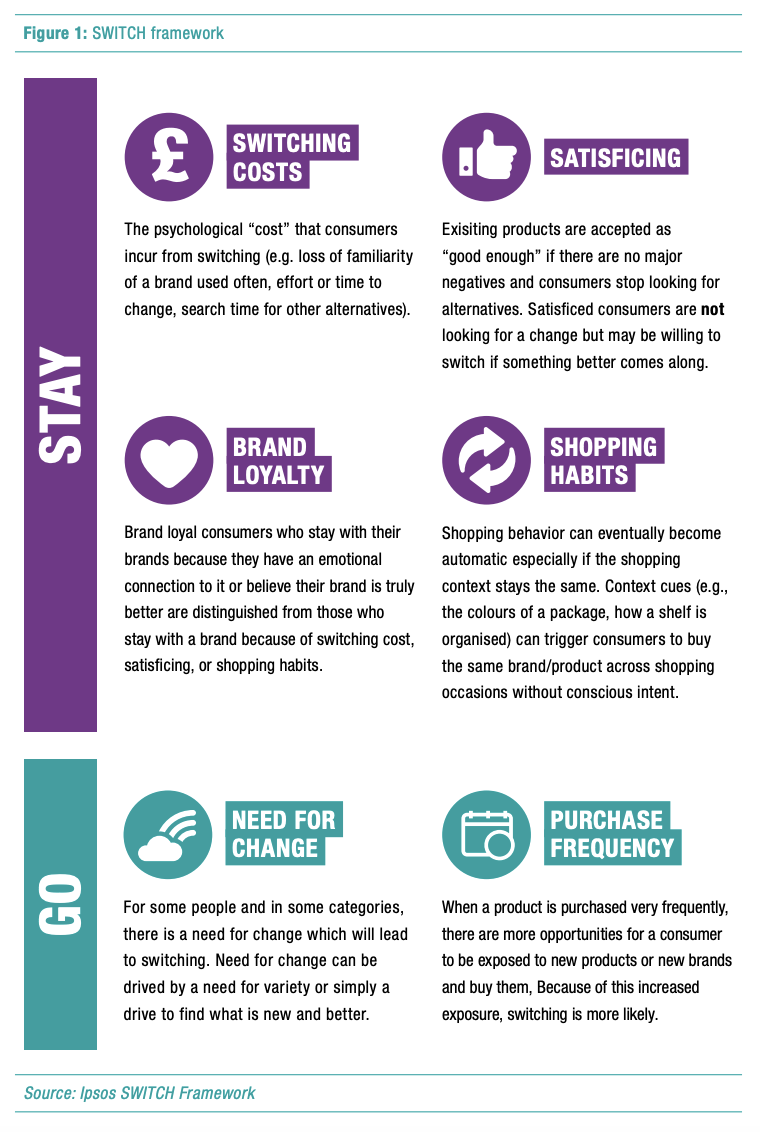
There are two sets of opposing forces in our framework (see Figure 1). One compels consumers to remain loyal to their existing products (stay), and the other pushes consumers away from the status quo (go). While our focus is on the forces that keep people with the status quo, our framework would be incomplete if we did not also include forces that pull consumers away from the status quo. While the latter may not be as pervasive, marketers can use them to counter the status quo.
THE FOUR CONSUMER DRIVERS OF STAY
1. SWITCHING HAS A COST: CHANGE IS UNCOMFORTABLE
Put simply, there is a psychological cost, real or anticipated, that comes with change. Past negative experiences from trying new products, unfamiliarity with new products, lack of time to investigate new products, effort to learn about a new product, and losing the comfort of a wellused product are all psychologically negative and can have a strong impact on our behavior.
Thankfully, once switching costs have been identified, they can often be addressed through marketing actions. As an example, if consumers perceive a risk in trying a new product, this could be addressed with an unconditional money back guarantee, or with a third-party endorsement that provides quality reassurance.
2. SATISFICING – IT’S GOOD ENOUGH!
People choose, and stay, with products if they exceed an acceptable threshold of satisfaction for them. That is, people use products if they are “good enough”. Consumers satisfice because it is a practical way to make decisions. In a world where there is too much information to process and not enough time to think through it all, satisficing is one way we can go about our lives without going crazy. Most of us cannot evaluate every possible option available and then choose the one with the maximum value. We can, however, quickly and easily determine if something is good enough.
Introducing a new product to consumers who believe that their existing product is good enough will have very little impact as the new product will simply be ignored.
To get satisficed consumers to try a new product, you must put the new product in their hands. One effective way to do this is by giving out free trial samples (e.g., in-store, mailed to consumer). If the new product delivers a superior experience, all else equal, the consumer will adopt it. Someone who is satisficing is not closed to new products. Consumers who are satisficed are simply not motivated enough to explore new options. Trial or sample products are critical for converting “satisficers” to new products.
3. BRAND LOYALTY – I LOVE WHAT I HAVE!
Among the forces that lead people to stay with the status quo, brand loyalty has been the most studied and requires the least explanation. Basically, brand loyalty is the term used to describe consumers who repeatedly buy the same brand or product because they believe the brand is superior and/or because of an emotional connection.8 Because of the underlying motivations, brand loyalty may be the most difficult to overcome. We include brand loyalty in our framework to distinguish it from other forces that may be more easily overcome with marketing efforts.
4. SHOPPING HABITS - AUTOMATIC OVERRIDES
When we shop at the same location, our purchase behavior becomes habitual over time. Once developed, habits are largely unconscious and triggered by contextual elements. When purchases are habitual, new products are ignored at shelf. Even if consumers develop favorable impressions of a new product from advertising, the automaticity of their purchase behavior may override any attention given to or interest in a new product.
There are actions that can lessen this impact. In this case, the key is to disrupt the habitual purchase behavior. Breaking a habit requires disrupting the cues that trigger it. In the context of new product launches, this could be done with highly visible new product packaging or point-of-sale display that changes the visual landscape and interrupts the habitual purchase routine. In Dancing with Duality: Achieving brand growth in a mindful and mindless world, we explored how decision-making is dynamic and contextual, adapting in accordance with what is going on within us and around us – our internal and external context.
THE TWO FORCES OF GO
1. A NEED FOR CHANGE – VARIETY OR BETTER SOLUTIONS
Research defines the need for change as the extent to which people view novelty and innovation as intrinsically valuable. This construct is operationalized by measuring how much people feel a need for variety and how much they seek out new products for information or out of curiosity. In some product categories (e.g., food), the need for change may be driven primarily by variety seeking tendencies. In other categories (e.g., analgesic), a need for change may be driven by consumers who are on the lookout for a more effective solution or simply out of curiosity.
2. PURCHASE FREQUENCY – EXPOSURE TO THE NEW PRODUCT
One of the basic tenets of new product forecasting is that awareness is necessary for trial. That is, trial can occur only when people are aware of the new product. In addition to marketing support (e.g., media spending), one factor that determines whether a person is likely to be aware of a new product is how often the person is in the market to purchase the category.
In general, consumers who are in the market more frequently to purchase the category are more likely to be exposed to the new product at the shelf, and hence more likely to purchase it. Identifying who higher frequency shoppers are can allow for more efficient targeting when it comes to launching new products.
SWITCH IS A UNIVERSAL FRAMEWORK, BUT EACH NEW PRODUCT HAS ITS OWN SPECIFIC POSITIVES AND NEGATIVES
SWITCH was developed to capture the broad forces that explain why people would stay with or leave their existing product, regardless of the new product under consideration. SWITCH does not address the specific forces a new product may have on people’s decision to stay or leave their existing solution (i.e., the benefits offered, the price of the new product). The forces that a particular new product has on purchase are clearly important and are addressed by concept testing.
A VALIDATED FRAMEWORK
To test and validate our framework, we designed a set of statements to capture each of the forces in the framework and then fielded them to 4,500 respondents in three countries (US, UK, and Poland) for three product categories (Analgesic, Beer, Laundry). In our survey, we also included a question to measure whether consumers had tried a new product or switched brand recently. This served as a metric against which we could test our statements to see how well they predicted recent switching.
From the data, we built a predictive model that provided the predicted probabilities of switching for each respondent in the study. This predicted probability is used to illustrate our findings. Given the large scope of this research project, we present only the key findings.
VALIDATION
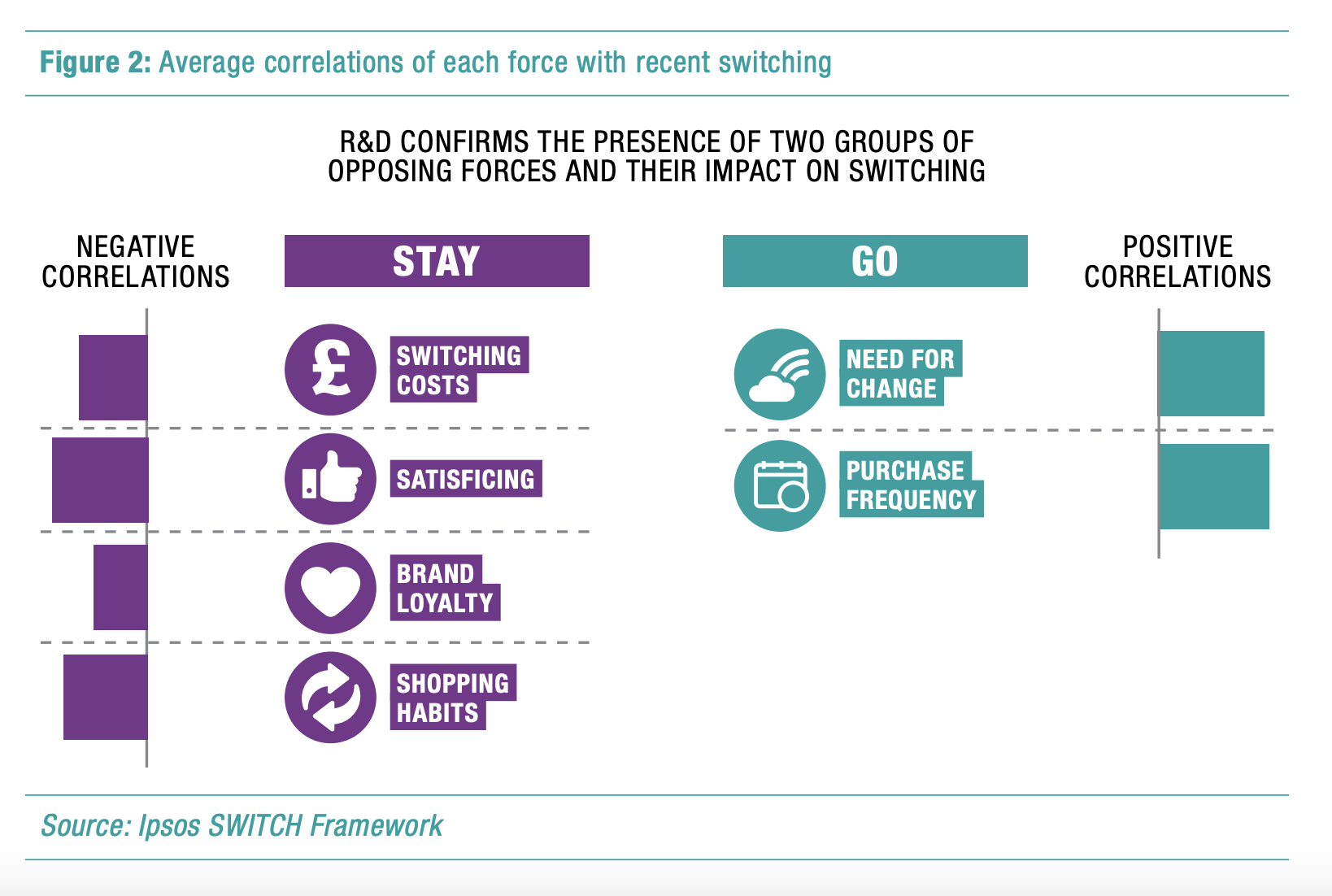
The findings confirmed the presence of two groups of opposing forces (Stay and Go) and their impact on switching. Across all three countries and categories tested, each of the forces were significantly correlated with recent switching and in the expected direction (see Figure 2).
BRAND LOYALTY IS NOT THE BIGGEST BARRIER TO NEW PRODUCT ADOPTION
Our findings showed that although brand loyalty is significantly correlated with switching, it is the smallest force among all the stay factors. This underscores the importance of capturing the other forces such as the cost of switching, satisficing, and shopping habits to fully understand switching. Consumers seem more likely to stay with a product because they are comfortable with it, because it is good enough (not necessarily better) or out of habit, rather than because they are brand loyal. This means that generating new product trial is not just about offering superior benefits: we need to overcome the comfort people have with their brands and convince them that they can, for example, do better than “good enough”.
A DEEPER DIVE INTO THE UNCONSCIOUSNESS OF SHOPPING HABITS
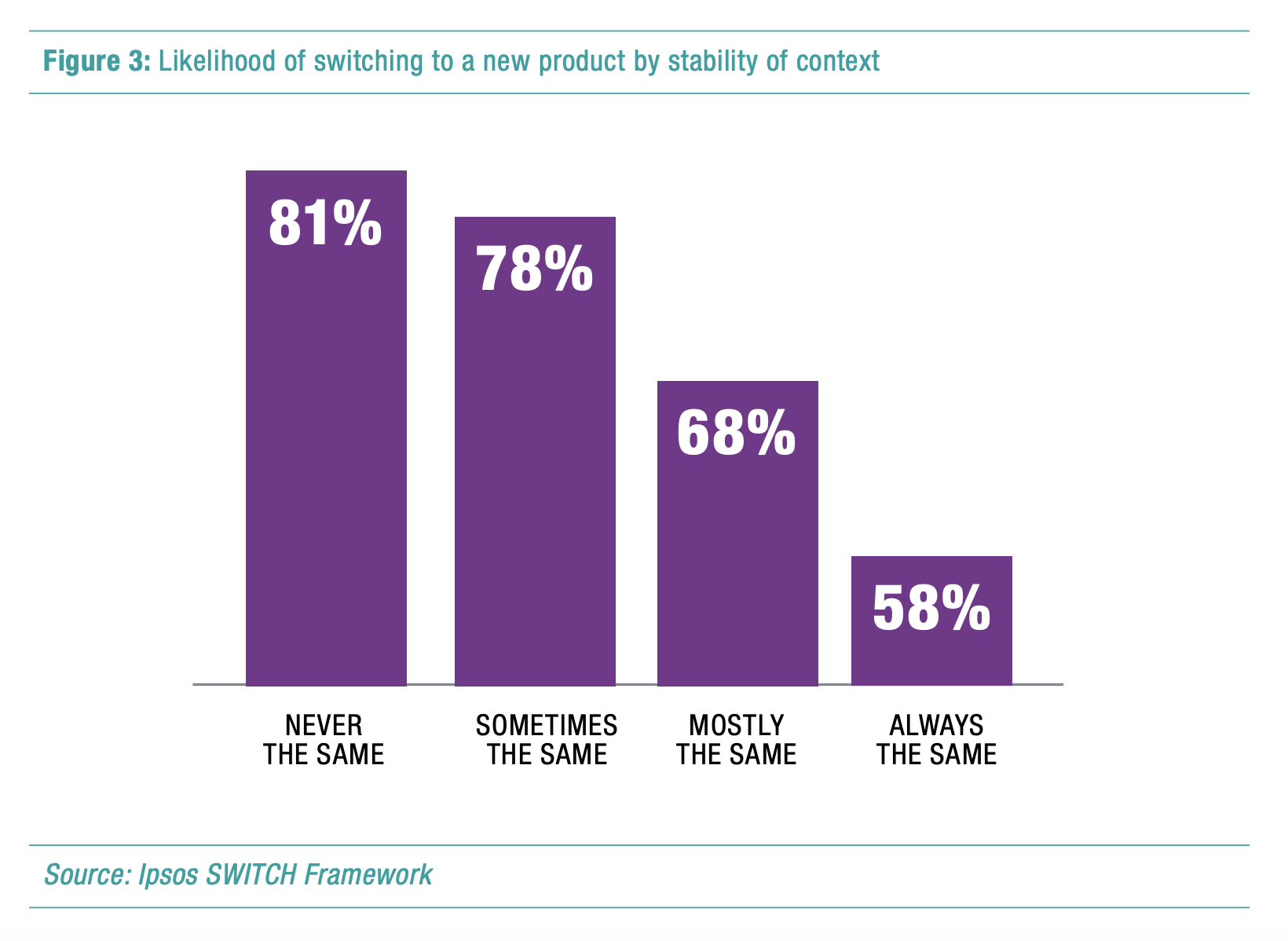
To illustrate the powerful insights our framework brings, we share the detailed findings for one component: shopping habits. To briefly recap, when we shop at the same location, our purchase behavior becomes habitual over time. When purchases are habitual, new products tend to be ignored at shelf. We captured habitual purchases by asking consumers to indicate the constancy of the location where they purchase a product. Our hypothesis was that shoppers who bought their product at the same location all the time were more likely to have strong habits, and hence less likely to purchase new products.
This turned out to be the case as those who shopped at the same location all the time were less likely to have tried a new product. In contrast, shoppers who buy their products in different locations were much more likely to have purchased a new product (see Figure 3).
DETERMINING WHO IS MOST LIKELY TO SWITCH, AND WHY
Once we predicted the probabilities of switching for each survey respondent, we profiled respondents to identify the consumers who were most open to switching and the reasons why. Using the findings from the US Analgesic category, for example, we found that consumers most likely to switch were more likely to report toothache, back or menstrual pain. Consumers who reported headache pain were not more likely to switch. Consumers with more specific and often acute or chronic pain like toothache or back pain may have unmet needs as the major players in this category cater more to headache, pain caused by muscle aches or fever.
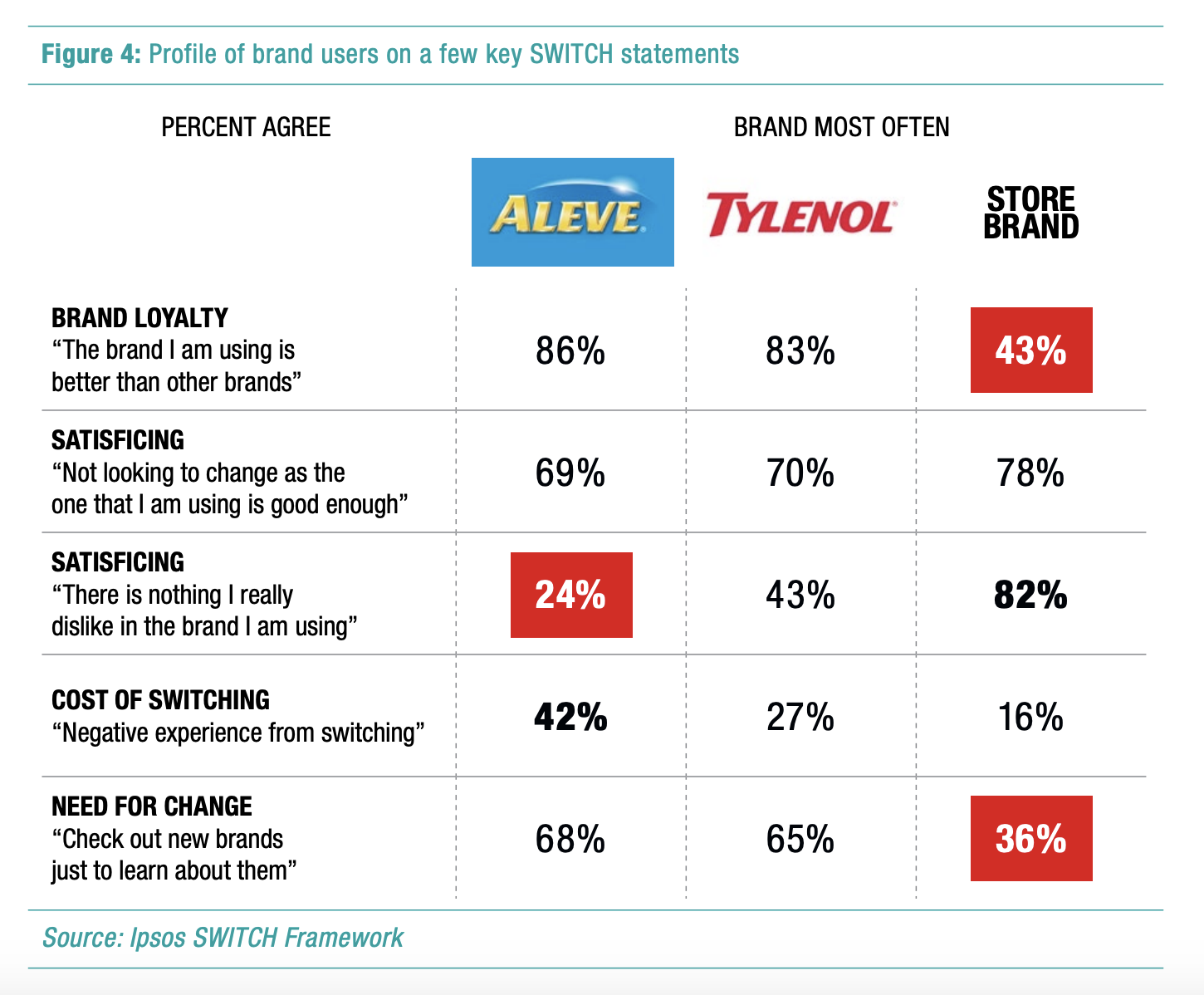
A detailed look at brand users on a few of the SWITCH statements helps us understand why and what it would take for a new product to attract buyers from other brands (see Figure 4). For the Aleve brand, almost half of the users indicated they had a negative experience from switching brands. To source volume from Aleve, a new product would need to provide reassurance that a negative experience will not occur. Store brand users, in contrast, are satisficers; they feel that what they are using is good enough and that there isn’t anything they dislike in the store brand. As a result, store brand users are unlikely to check out new brands. This does not mean that store brand users are closed off to new products. A new product can still source from store brands if it offers more benefits than that of the store brand and the price gap between the new product and store brand is within an acceptable range. Basically, the new product value needs to be optimized (benefit price trade-off).
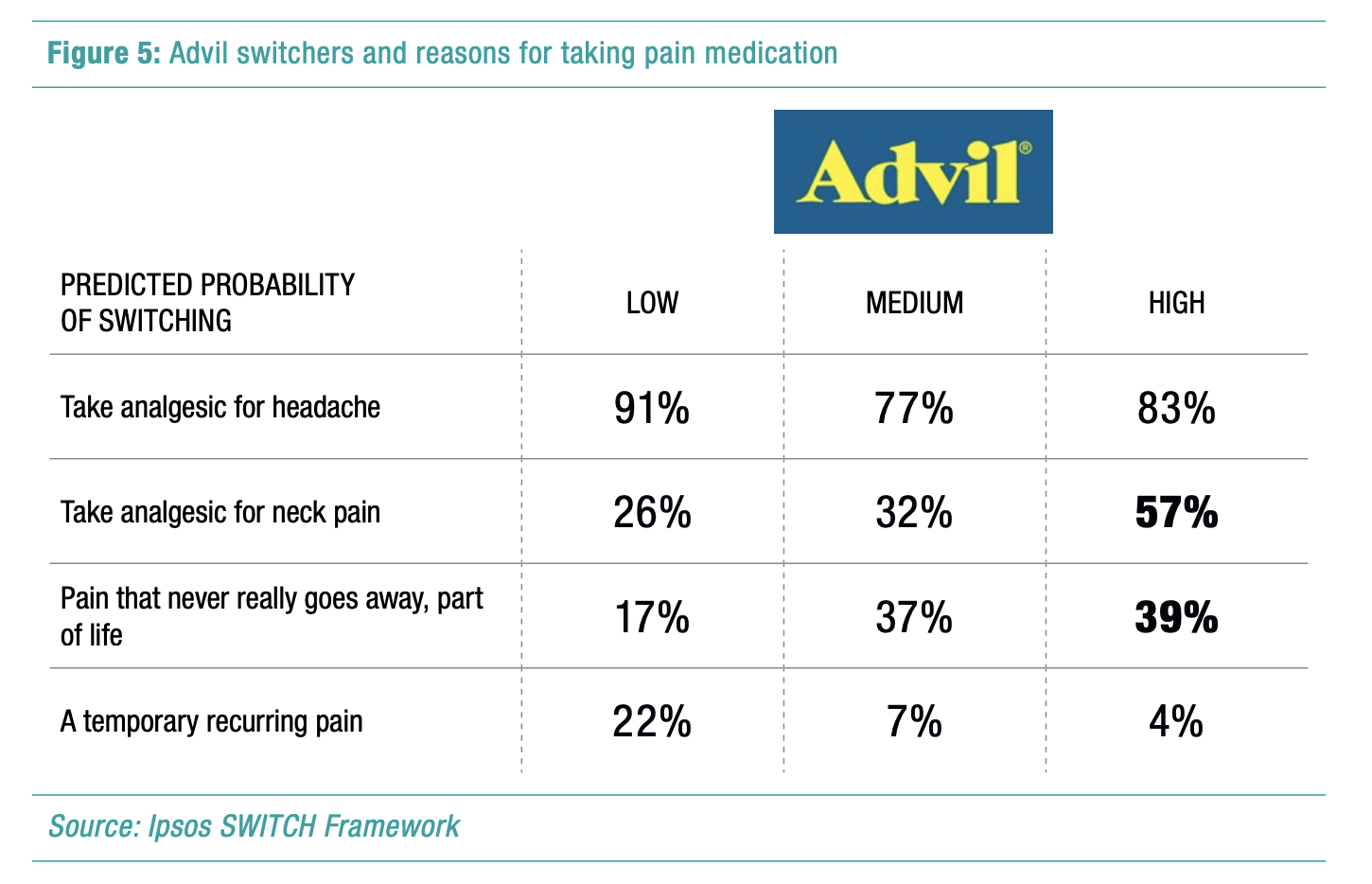
To understand how to source volume from a particular brand, we can look at the people most likely to switch within a brand. For example, if we look at high switchers within Advil (Figure 5), we see that these consumers are more likely to take pain medication for neck pain, have pain that never really goes away, and that is part of their life. Clearly, there is an unmet need for these consumers, and this explains their higher likelihood to switch. Repeating this exercise for the key brands in a category can provide insights into the unmet needs for a category and help guide new product development.
WHAT THIS MEANS FOR CONCEPT TESTING
Consumers make decisions about new products relative to what they have today. Because of this, our view is that new products should always be evaluated in the context of what consumers are using today.
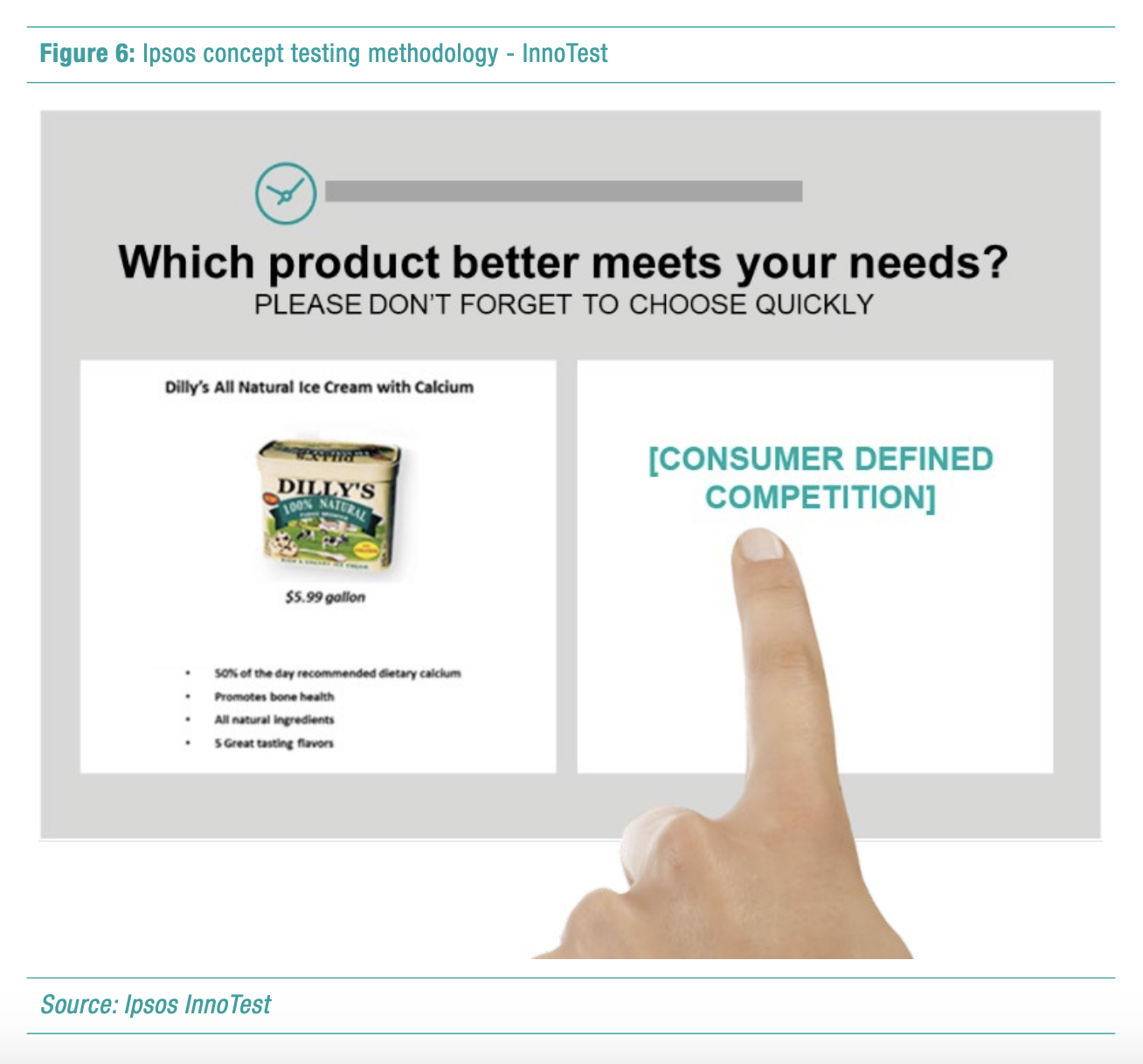
At Ipsos, we test innovations by benchmarking them against real in-market products, defined by each consumer. This is done by having consumers first define their current solution (e.g., most often purchased product) and then after consumers have been exposed to the innovation, presenting the innovation together with their current solution as a choice exercise (see Figure 6). In this comparative context, consumers are forced to evaluate the reality of whether they would really choose a new product versus what they use today, just as in real life. By comparing an innovation to each respondent’s competitive product on Ipsos’s key metrics, we can more accurately benchmark the innovation’s performance.
There are specific forces that a new product could trigger that cause a consumer to stay with their existing product or to try the new. For example, if a new product is expensive, it would cause consumers to stay with their existing product. In contrast, if a new product has very attractive benefits, they would cause consumers to go to the new product. Because of this, we have a similar framework within our concept testing approach where we address the specific forces that a new product may generate that cause people to stay or leave the status quo.
The SWITCH framework allows a marketer to understand the overarching forces that maintain or disrupts the status quo regardless of the new offering, while our concept testing approach allows a marketer to zoom in on the specific forces a particular new product generates. Both are important.
COMPLETE THE STORY – VIEWING THE STATUS QUO BIAS AS THE ANTAGONIST
In storytelling, there is always a protagonist (the main character) and a character that works against the protagonist’s goals and creates conflict - the antagonist. Our goal was to convince you that current innovation stories consider the new product as the protagonist but ignores the primary antagonist - the incumbent and the forces that keep it where it is.
The success of a new product depends not only on the the product itself but also on how strongly people cling to the incumbent. All too often, consumers fail to buy products even when doing so would yield a better outcome. We have endeavored to show that the reasons for rejection of a new product may lie less in the new products themselves and more in the minds of people. There is a need to understand, anticipate, and respond to the psychological forces that cause consumers to stay with the status quo. Failure to do so may result with the story ending with an unsuccessful innovation.
The success of your new product depends not just on how good it is but also on how strongly people are attached to their existing solution:
- People stay with an existing solution for different reasons. Persuading consumers to leave their existing solution will require a multitude of strategies
- There are psychological costs to leaving one’s existing solution; help consumers overcome them
- People sometimes stay with an existing solution simply because it’s good enough; that doesn’t mean they are not willing to try something new, but you will need to put your new product into their hands as they are not motivated to seek out alternatives
- Most of us shop like zombies, purchasing what we usually do without much thought. You will need to disrupt that automaticity for people to purchase your new product
- When testing new innovations, have consumers evaluate them in the context of their existing solutions


