The Iran Conflict
Concern about armed conflict tends to track with geographic proximity. The closer people are to a war, the more worried they tend to be. We see this in Europe, where the countries closest to Ukraine are consistently the most concerned about what’s happening there.
This war could be different. The main effect may not be driven primarily by casualties, humanitarian concerns, or military escalation. Instead, the impact may come through the economy and people’s everyday experience of it. Even those far from the conflict will be pulled into it if these economic effects begin to affect their daily lives.
In some ways the pattern resembles what happened with COVID. That crisis began as a health issue but quickly became something people experienced personally as it disrupted both the economy and everyday lives. This conflict may follow a similar path as its effects feed into household budgets and consumer behaviour.
Here we share the latest Ipsos research from around the world. We hope it can serve as a useful guide to where public sentiment is right now - and where it may be heading.
The Global view ...
28 April 2026: On average across 31 countries, 81% think their country should avoid getting involved in the Iran war, with 48% strongly agreeing their country should stay out of the conflict. 33% think the war will last until 2027 or beyond. 31% think it will end by the end of the year, 26% within the next three months and 10% within the next month. The proportion of respondents who think the U.S. will have a positive impact on the world has fallen while a grater proportion think China (50%) will have a positive impact on the world than the U.S. (39%) over the next decade.
The Asia Pacific view ...
6 May 2026: Ipsos’ latest research and analysis from the Asia Pacific markets show how the Iran conflict is sending shockwaves across Asia Pacific. This has implications for economic stability, energy security, consumer confidence, and geopolitical perceptions. The impact varies by market, but the regional story is clear: Asia Pacific is absorbing the conflict (for now) through energy costs, inflation anxiety and weakening consumer confidence.
View the Understanding Asia newsletter
The view from here ...

CEO, Ipsos in Türkiye

Public Affairs Service Line Leader, Ipsos in Italy

Executive Insights and Sustainability lead, Ipsos in Canada
The view from ...
🇺🇸 United States 🇧🇷 Brazil 🇨🇦 Canada 🇫🇷 France 🇮🇳 India
🇮🇹 Italy 🇯🇵 Japan 🇱🇧 Lebanon 🇳🇱 Netherlands 🇪🇸 Spain
🇹🇷 Türkiye 🇬🇧 United Kingdom
United States: Presidential Approval Latest
15 June 2026: The latest Reuters/Ipsos poll, conducted 3-8 June, is out now. It finds President Trump’s approval rating, currently 35%, at a near-record low. Fewer (29%) approve of the way he is handling Iran, while the proportion positive about his management of “your cost of living” is lower still, at 22%. When asked to consider both the costs and benefits to the U.S., 25% of Americans say it has been worth it; 53% say it hasn’t.
United States: Slightly over half say that it has not been worth the U.S. taking military action in Iran
19 May 2026: When it comes to the war in Iran, views of Americans towards the conflict continue to tilt negative: 52% say that it has not been worth the U.S. taking military action in Iran, compared to 23% who say it has been worth it. These views are similar to those measured in previous Reuters/Ipsos polling in April.
United States: Two-thirds say rising gas prices have affected their household finances
11 May 2026: A new Reuters/Ipsos poll conducted May 8-11 finds that 64% of Americans say that recent increases in gas prices have affected their household’s financial situation, with a large majority (83%) expecting gas prices to continue to rise in the next month.With gas prices approaching all-time highs, 86% of Americans say the conflict with Iran bears a great deal or fair amount of responsibility for the recent rise in prices. Three-quarters say the Trump administration is responsible, while 73% say the same about oil and gas companies.
United States: Many Americans are skeptical that U.S. military action in Iran has been worth it
13 April 2026: An Ipsos poll conducted April 10-12 finds that support for U.S. military action in Iran remains limited. Just 24% say that, considering both the costs and the benefits, the decision to take military action in Iran has been worth it. A larger share (51%) say it has not been worth it, while 22% are unsure. As the U.S. moves to blockade the Strait of Hormuz and restrict Iranian oil tanker traffic, 54% say U.S. military action in Iran has had a mostly negative impact on their personal financial situation.
United States: Small business sentiment declines as concerns about inflation rise
7 April 2026: Compared to last quarter, significantly fewer small businesses report planning to increase their staff or investment in the next year. This comes as concerns about inflation have risen, with a majority now saying it is the biggest challenge facing small business owners. Notably, the share who are very comfortable with their cash flow has declined significantly over the past two quarters.
United States: Majority of Americans favor exit from Iran conflict, even if not all U.S. goals are achieved
31 March 2026: An Ipsos poll conducted March 27-29 finds Americans prefer an expedited end to U.S. military action in Iran, even if it comes with tradeoffs. Overall, 66% say the U.S. should work to end its involvement in the conflict quickly, even if it means we do not achieve all of our goals in Iran. Far fewer (27%) take the view that the U.S. should work to achieve all of its goals in Iran, even if it means the conflict continues for an extended period of time.
United States: Support for U.S. troop deployment is limited
20 March 2026: Just 7% would support deploying a large number of ground troops to Iran for a large-scale ground operation; a higher share (34%) would support the deployment of a small number of special forces for targeted operations. A majority of Americans (55%) say they would not support the U.S. deploying any troops inside Iran. The survey also finds that Americans continue to be keenly aware of the impact the conflict is having on gas prices. Nearly nine-in-ten (87%) expect gas prices to continue to rise in the next month and a majority report that rising gas prices have impacted their households’ finances.
United States: U.S. military action in Iran remains unpopular as 53% expect negative personal financial impacts
16 March 2026: An Ipsos poll conducted March 13–15 finds Americans continue to hold negative views of U.S. military strikes against Iran, with disapproval of the strikes significantly outweighing approval. Americans’ concerns about the U.S. military engagement range from risks to American service members’ lives to the conflict’s impact on Americans’ personal finances.Overall, 58% say they disapprove of U.S. military strikes against Iran, compared with 38% who say they approve. This negative balance of opinion is broadly consistent with previous Ipsos and Reuters/Ipsos surveys.
Brazil: 9 out of 10 Brazilians see the impact of the conflict between the United States, Israel and Iran on the country's economy
23 April 2026: An Ipsos poll conducted April 8-12 reveals concerns about the economic effects of the conflict between the United States, Israel, and Iran. The vast majority (90%) of Brazilians believe that the country’s economy as a whole will be affected: 65% say it will be greatly affected, and 25% say it will be somewhat affected. Those who believe it will not affect the Brazilian economy account for 6%, and those who do not know how to respond make up 5%. The perception of the impact on the economy in general is consistent across sociodemographic segments.
Canada: 6 in 10 Canadians disapprove of US military strike against Iran
13 March 2026: Ipsos polling for Global News reveals Canadian disapproval (61%) of the US military action against Iran, with 42% strongly disapproving. Only one in four (23%) approve (8% strongly/15% somewhat), while 16% are unsure either way. Concerns about potential Canadian involvement are high, with 66% expressing fear that Canada will be pulled into this war and the lives of our soldiers will be at risk. Notably, just 32% think the war in Iran will be over in a couple of months, with more (41%) disagreeing and a substantial portion (28%) who aren't sure either way.

France: Marked increase in proportion of French people concerned about consequences of Iran conflict on rising fuel prices and inflation
13 April 2026: In the latest poll by Ipsos bva fielded 8-9 April, we see a marked increase in the proportion of French people who say they are very worried about the consequences of the conflict in Iran on rising fuel prices (up 8 points over the month, to 53%) and on rising inflation (+5 points, to 49%). In contrast, the proportion of French people very worried about the conflict extending beyond the Middle East (32%) or direct French involvement (31%) is down compared to mid-March (respectively -2 and -4 points).
In the face of this concern about rising fuel prices, a majority of French (68%) want measures implemented to limit fuel price increases. The French still overwhelmingly disapprove of the recent actions of Iran (83%, +2 points on last month), but also of Israel (75%, +7 points) and the United States (74%, +11 points). In contrast, only 41% (-3 points) disapprove of France's actions. The French appear unconvinced about the permanence of the ceasefire announced on Tuesday 7th April by Donald Trump, with only 17% believing it will last compared to 83% who think it will not.
France: A small majority of French people approve of the actions carried out by France since the beginning of the conflict
13 March 2026: Ipsos bva and its partner CESI Engineering School have recently revealed the results of a new survey “The French and the conflict in Iran”. Faced with the conflict in Iran, a majority of French fear an increase in inflation (88%) and fuel prices (86%). While the action of France since the beginning of the conflict is approved by a small majority of French people (53%), French opinion is evenly split when it comes to attitudes to deploying the aircraft carrier Charles de Gaulle: 49% support such a move, while 50% oppose. The survey finds 79% expressing a fear that the conflict will spread spread beyond the Middle East.

India: Consumers turn cautious amid economic uncertainty: Ipsos Consumer Pulse
13 May 2026: Rising geopolitical tensions in the Middle East and increasing crude oil prices are beginning to reshape consumer behaviour in India. The latest Ipsos India Consumer Pulse survey reveals that Indian households are becoming more cautious with spending, stocking up on essentials and increasingly turning toward value-driven and fuel-efficient choices. With uncertainty continuing around the Strait of Hormuz and the ongoing US-Iran conflict, consumers are preparing for sustained inflationary pressure in the months ahead. According to the survey, nearly 9 in 10 consumers say they are likely to cut back on expenses if prices continue to rise.
India: Indians track West Asia conflict closely; deep concern spurs spending cutbacks
7 April 2026: 80% are actively following developments and nine in ten expect prices to rise. Two in three say they are stocking up on essentials. Suresh Ramalingam, CEO of Ipsos in India says: “While India has taken steps to diversify energy sourcing, a prolonged conflict could continue to exert pressure through rising input costs. In this context, it becomes important for brands to stay aligned to consumer expectations and respond with relevance and responsibility.”
Italy: Criticism of the war
16 May 2026: A comprehensive digest of Italians’ attitudes to the war, including their hopes and fears, reveals that 69% describe it as “bad news” and 78% say it makes them worried, while just 9% are positive about the way President Trump has handled things.
Italy: A majority of Italian citizens say they are concerned about the escalation of the Iran war
9 March 2026: 35% of Italians fear an escalation of the conflict, followed by concerns over the economic consequences (21%); the risk of terrorist attacks in Europe (19%); and humanitarian consequences (15%).
Japan: Painful prices, worrying taxes
3 June 2026: Our latest Decoding Japanese Public Opinion and Politics through Data release notes that inflation is the most important issue (mentioned by 34%), followed by poverty & social inequality (31%) and taxation (31%). Concerns over military conflict between nations (now at 23%) fell by 6 points from the previous month, in the wake of the fragile pause to the war. It notes that, while the immediate panic may have passed, the instability in the Middle East and the potential anxiety over high crude oil prices and energy supply risks remain deeply rooted in the hearts of the Japanese people.
Lebanon: Public evaluations of the Lebanese government’s management of the war are largely negative
26 May 2026: Public evaluations of the Lebanese government’s management of the war are largely negative, with most respondents expressing dissatisfaction. Dissatisfaction is strongest in predominantly Shia-dominated districts, while Druze-dominated and mixed districts show relatively more balanced views. Confidence in the government’s ability to secure a ceasefire remains very low, reflecting a broader credibility gap across communities.
Netherlands: On balance, Dutch are critical of attacks on Iran
12 March 2026: Public opinion in the Netherlands tends to be critical of the US and Israeli strikes on Iran. Four in ten (39%) consider the attacks a bad thing, compared with 21% who view them positively. A significant share remains neutral (25%) or undecided (15%). Political preferences play a clear role: support for the attacks is higher among voters of right-wing conservative parties (especially SGP, JA21 and PVV), while voters of left-leaning and progressive parties (GL-PvdA, PvdD, SP, D66) are more likely to oppose the attacks.
Q: Do you think it is a good or a bad thing that the US and Israel have carried out attacks in Iran?

Spain: Broad rejection of war against Iran trumps partisan division
13 April 2026: The new Ipsos/La Vanguardia Spanish Political Barometer finds 72% of Spaniards describing the military campaign as unjustified, compared with just 12% who say the actions of the U.S. and Israel are justified. And on the diplomatic front, the critical stance taken by Spain so far in response to the military conflict is given a positive rating by 50% of the Spanish public, with 23% in the negative camp.
Email Paco Camas Download the Slides (PDF)
Türkiye: How does the Iran War affect Türkiye?
This new Ipsos research project will investigate the societal and economic impacts of the conflicts on Türkiye, revealing the effects of regional tensions on the Turkish market and social perceptions with data-driven insights. In addition to attitudes towards the parties to the war, perceptions of Türkiye's role and expectations regarding the course of the war, the report reveals the macroeconomic effects, energy price projections and changes in household consumption behavior with a holistic perspective.
Request the Report Download the Leaflet
United Kingdom: Businesses feel the impact
7 June 2026: British business leaders and decision makers are reporting that the geopolitical instability is having a direct impact. Our latest business polling finds 70% saying operating costs have risen due to the Iran war, with 48% seeing increases of 5% or more.
United Kingdom: Nearly 9 in 10 Britons concerned over personal impact of Strait of Hormuz closure on the cost of food and other goods
24 April 2026: New polling data from Ipsos in the UK, conducted 17-21 April 2026, reveals high levels of public anxiety as the continued closure of the Strait of Hormuz begins to disrupt global supply chains.
- More than 7 in 10 (77%) Britons say they have heard a great deal or a fair amount about potential fuel shortages, with a further 6 in 10 (62%) aware of the potential for shortages of food and other essential goods
- Nearly 9 in 10 (87%) British adults expressed concern about the personal impact of price increases for food and goods, with 3 in 4 (74%) concerned about the potential of shortages
- 71% are concerned about the rising cost of petrol, with 62% expressing concern over the potential for fuel shortages
United Kingdom: Public opinion hardens against Iran war, as economic concerns persist
9 April 2026: Disapproval of the US strikes has increased 9pp since March, and not stands at 65%. Gideon Skinner, Senior Director of Politics Research, Ipsos in the UK, notes that: “The British public is increasingly out of step with Washington; disapproval of US strikes and criticism of Donald Trump is climbing, and support for the use of British bases is falling”. Some 86% of Brits say they are worried about the conflict’s impact on fuel/energy prices.

United Kingdom: Public concern about defence and foreign affairs doubles in wake of Iran conflict
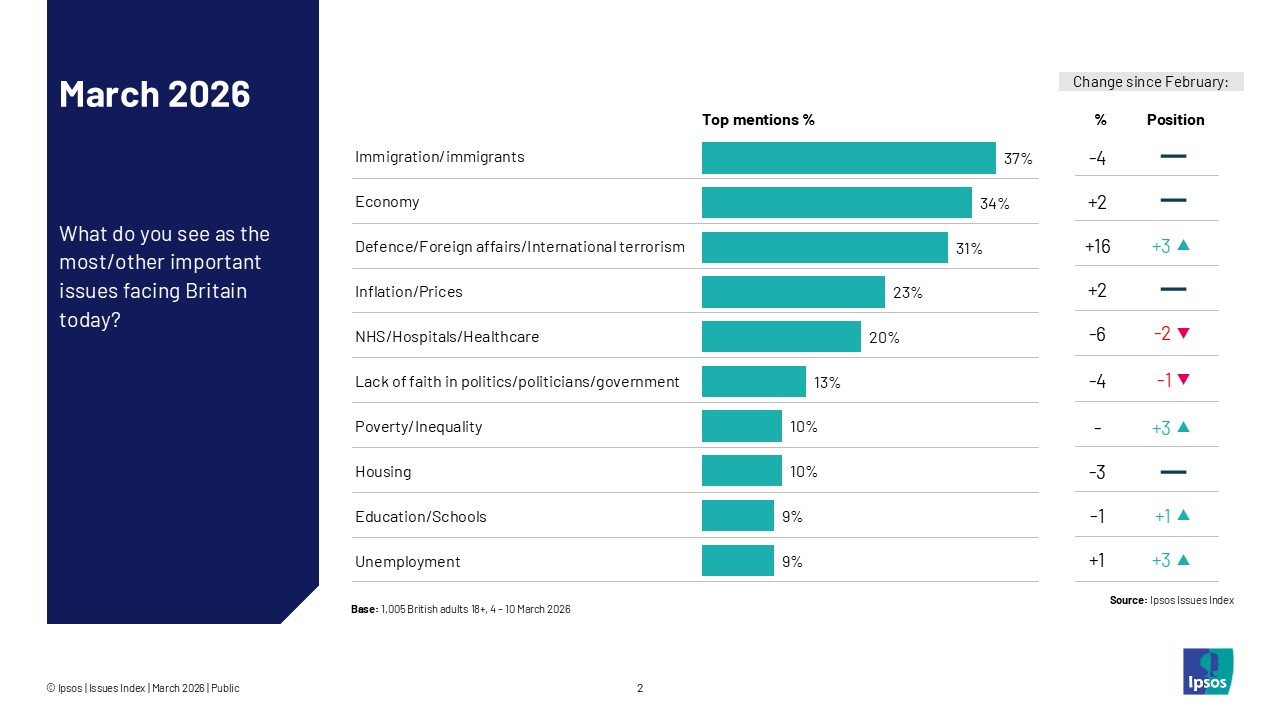
18 March 2026: The March 2026 edition of the long-running Ipsos in the UK Issues Index reveals a sharp increase in public concern about defence and foreign affairs. Thirty-one per cent mention it as a big issue for Britain, double the score of 15% it reached in February. This is the highest level of concern on the issue since March 2022 in the immediate aftermath of Russia’s invasion of Ukraine (35%). Fieldwork was conducted between 4 and 10 March, following the outbreak of war between Iran, the US and Israel.
United Kingdom: Over 8 in 10 Britons concerned about impact of Iran conflict on fuel/energy prices as belief in the special relationship falls
16 March 2026: Over eight in ten Britons express concern about the impact of the US/Israel-Iran conflict on the UK economy (83%), and specifically the price of fuel/energy (84%, with 49% very concerned). This is slightly higher than the level of concern over the economic impact of the conflict between Israel and Iran in June 2025, and in line with levels of concern at the start of the Ukraine conflict in 2022.