More think opening businesses puts too many people at risk of COVID-19 and we need to wait

A majority of people in some hard-hit countries think jobs lost will not be recovered.

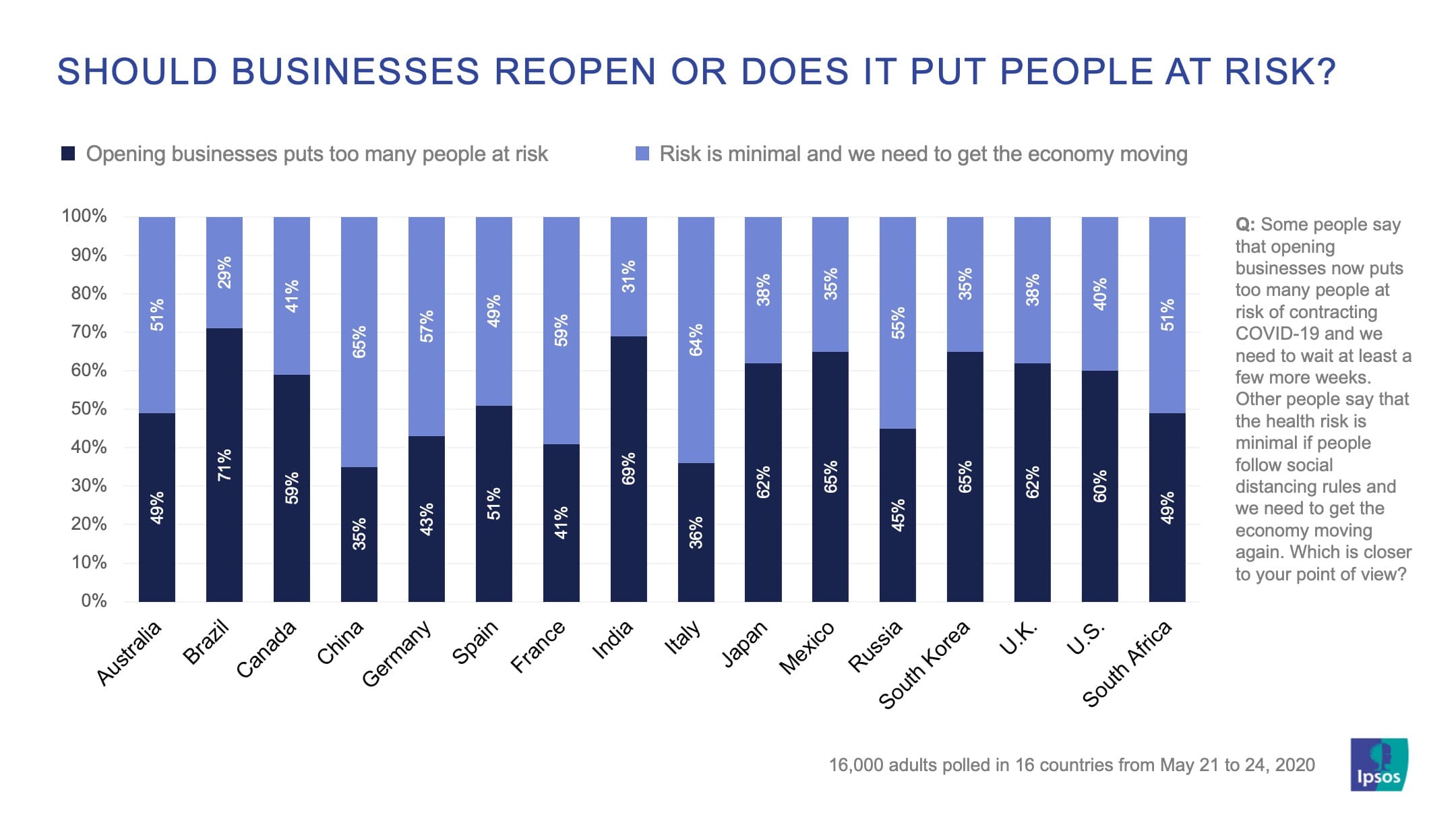
A majority of people in nine out of 16 countries think opening businesses now puts too many people at risk of contracting COVID-19, according to the latest Ipsos suvey.

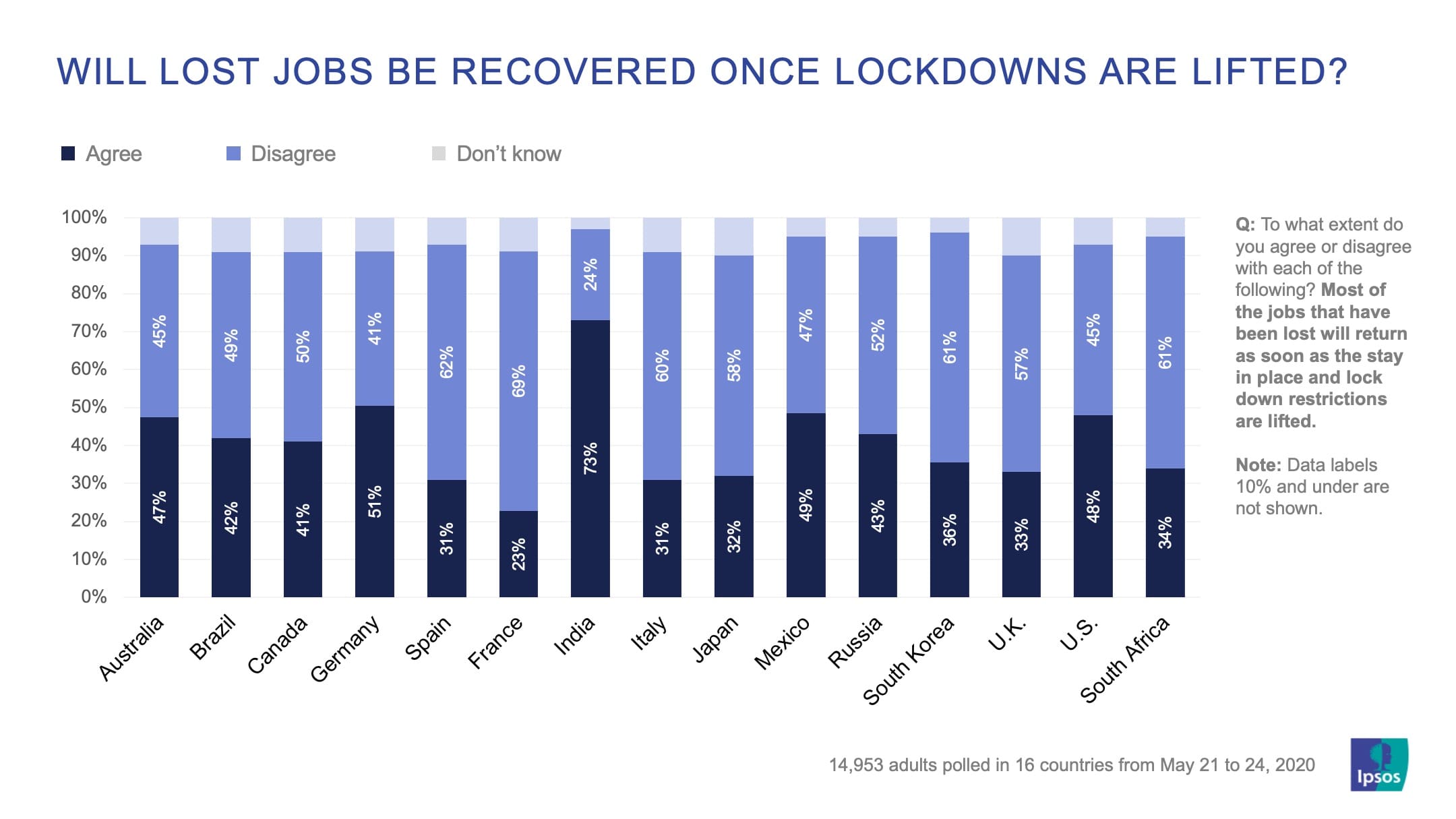
More people also say most jobs lost during the lockdown will not return, suggesting those that support reopening are doing so in spite of the risk rather than believing the risk is low.  

In a poll of 16,000 people in 16 major countries conducted from May 21 to 24, people in Brazil (71%), India (69%), Mexico and South Korea (65%), Japan and the United Kingdom (62%) and the United States (60%) are most likely to say we need to wait at least a few more weeks before opening businesses, because opening now would put too many people at risk of contracting COVID-19.

But on the opposite end, those in hard hit countries of China (65%), Italy (64%), France (59%), Germany (57%) and Russia (55%) are most likely to say the health risk is minimal if people follow social distancing rules, and we need to get the economy moving again.

People most divided on taking this action are in Spain, Australia and South Africa with only 2 percentage points between those who think opening businesses now puts too many people at risk versus those who say the risk is minimal.
Should businesses reopen or does it put people at risk? | Ipsos | Essentials | Coronavirus tracker

Added to this, a majority of people in France (69%), Spain (62%), South Korea and South Africa (61%), Italy (60%), Japan (58%), the U.K. (57%), and Russia (52%) don’t think most jobs lost during the pandemic will return as soon as the stay in place and lockdown restrictions are lifted.

A majority of respondents in India (73%) and Germany (51%) are the only ones out of 15 countries to believe most lost jobs will return once restrictions are eased.

A number of countries are divided on this question with only 2 points separating those who agree and disagree on whether jobs will be recovered in Australia and Mexico, followed by the U.S. (3), Brazil (7), Canada (9) and Germany (10).
Will lost jobs be recovered once lockdowns are lifted? | Ipsos | Essentials | Coronavirus tracker

These are the results from Essentials, an Ipsos weekly global syndicated study examing the opinions and behaviours as countries move through the pandemic. These results were collected May 21st to 24th, 2020 using an online methodology 16,000 adults aged 18-74 in Canada and the United States and 16-74 in Australia, Brazil, China, France, Germany, Italy, Spain, India, Japan, Mexico, Russia, South Africa, South Korea and the United Kingdom.

Ähnliche Inhalte

  • Weihnachtskarten & E-Mails – Insights zur Relevanz in 2025 | Ipsos
    Marketing Umfrage

    Weihnachtskarten & E-Mails – Insights zur Relevanz in 2025

    Alle Jahre wieder kommt am Jahresende Weihnachtsport ins Haus geflattert. Doch wie kommt die überhaupt an?
  • Mehrheit erwartet erneuten Koalitionsbruch | Ipsos
    Regierung Umfrage

    Mehrheit erwartet erneuten Koalitionsbruch – Schwarz‑Rot gilt dennoch als handlungsfähiger als die Ampel-Regierung

    Nach großen Differenzen zwischen den damaligen Regierungsparteien kam es vor rund einem Jahr zum Bruch der Ampel-Koalition. Auch die neue schwarz-rote Koalition musste bereits Unstimmigkeiten überwinden, etwa bei der Sozialstaatsreform oder der Wiedereinführung der Wehrpflicht. Einer aktuellen Umfrage des Markt- und Sozialforschungsinstituts Ipsos zufolge hält eine Mehrheit von 56 Prozent der Deutschen einen erneuten Koalitionsbruch für wahrscheinlich. Gleichzeitig beurteilt die Hälfte der Bevölkerung (50 %) die aktuelle Bundesregierung aus CDU/CSU und SPD als handlungsfähiger als die Vorgängerregierung.
  • Wie beurteilen die Deutschen ihr Gesundheitssystem? Laut einer Ipsos-Studie halten nur noch 42 Prozent die Qualität der Gesundheitsversorgung in Deutschland für gut – ein Rückgang um 14 Prozentpunkte seit 2018.

    Steigende Impfskepsis, mehr Pessimismus: So sehen die Deutschen das Gesundheitssystem

    Die Impfskepsis nimmt weiter zu. Nur noch die Hälfte der Deutschen (49 %) befürwortet eine Impfpflicht bei ernsthaften Infektionskrankheiten. Vor der Corona-Pandemie im Jahr 2018 lag der Anteil der Befürworter:innen in Deutschland noch bei 62 Prozent. Rund ein Viertel (24 %) der Bevölkerung spricht sich dagegen aus – lediglich in Ungarn ist die Impfskepsis mit 25 Prozent noch etwas höher. Besonders deutlich ist der Rückgang bei den älteren Befragten zwischen 50 und 74 Jahren (49 %, -15 pp seit 2018). In dieser Altersgruppe war die Zustimmung zur Impfpflicht im Jahr 2018 mit 64 Prozent noch am höchsten.