

Know the New America & Beyond: July 2026
Americans are weary of war — but expect it to continue nonetheless.
As the war in Iran resumed earlier this month, the number of Americans who expect that military involvement will go on for an extended period of time is up to 79% — 14 percentage points higher than in March, according to Reuters/Ipsos polling. Half of Americans (51%) say the war has not been worth it, compared to only 24% who say the opposite. And 60% of Americans expect gas prices to get worse as a result of the war — which they already have in the U.S. in the days since the poll, as oil rose over $100 USD per barrel.
Indeed, many American consumers remain pessimistic about their economic future. Six in ten (59%) Americans say they do not think people similar to them and their families have a good chance at improving their standard of living, given the way things are in America, according to a new Washington Post/Ipsos poll.
As the war and the economy compound heading into November, they’re likely to shape midterm elections in the U.S. At the moment, history is working against Republicans: Even without an unpopular war and a wavering economy, the U.S. president’s political party usually loses ground in the first election after their victory. It wouldn’t take much for political power to swing against the president, which would vastly reshape the regulatory landscape for businesses in the U.S.
Thank you for reading — please contact us to help you navigate this uncertain environment.
Read on to discover the latest insights on America from Ipsos.

What it took for ads to break through at the 2026 World Cup
Spain won the World Cup, but which brands won with fans? Ipsos data shows that the most effective ads moved beyond traditional “on the field” and “sports bar” settings and leveraged distinctive product iconography.
- In America, most still call it soccer - Read more

How Americans feel about GLP-1s
Five charts on the rise of GLP-1s and where Americans stand on their risks, benefits, and impact.
- How GLP-1 drugs change the game for food and beverage, retail, travel and beyond - Read more
- Heading into 2026 midterms, Americans back policies targeting lower healthcare costs, according to the latest Axios/Ipsos American Health Index - Read more

Most Americans now expect the Iran war to continue for an extended period
Amid the resumption of U.S. military strikes in Iran, 79% of Americans say they expect U.S. military involvement in Iran to go on for an extended period of time, according to a new Ipsos poll.
- Americans’ economic frustrations to loom large in 2026 midterms, according to a new Washington Post/Ipsos poll - Read more
Trump’s approval bounces back slightly
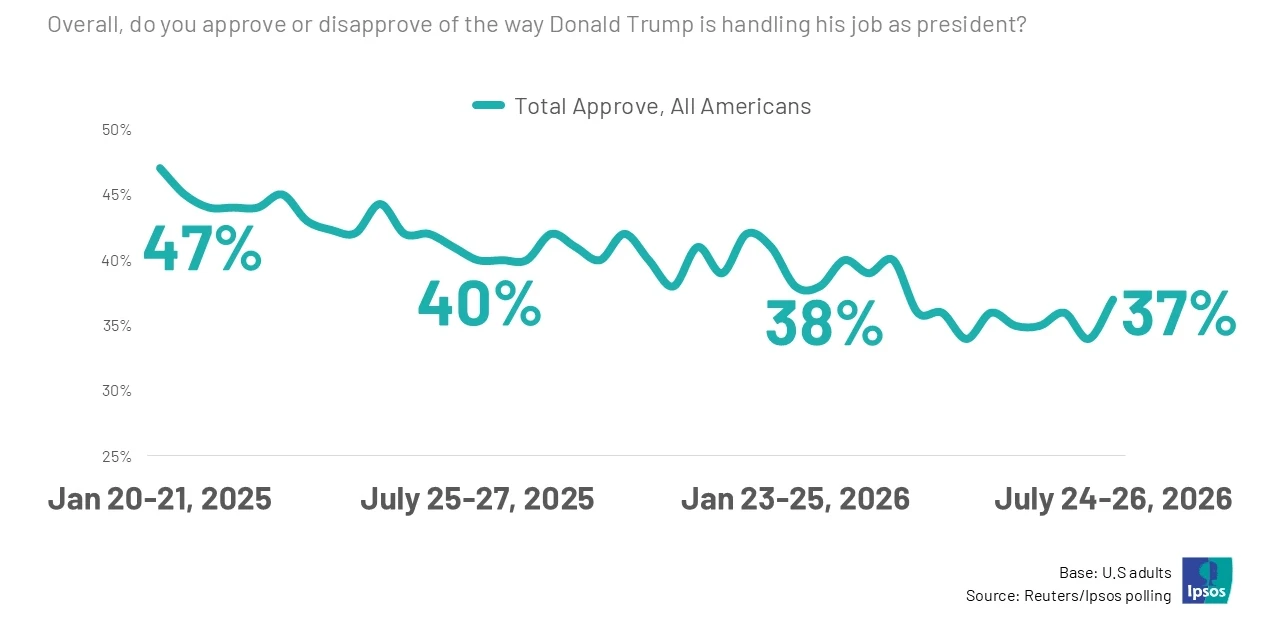
President Trump’s approval rating has ticked up to 37% this month, slightly above his record low of 34%. Still, his approval rating remains lower than its average before the Iran war began, when it hovered around 40% for close to a year.
Consumer confidence sees small, possibly temporary, bump
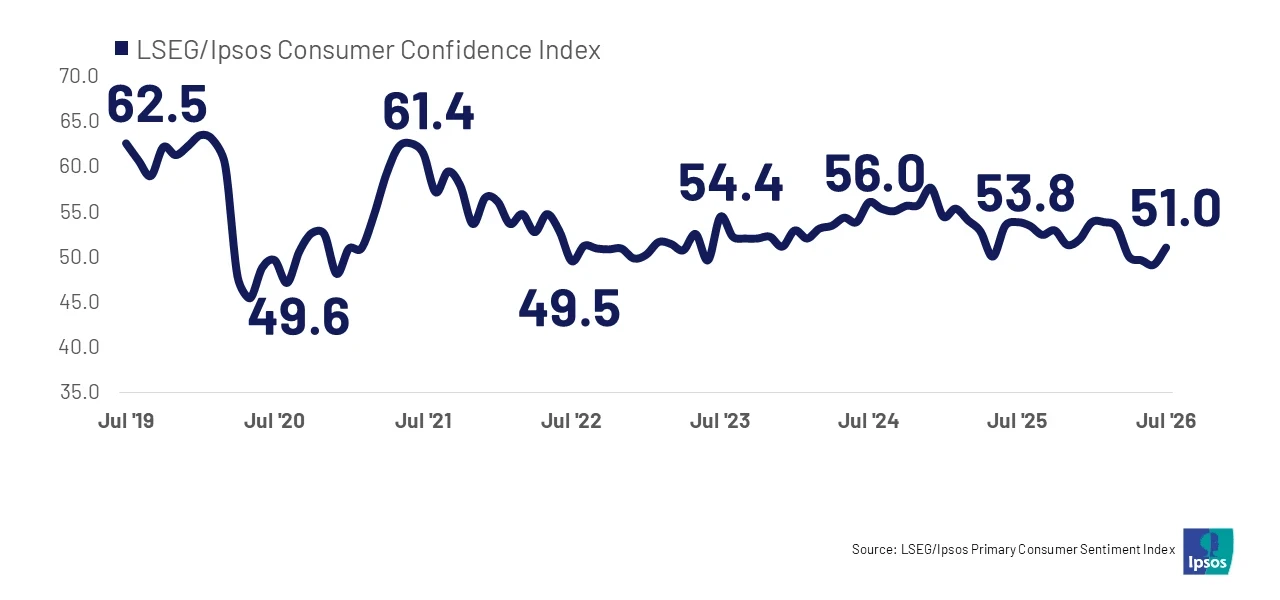
Americans’ consumer confidence for July ticked up slightly from the post-COVID low it hit last month. But a major caveat: The survey was fielded during the brief period while the U.S.-Iran ceasefire was still holding.
After the war resumed, Washington Post/Ipsos polling found that 48% of Americans believe the nation’s economy will get worse in the next year, compared to 20% who think it will get better.
What the rest of the world thinks
The view from Great Britain
British attitudes towards the United States have become markedly less positive over time. Ipsos' latest Understanding Society report, “We British”, shows that just 26% of Britons now view America favourably, down sharply from 63% in 1984. The findings suggest that the image of America held by many Britons today is very different from that of the Reagan era.
Recent polling points to a wider cooling in perceptions of the UK-U.S. relationship. In April, nearly half of Britons (48%) disagreed that a "special relationship" exists between the two countries, while only 23% agreed — the weakest reading Ipsos has recorded in a decade.
Although sentiment improved somewhat following King Charles III's state visit, more Britons still questioned the relationship than endorsed it. Views of Donald Trump remain particularly negative, with 69% of Britons holding an unfavourable opinion of the US President.
Together, these findings suggest British perceptions of America are not what they once were. Whether this trend is permanent is another question.

Ben Roff
Senior Public Affairs Researcher, Ipsos
United Kingdom
- 60% of Britons think Donald Trump is doing a bad job handling the conflict with Iran - Read more
- Four in five Britons express concern about the impact of the Iran conflict on the UK economy - Read more
Italy
- 36% of respondents think that the EU and the U.S. should hinder Israel in its policies towards Gaza, Lebanon and Iran - Read more
- 34% of respondents say that the EU and U.S. should convince Ukraine to accept a peace agreement with Russia - Read more
Keep in touch with the latest Ipsos research and polling on the Iran conflict from around the world on our new web page.
And finally, other Ipsos global reports this month
- What Worries the World: Conducted monthly in 30 countries among around 20,000 adults for over a decade, the Ipsos What Worries the World study offers an exceptional snapshot of world opinion on pressing global issues.
- Shopping with AI: Where is AI gaining traction? Where are shoppers drawing firm boundaries? Our new report offers practical guidance for brands and retailers navigating a future that demands both digital innovation and human connection.
- The Ipsos Energy Transition Barometer: How affordability, security, and reliability concerns are converging to reshape public support for the energy transition across 31 countries — including a rare before-and-after view of attitudes following the Iran conflict.
- The 2026 Global Infrastructure Index: The 2026 Global Infrastructure Index from Ipsos and the Global Infrastructure Investor Association (GIIA) finds that there’s continued appetite for investment in infrastructure, alongside pragmatism to improve outcomes.
- Ipsos Pride Report 2026: Our 2026 edition of the Ipsos LGBT+ Pride report shows attitudes stabilizing across 26 countries on several key measures, including trans athletes and LGBT media representation.
- Why oncologists are prescribing GLP-1s: Given the increasing prevalence of weight-related conditions and the rapid uptake of GLP-1s on the one hand, and the increasing incidence of cancer on the other hand, it was inevitable that these two worlds would collide. Here’s what's really happening at the intersection of two of healthcare's most defining challenges.
- Differential Diagnosis: By combining established methods of market research with synthetic data technology, organizations can gain access to new sources of insight that were previously unattainable due to sample constraints. While synthetic data is not a single answer, it is a powerful tool when used expertly.
- Ipsos Update: Our regular round-up of research from around the world features a poll digest alongside short summaries of the latest releases. Available in English, French, Spanish and Portuguese.


