Know the New America & Beyond: October 2026
Americans’ confidence in the economy has been bad since the Iran war began, flirting with levels not seen since COVID.
Now the bottom has dropped out.
Consumer confidence is now the worst it’s been since 2011, with the LSEG/Ipsos Primary Consumer Sentiment Index sitting at 45.2. It’s also a one-month drop of 5.3 points, the second-largest on record for Ipsos.
That’s potentially bad news for the Republican party in next week’s midterm elections, which will shape the American political and regulatory landscape for the next two years. For years, the Republicans were perceived as being the party that was better on the economy; today, that has flipped. A new ABC News/Washington Post/Ipsos poll shows that 37% of Americans trust the Democratic party more on the economy compared to 28% who trust Republicans, while the two parties were tied as recently as July. That comes as 59% of Americans would rather see the next Congress controlled by Democrats, to act as a check on President Donald Trump.
Businesses who operate in the U.S. should not wait — they should begin planning today for how their operations could change if the Trump administration and its regulators must spar with an empowered opposition party.
Read on to discover the latest insights on America from Ipsos — please contact us to help you navigate this uncertain environment.

Democrats are now more trusted than Republicans on economic issues
A new ABC News/Washington Post/Ipsos poll finds that Democrats have a growing lead over Republicans on economic issues, with Americans being more likely to trust Democrats than Republicans on the economy (37% trust Democrats, 28% trust Republicans).

Most Americans now understand how tariffs work; More see the costs, fewer see the benefits
More Americans now understand how tariffs work, according to the Ipsos Consumer Tracker — and understanding is up 10 points from when we first asked in December 2024.
- Facing rising health insurance costs, Americans support increased government spending to lower costs, according to the Axios/Ipsos American Health Index - Read more

Americans don’t expect many rewards for increased AI productivity
Workers are just as likely to expect negative outcomes as positive ones if AI makes them more productive, according to new data from the Ipsos Consumer Tracker.
Trump’s approval keeps dropping as midterms approach
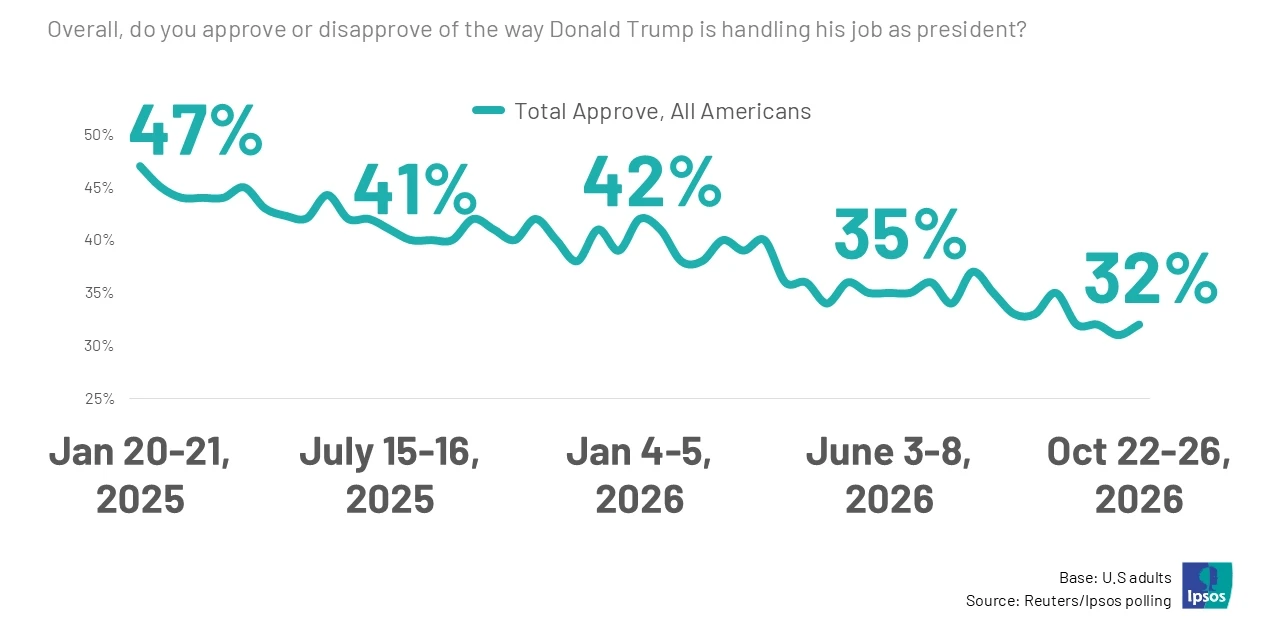
Among all Americans, just 25% approve of how President Donald Trump is handling the U.S. economy, while only 20% approve of his handling of the cost of living. The president's overall approval rating remains at a near low for his presidency, with just 32% saying they approve.
In recent months, signs of softening support for the president have become visible within the Republican base. Republicans are now more likely to say they approve of his job performance “somewhat” (42%) rather than “strongly” (34%) — a notable waning in enthusiasm that could mean trouble for the party in next week’s elections.
American consumer confidence has biggest drop since COVID
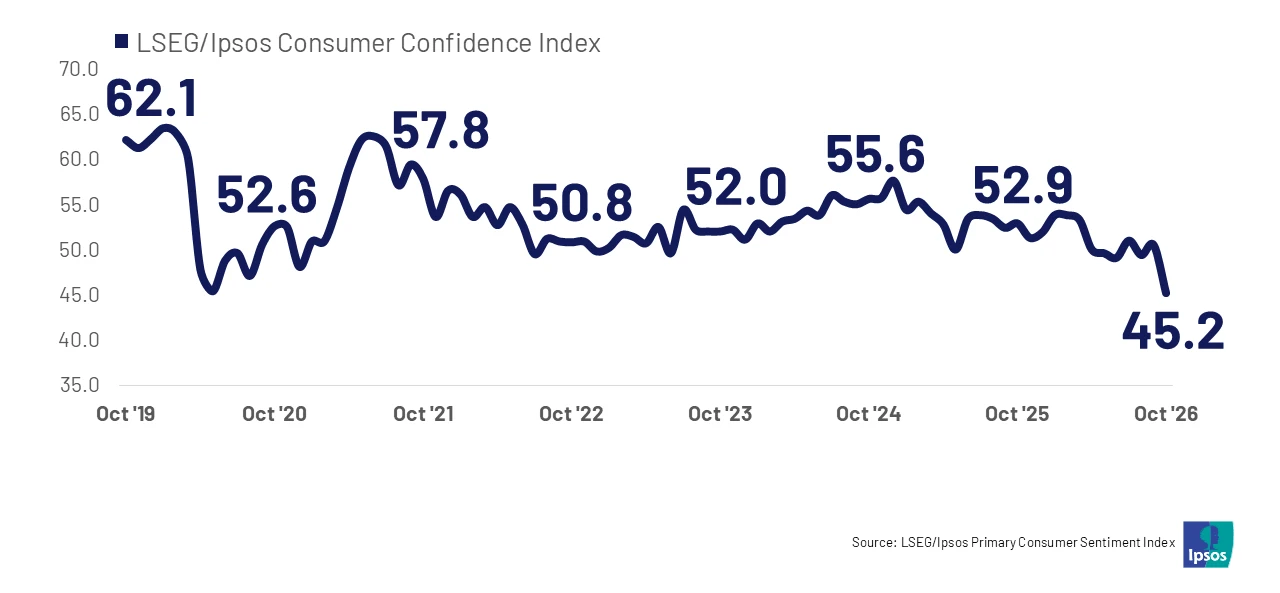
The LSEG/Ipsos Primary Consumer Sentiment Index for October 2026 is at 45.2, its lowest reading since October 2011. That’s down 5.3 points from last month, the second-largest month-over-month decline on record, behind only April 2020.
What’s driving this? People are pessimistic about most things, but confidence in making household and major purchases are the biggest changes, with each down by double digits.
What the rest of the world thinks
The view from the Middle East and North Africa
Across many countries within the Middle East and North Africa region, opinion leaders view Donald Trump as a major disruptor on both global and regional levels.
On one hand, critics argue that his presidency exposed deep structural fractures within U.S. politics and accelerated the transition away from a unipolar world order. His unwavering support for Israel, particularly during the Gaza conflict, deepened regional skepticism toward Western institutions. For many, this reinforced a long-held perception of Western double standards regarding human rights, free speech, freedom of the press, and international law.
On the other hand, his administration provided undeniable transactional clarity regarding U.S. priorities and strategic limits. By signaling that broad U.S. security guarantees were no longer guaranteed, he impelled regional states to pursue strategic self-reliance, fundamentally shifting reliance away from Washington as a predictable partner. Ultimately, while his policies intensified regional instability and emboldened Netanyahu’s government, his legacy is framed as a catalyst for a strategic awakening, marked by profound geopolitical disruption and heightened uncertainty.

Mustapha Tabba
Deputy CEO, Ipsos in the Middle East and North Africa
United Kingdom
- 44% of Britons blame decisions by Trump for the state of their economy - Read more
- Three in five Americans tuned out to British domestic news - Read more
And finally, other Ipsos global reports this month
- What Worries the World: Conducted monthly in 30 countries among around 20,000 adults for over a decade, the Ipsos What Worries the World study offers an exceptional snapshot of world opinion on pressing global issues. Australia, Canada, France, Japan, Singapore and Türkiye sit alongside the U.S. in having inflation as their No. 1 issue.
- Ipsos Global Trends: It’s easy to look at what’s going on in the world and worry about the future. The 10th edition of Ipsos Global Trends finds that people remain optimistic for ourselves, but many feel less optimistic this year than they have in the past about the world around us.
- The Ipsos Reputation Council: Drawing on 200 one-to-one conversations with senior communications and corporate affairs leaders at some of the world's largest and most influential organizations, “Life After Predictability” explores how communicators are adapting to a more fragmented, uncertain and AI-shaped world, and why judgement is becoming the profession's most valuable asset.
- Ipsos Cost of Living Monitor 2026: Across 33 countries surveyed, there is a mixed picture of many being financially stable but worried about what’s ahead and the feeling that a return to “normal” is getting further away.
- AXA Future Risks Report 2026: Artificial Intelligence has become experts’ top concern, ahead of climate change, according to the 2026 AXA Future Risks report, "The Intergenerational Moment," published in partnership with Ipsos bva.
- Ipsos Health Service Report 2026: On average across 32 countries, one in two (48%) see mental health as one of the biggest health problems in their country ahead of cancer (40%), stress (32%) and obesity (25%).
- The Life Well Lived: We look at how brands can move beyond performative wellbeing to support real human connection.
- Ipsos Update: Our regular round-up of research from around the world features a poll digest alongside short summaries of the latest releases. Available in English, French, Spanish and Portuguese.