The Iran Conflict - Latest Ipsos Polling and Trends

イラン紛争に対する最新調査

イラン紛争とその影響に関する、世界各国のイプソスによる最新の調査と世論調査のまとめです。

武力紛争に対する懸念は、地理的な近接性と連動する傾向があります。戦争の現場に近い人々ほど、より強い不安を抱くものです。これらはヨーロッパでも見られ、ウクライナに最も近い国々ほど、同国で起きている事態に対して一貫して強い懸念を示しています。

しかし、今回の戦争は異なる可能性があります。主な影響は、死傷者数や人道上の懸念、あるいは軍事的なエスカレーションによって引き起こされるものではないかもしれません。その代わりに、経済や人々の日常生活への影響を通じて現れる可能性があります。たとえ紛争から遠く離れていても、こうした経済的影響が日常生活に及ぶようになれば、人々は紛争に巻き込まれることになるでしょう。

ある意味では、このパターンは新型コロナウイルスの状況に似ています。あの危機は当初、健康問題として始まりましたが、経済と日常生活の両方を混乱させたことで、すぐに人々が身をもって体験する事態へと変化しました。今回の紛争も、その影響が家計や消費者の行動に波及するにつれ、同様の道をたどる可能性があります。

ここでは、世界各国におけるイプソスの最新調査結果をご紹介します。これが、現在の世論の動向、そして今後どのような方向に向かう可能性があるかについて、有益な指針となることを願っています。

各国の状況は……

🇺🇸 米国  🇨🇦 カナダ  🇫🇷 フランス  🇮🇳 インド  🇮🇹 イタリア 

🇳🇱 オランダ   🇪🇸 スペイン   🇹🇷 トルコ   🇬🇧 英国


🇺🇸 米国:多くの米国人は、イランに対する米国の軍事行動が「価値があった」とは考えていない

2026年4月13日: 4月10日から12日にかけて実施されたイプソスの世論調査によると、イランに対する米国の軍事行動への支持は依然として限定的であることが分かった。コストと利益の両方を考慮しても、イランへの軍事行動の決定は「価値があった」と答えたのはわずか24%にとどまった。それより多くの回答者(51%)が「価値はなかった」と答え、22%は「分からない」としている。米国がホルムズ海峡の封鎖やイランの石油タンカーの航行制限に乗り出す中、54%が、イランに対する米国の軍事行動は自身の経済状況に主に悪影響を及ぼしたと回答している。

調査の全文を読む


米国:インフレ懸念の高まりを受け、中小企業の景況感が悪化

2026年4月7日:前四半期と比較して、今後1年間に従業員や投資を増やす計画があると回答した中小企業の数が大幅に減少しました。これはインフレへの懸念が高まっていることを反映しており、現在では過半数が、インフレこそが中小企業経営者が直面する最大の課題であると述べています。特に、キャッシュフローに「非常に余裕がある」と答えた企業の割合は、過去2四半期で大幅に低下しました。

調査の全文を読む


米国:米国の目標がすべて達成されなくても、イラン紛争からの撤退を支持するアメリカ人が過半数を占める

2026年3月31日:3月27日から29日にかけて実施されたイプソスの世論調査によると、アメリカ人は、たとえ代償を伴うとしても、イランにおける米国の軍事行動を早期に終結させることを望んでいることが分かりました。全体として、66%が、たとえイランにおける米国の目標をすべて達成できなくても、米国は紛争への関与を早期に終結させるよう努めるべきだと回答しています。一方、たとえ紛争が長期化することになっても、米国はイランにおける目標をすべて達成するよう努めるべきだという見解を持つ人は、はるかに少なく(27%)なっています。
 

調査の全文を見る


米国:大統領支持率の最新動向

2026年3月24日:米国におけるトランプ大統領の支持率がわずかに低下している。ロイター/イプソス・コア・ポリティカルによる最新の世論調査によると、アメリカ国民は現在、経済と海外での紛争を国の最も差し迫った懸念事項として挙げている。
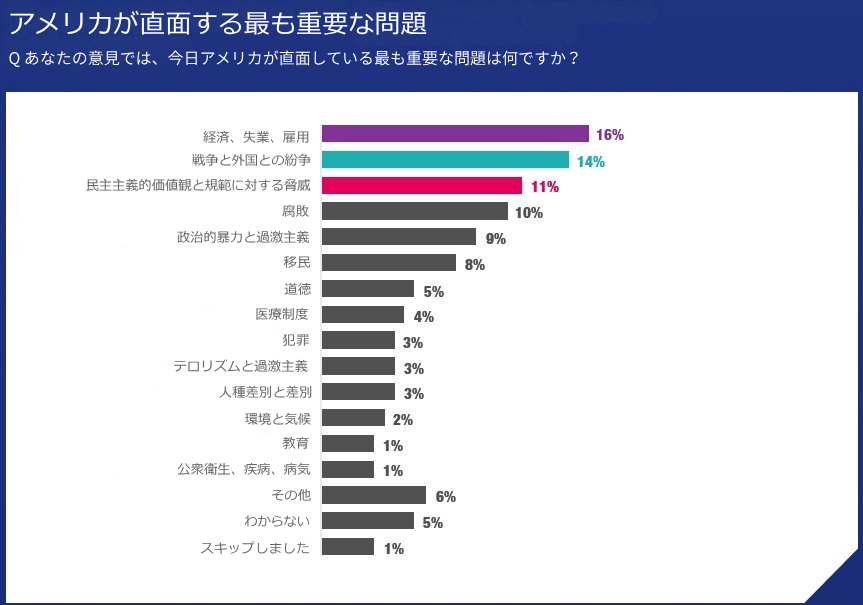
アメリカが直面する課題


調査の全文を見る


米国:米軍派遣への支持は限定的

2026年3月20日:大規模な地上作戦のために多数の地上部隊をイランに派遣することに賛成するのはわずか7%にとどまる。一方、標的を絞った作戦のために少数の特殊部隊を派遣することには、より高い割合(34%)が賛成している。アメリカ人の過半数(55%)は、米国がイラン国内に部隊を派遣することには支持しないと回答している。また、この調査では、アメリカ人が紛争がガソリン価格に与えている影響を依然として強く認識していることも明らかになった。10人中9人近く(87%)が、今後1ヶ月間でガソリン価格が上昇し続けると予想しており、過半数がガソリン価格の上昇が家計に影響を与えていると報告している。

調査の全文を見る


米国:イランに対する米軍の軍事行動は依然として不人気で、53%が個人的な経済的悪影響を懸念

2026年3月16日:3月13日から15日にかけて実施されたイプソスの世論調査によると、アメリカ国民はイランに対する米国の軍事攻撃に否定的な見方をしており、攻撃への不支持が支持を大幅に上回っています。米国の軍事介入に対するアメリカ人の懸念は、米軍兵士の命の危険から、紛争が個人の家計に与える影響まで多岐にわたります。全体として、58%がイラン軍事攻撃に反対しており、賛成は38%にとどまりました。この否定的な世論の傾向は、過去のイプソスおよびロイター/イプソスの調査結果とおおむね一致しています。

調査の全文を見る


🇬🇧 英国:イラン紛争を受け、防衛・外交問題に対する国民の懸念が倍増

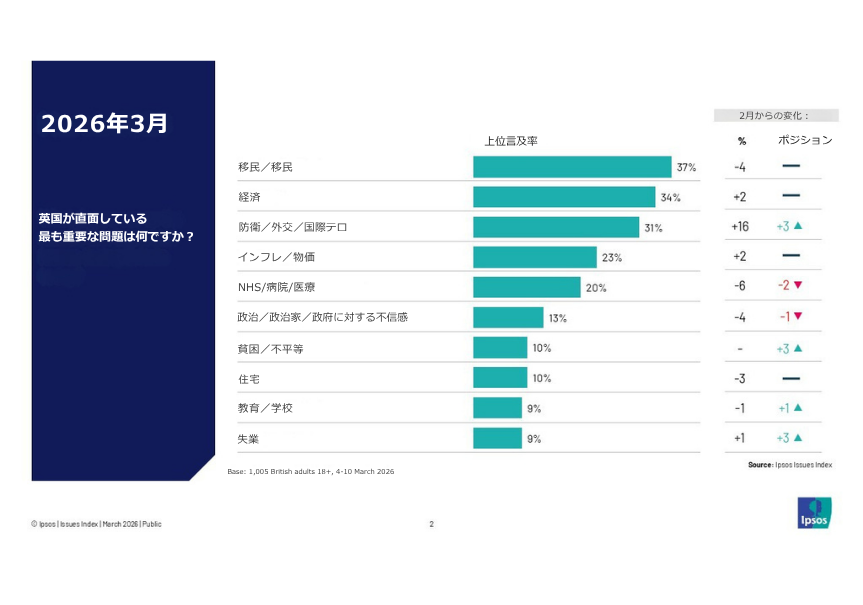
2026年3月18日:長年にわたり実施されている「Ipsos in the UK Issues Index」の2026年3月版によると、防衛・外交問題に対する国民の懸念が急増していることが明らかになりました。英国にとっての重大な問題としてこれを挙げる人は31%に達し、2月の15%から倍増しました。これは、ロシアによるウクライナ侵攻直後の2022年3月(35%)以来、同問題に対する懸念が最も高まった水準です。調査は、イラン、米国、イスラエルの間で戦争が勃発した後の3月4日から10日にかけて実施されました。

英国のデータ

調査の全文を見る


英国:燃料・エネルギー価格への影響を8割以上が懸念、英米間の「特別な関係」への信頼は低下

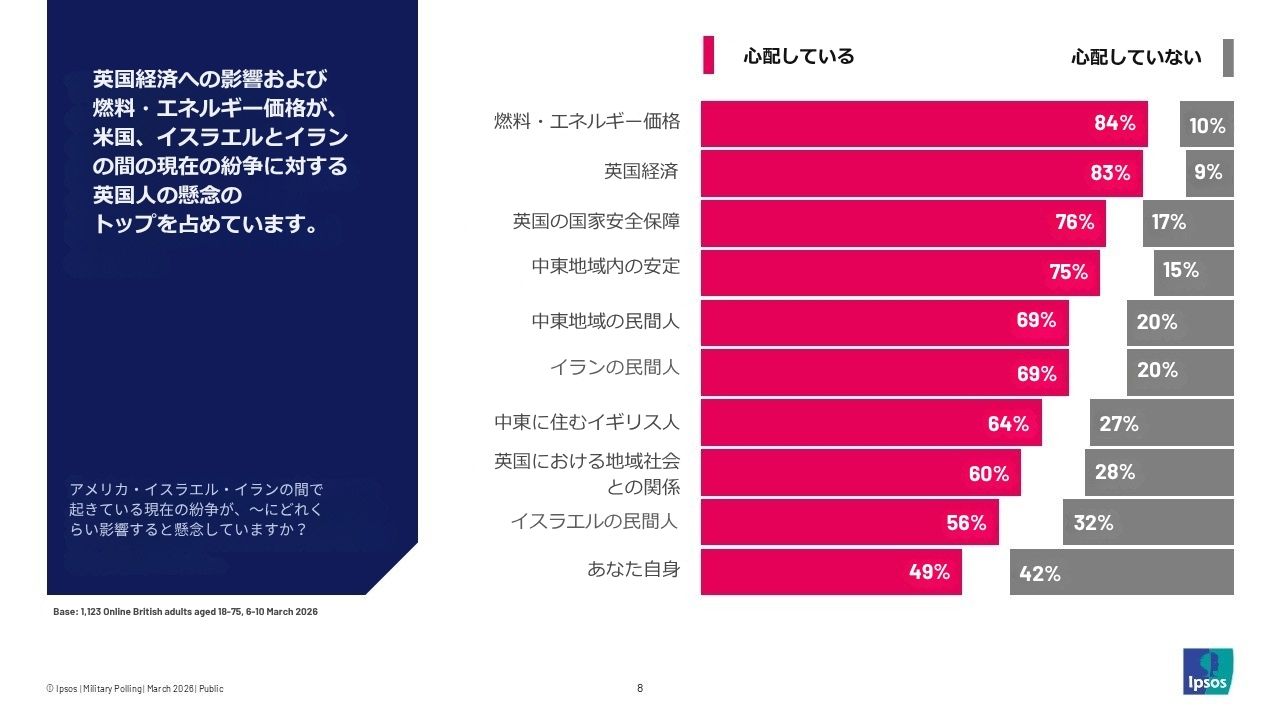
英国では、米国・イスラエルとイランの紛争が英国経済に与える影響について83%が懸念を示し、特に燃料・エネルギー価格への影響については84%(うち49%が「非常に懸念している」)が不安を感じています。 これは、2025年6月のイスラエル・イラン紛争の経済的影響に対する懸念をわずかに上回っており、2022年のウクライナ紛争開始時の懸念度と同水準です。


イギリスの調査


調査の全文を見る


🇫🇷 フランス:イラン情勢が燃料価格の高騰やインフレに及ぼす影響を懸念するフランス人の割合が大幅に増加

2026年4月13日:4月8日から9日にかけて実施されたイプソスBVAの最新世論調査によると、イラン紛争が燃料価格の高騰(前月比+8ポイント、53%)やインフレの加速(同+5ポイント、49%)に及ぼす影響について「非常に懸念している」と答えたフランス人の割合が顕著に増加している。対照的に、紛争が中東を越えて拡大すること(32%)や、フランスが直接関与すること(31%)を「非常に懸念している」とするフランス人の割合は、3月中旬と比較して減少している(それぞれ-2ポイント、+4ポイント)。

燃料価格の上昇に対するこうした懸念を背景に、フランス人の過半数(68%)は、燃料価格の上昇を抑制するための措置の実施を望んでいる。フランス人は依然として、イランの最近の行動(83%、前月比+2ポイント)を圧倒的に不支持としているが、イスラエル(75%、+7ポイント)や米国(74%、+11ポイント)に対しても同様に不支持を示している。対照的に、フランスの行動を不支持とする回答は41%(-3ポイント)にとどまっている。フランス国民は、4月7日(火)にドナルド・トランプ大統領が発表した停戦の持続性について懐疑的であり、停戦が持続すると考える人は17%にとどまる一方、持続しないと考える人は83%に上っている。

調査の全文を見る


フランス:紛争開始以降のフランスの対応に、わずかながら過半数が賛成

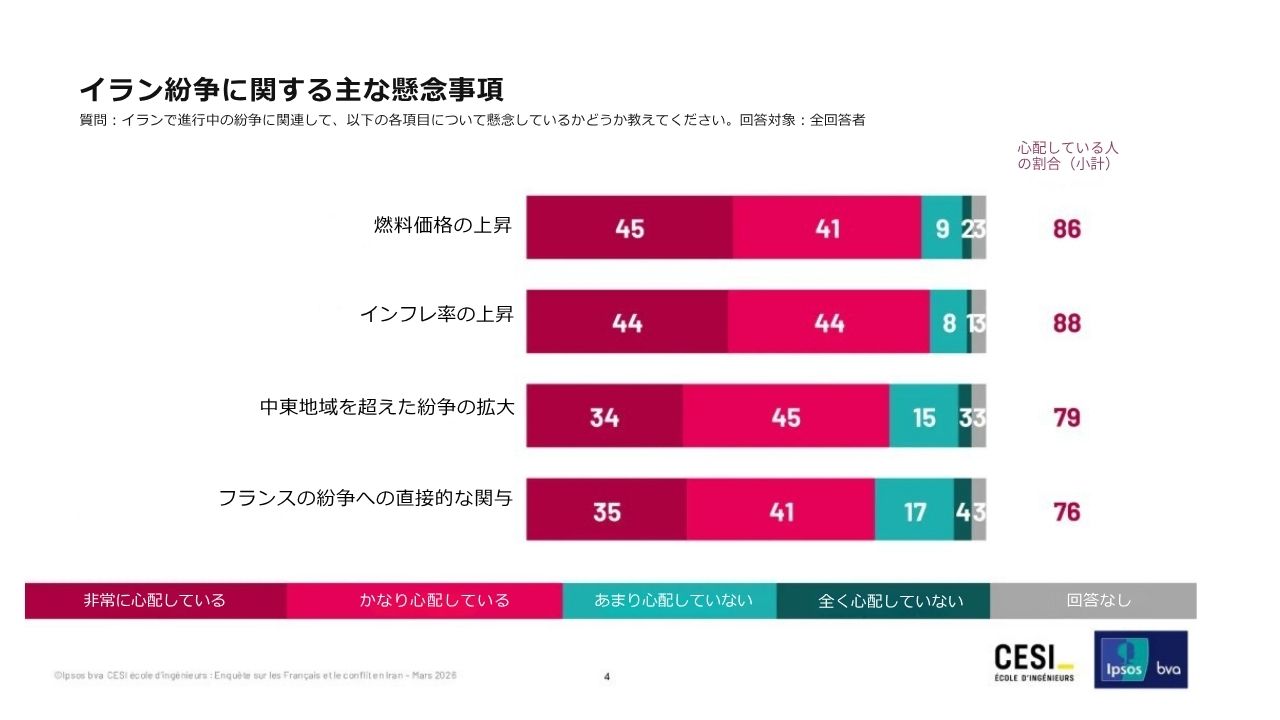
2026年3月18日:イプソスBVAとそのパートナーであるCESI工科大学が実施した最新調査「フランス人とイラン紛争」の結果を発表しました。イラン紛争に直面し、フランス人の過半数はインフレの加速(88%)と燃料価格の高騰(86%)を懸念しています。紛争開始以来のフランスの行動については、フランス人のわずかな過半数(53%)が支持していますが、空母シャルル・ド・ゴールの派遣については、世論は二分されています。49%が支持する一方、50%が反対しています。また、この調査では、79%が紛争が中東を越えて拡大することを懸念していると回答しています。

イラン紛争に対するフランス人の懸念


調査の全文を見る


🇨🇦 カナダ:10人中6人が米国によるイランへの軍事攻撃に反対

Global Newsの依頼によるイプソスの世論調査によると、カナダ人の61%が米国によるイランへの軍事行動に反対しており、そのうち42%が強く反対しています。賛成は4人に1人(23%)にとどまり(強く賛成8%/やや賛成15%)、16%はどちらとも判断できないとしています。カナダが戦争に巻き込まれる可能性への懸念は高く、66%がカナダがこの戦争に巻き込まれ、兵士の命が危険にさらされることを恐れています。特に注目すべきは、イランでの戦争が数ヶ月で終わると思う人はわずか32%にとどまり、それに対して反対する人が41%と多く、28%がどちらとも判断できないと答えています。

カナダ人の世論


調査の全文を見る


🇳🇱 オランダ:全体としてイランへの攻撃に批判的

オランダの世論は、米国とイスラエルによるイランへの攻撃に対して批判的である傾向があります。39%が攻撃を「悪いこと」だと考えており、肯定的に見ているのは21%です。かなりの割合が中立(25%)または判断を保留(15%)しています。政治的志向立場も影響しており、右派保守政党(特にSGP、JA21、PVV)の有権者では攻撃への支持率が高く、一方、左派・進歩的政党(GL-PvdA、PvdD、SP、D66)の有権者は攻撃に反対する傾向が強くなっています。
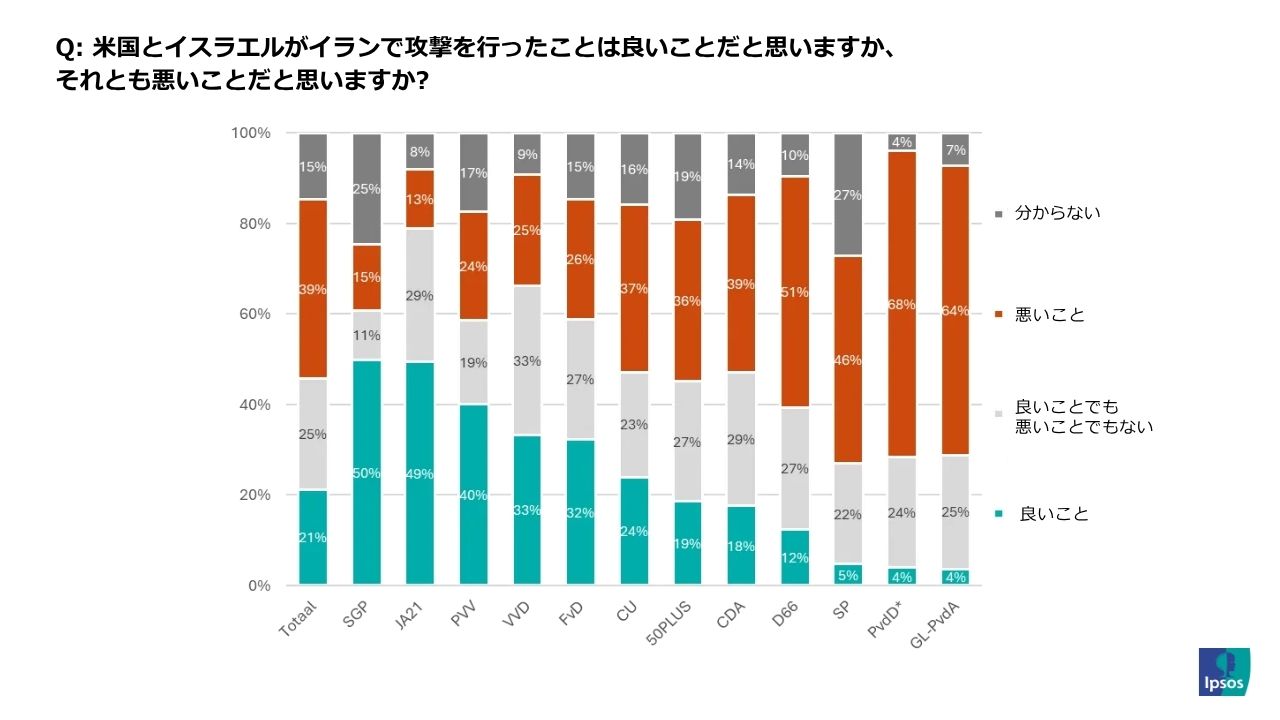
オランダの世論


調査の全文を見る


🇪🇸 スペイン:イランへの戦争に対する広範な反対が党派間の対立を上回る

2026年4月13日:最新のイプソス/ラ・バンガルディア・スペイン政治バロメーターによると、スペイン人の72%がこの軍事作戦を「正当化できない」と回答したのに対し、米国とイスラエルの行動を「正当化できる」と答えたのはわずか12%にとどまった。また外交面では、これまでの軍事紛争に対するスペインの批判的な姿勢について、スペイン国民の50%が肯定的に評価しており、否定的な見方は23%にとどまっている。


Email Paco Camas  Download the Slides (PDF)


🇹🇷 トルコ:イラン戦争はトルコにどのような影響を与えるか?

この新しいイプソスの調査プロジェクトでは、紛争がトルコに与える社会的・経済的影響を調査し、データに基づく洞察を通じて、地域的な緊張がトルコ市場や社会の認識に及ぼす影響を明らかにします。本報告書では、戦争当事国に対する態度、トルコの役割に対する認識、戦争の行方に対する期待に加え、マクロ経済への影響、エネルギー価格の予測、家計の消費行動の変化についても、包括的な視点から明らかにしています。


Request the Report  Download the Leaflet


🇮🇹 イタリア:イタリア国民の過半数が、イラン戦争の激化を懸念していると回答

イタリア人の35%が紛争の激化を懸念しており、次いで経済的影響(21%)、欧州でのテロ攻撃のリスク(19%)、人道的影響(15%)への懸念が挙げられました。


調査結果の全文を見る


インド: インド国民は西アジアの紛争を注視、深刻な懸念から支出削減へ

2026年4月7日:80%が情勢を注視しており、10人中9人が物価上昇を予想しています。3人に2人は生活必需品を買いだめしていると答えています。インドのイプソスCEO、スレッシュ・ラマリンガム氏は次のように述べています。

「インドはエネルギー供給源の多様化に向けた措置を講じていますが、紛争が長期化すれば、投入コストの上昇を通じて引き続き圧力が加わる可能性があります。こうした状況下では、ブランドが消費者の期待に沿い、適切かつ責任ある対応をすることが重要となります。」

調査結果の全文を見る


Panicos Ioannides | Ipsos
Panicos Ioannides,
CEO, Ipsos in GCC
The current regional climate has significantly reshaped consumer behaviour in the UAE, driving a shift toward more intentional and controlled decision-making. Today, 73% of consumers are prioritizing essential purchases, 55% are reducing overall spending, and 57% are switching to cheaper alternatives. At the same time, digital engagement continues to rise, with social media usage up by 55% and 85% of shoppers maintaining or increasing their use of online shopping platforms. Trust is also evolving, with consumers increasingly relying on personal networks and local brands, while 30% remain willing to pay more for trusted names, highlighting the continued importance of credibility and value during uncertain times. The current environment is not creating consumer paralysis, but consumer recalibration. In periods of uncertainty, resilience is reflected not in the absence of caution, but in the ability of consumers and brands alike to adapt, prioritize value, and maintain confidence in the future.
Jean-Christophe Salles | Ipsos
Jean-Christophe Salles,
CEO, Ipsos in Latin America
Latin America remains somewhat distant from the conflict in Iran, and consumer confidence is holding up better than in other parts of the world. One exception is Chile, where the sharp increase in gasoline prices generated high concern about inflation and a negative perception of the country's economic situation. For the moment, the other countries remain more concerned about social issues such as crime and violence (Peru, Mexico), corruption (Brazil), or unemployment (Argentina).
Nick Coates | Ipsos
Nick Coates,
CEO, Ipsos in Sub-Saharan Africa
The war in Iran is significantly harming Sub-Saharan African economies, causing a significant decline in consumer confidence, and reversing the positive momentum from a strong 2025. The IMF projects a 0.3-point decline in regional growth. With rising energy costs and disrupted shipping, both businesses and consumers are facing higher inflationary pressure which is expected to reach roughly 5% on average. Fertilizer shortages threaten agricultural yields across the continent, with around 20 million people facing increased food insecurity.

The view from ...

🇺🇸 United States  🇧🇷 Brazil  🇨🇦 Canada  🇫🇷 France  🇮🇳 India

🇮🇹 Italy  🇳🇱 Netherlands  🇪🇸 Spain  🇹🇷 Türkiye  🇬🇧 United Kingdom


United States: Two-thirds say rising gas prices have affected their household finances

11 May 2026: A new Reuters/Ipsos poll conducted May 8-11 finds that 64% of Americans say that recent increases in gas prices have affected their household’s financial situation, with a large majority (83%) expecting gas prices to continue to rise in the next month.With gas prices approaching all-time highs, 86% of Americans say the conflict with Iran bears a great deal or fair amount of responsibility for the recent rise in prices. Three-quarters say the Trump administration is responsible, while 73% say the same about oil and gas companies.

View the full survey

United States: Many Americans are skeptical that U.S. military action in Iran has been worth it

13 April 2026: An Ipsos poll conducted April 10-12 finds that support for U.S. military action in Iran remains limited. Just 24% say that, considering both the costs and the benefits, the decision to take military action in Iran has been worth it. A larger share (51%) say it has not been worth it, while 22% are unsure. As the U.S. moves to blockade the Strait of Hormuz and restrict Iranian oil tanker traffic, 54% say U.S. military action in Iran has had a mostly negative impact on their personal financial situation. 

View the full survey

United States: Small business sentiment declines as concerns about inflation rise

7 April 2026: Compared to last quarter, significantly fewer small businesses report planning to increase their staff or investment in the next year. This comes as concerns about inflation have risen, with a majority now saying it is the biggest challenge facing small business owners. Notably, the share who are very comfortable with their cash flow has declined significantly over the past two quarters.

View the full survey

United States: Majority of Americans favor exit from Iran conflict, even if not all U.S. goals are achieved

31 March 2026: An Ipsos poll conducted March 27-29 finds Americans prefer an expedited end to U.S. military action in Iran, even if it comes with tradeoffs. Overall, 66% say the U.S. should work to end its involvement in the conflict quickly, even if it means we do not achieve all of our goals in Iran. Far fewer (27%) take the view that the U.S. should work to achieve all of its goals in Iran, even if it means the conflict continues for an extended period of time.

View the full survey

United States: Presidential Approval Latest

30 April 2026: About three in five Americans disapprove of how Donald Trump is handling his job as president, while 34% approve. The economy is cited as the most important problem by 20% of Americans, up from 16% in the previous month. This is followed by threats to democratic norms and corruption at 12%. Amid the ongoing situation in Iran, 8% of Americans cite war and foreign conflicts as the most important problem—a 6-point decrease from the previous month but elevated compared to February (1%).

Ipsos Chart: Donald Trump Job Approvval Ratings - 64% disapprove, 34% approve


View the full survey

United States: Support for U.S. troop deployment is limited

20 March 2026: Just 7% would support deploying a large number of ground troops to Iran for a large-scale ground operation; a higher share (34%) would support the deployment of a small number of special forces for targeted operations. A majority of Americans (55%) say they would not support the U.S. deploying any troops inside Iran. The survey also finds that Americans continue to be keenly aware of the impact the conflict is having on gas prices. Nearly nine-in-ten (87%) expect gas prices to continue to rise in the next month and a majority report that rising gas prices have impacted their households’ finances.

View the full survey
 

United States: U.S. military action in Iran remains unpopular as 53% expect negative personal financial impacts

16 March 2026: An Ipsos poll conducted March 13–15 finds Americans continue to hold negative views of U.S. military strikes against Iran, with disapproval of the strikes significantly outweighing approval. Americans’ concerns about the U.S. military engagement range from risks to American service members’ lives to the conflict’s impact on Americans’ personal finances.Overall, 58% say they disapprove of U.S. military strikes against Iran, compared with 38% who say they approve. This negative balance of opinion is broadly consistent with previous Ipsos and Reuters/Ipsos surveys. 

View the full survey


Brazil: 9 out of 10 Brazilians see the impact of the conflict between the United States, Israel and Iran on the country's economy

23 April 2026: An Ipsos poll conducted April 8-12 reveals concerns about the economic effects of the conflict between the United States, Israel, and Iran. The vast majority (90%) of Brazilians believe that the country’s economy as a whole will be affected: 65% say it will be greatly affected, and 25% say it will be somewhat affected. Those who believe it will not affect the Brazilian economy account for 6%, and those who do not know how to respond make up 5%. The perception of the impact on the economy in general is consistent across sociodemographic segments.

View the full survey


Canada: 6 in 10 Canadians disapprove of US military strike against Iran

13 March 2026: Ipsos polling for Global News reveals Canadian disapproval (61%) of the US military action against Iran, with 42% strongly disapproving. Only one in four (23%) approve (8% strongly/15% somewhat), while 16% are unsure either way. Concerns about potential Canadian involvement are high, with 66% expressing fear that Canada will be pulled into this war and the lives of our soldiers will be at risk. Notably, just 32% think the war in Iran will be over in a couple of months, with more (41%) disagreeing and a substantial portion (28%) who aren't sure either way.

New Ipsos polling for Global News reveals Canadian disapproval (61%) of the US military action against Iran, with 42% strongly disapproving. Only one in four (23%) approve (8% strongly/15% somewhat), while 16% are unsure either way. Concerns about potential Canadian involvement are high, with 66% expressing fear that Canada will be pulled into this war and the lives of our soldiers will be at risk. Notably, just 32% think the war in Iran will be over in a couple of months, with more (41%) disagreeing and a substantial portion (28%) who aren't sure either way.

View the full survey


France: Marked increase in proportion of French people concerned about consequences of Iran conflict on rising fuel prices and inflation

13 April 2026: In the latest poll by Ipsos bva fielded 8-9 April, we see a marked increase in the proportion of French people who say they are very worried about the consequences of the conflict in Iran on rising fuel prices (up 8 points over the month, to 53%) and on rising inflation (+5 points, to 49%). In contrast, the proportion of French people very worried about the conflict extending beyond the Middle East (32%) or direct French involvement (31%) is down compared to mid-March (respectively -2 and -4 points).

In the face of this concern about rising fuel prices, a majority of French (68%) want measures implemented to limit fuel price increases. The French still overwhelmingly disapprove of the recent actions of Iran (83%, +2 points on last month), but also of Israel (75%, +7 points) and the United States (74%, +11 points). In contrast, only 41% (-3 points) disapprove of France's actions. The French appear unconvinced about the permanence of the ceasefire announced on Tuesday 7th April by Donald Trump, with only 17% believing it will last compared to 83% who think it will not.

View the full survey
 

France: A small majority of French people approve of the actions carried out by France since the beginning of the conflict

13 March 2026: Ipsos bva and its partner CESI Engineering School have recently revealed the results of a new survey “The French and the conflict in Iran”. Faced with the conflict in Iran, a majority of French fear an increase in inflation (88%) and fuel prices (86%). While the action of France since the beginning of the conflict is approved by a small majority of French people (53%), French opinion is evenly split when it comes to attitudes to deploying the aircraft carrier Charles de Gaulle: 49% support such a move, while 50% oppose. The survey finds 79% expressing a fear that the conflict will spread spread beyond the Middle East.

Ipsos chart: The principal concerns in France about the conflict in Iran: 88% of French people say they are worried about the rise in inflation, of which 44% say they are very worried. This feeling of very strong concern is stronger among supporters of the RN (58%) and Environmentalists (48%) while those in the Central Bloc are less worried (26%). The fear of a rise in fuel prices is also a strong concern (86% of worries including 45% of very worried). It is particularly lively among supporters of the National Rally (60% of "very worried"), while it affects only 20% of the supporters of the Central Bloc. France’s direct involvement in the conflict worries 76% of the population (of which 35% are very worried). This fear is markedly more marked on the left, culminating among supporters of La France Insoumise (47% of very worried) and Ecologists (45%), against only 23% for PS and Central Bloc supporters. 79% of French people fear an extension of the conflict beyond the Middle East.


View the full survey


India: Consumers turn cautious amid economic uncertainty: Ipsos Consumer Pulse

13 May 2026: Rising geopolitical tensions in the Middle East and increasing crude oil prices are beginning to reshape consumer behaviour in India. The latest Ipsos India Consumer Pulse survey reveals that Indian households are becoming more cautious with spending, stocking up on essentials and increasingly turning toward value-driven and fuel-efficient choices. With uncertainty continuing around the Strait of Hormuz and the ongoing US-Iran conflict, consumers are preparing for sustained inflationary pressure in the months ahead. According to the survey, nearly 9 in 10 consumers say they are likely to cut back on expenses if prices continue to rise.

View the full survey

India: Indians track West Asia conflict closely; deep concern spurs spending cutbacks

7 April 2026: 80% are actively following developments and nine in ten expect prices to rise. Two in three say they are stocking up on essentials. Suresh Ramalingam, CEO of Ipsos in India says: “While India has taken steps to diversify energy sourcing, a prolonged conflict could continue to exert pressure through rising input costs. In this context, it becomes important for brands to stay aligned to consumer expectations and respond with relevance and responsibility.”

View the full survey


Italy: A majority of Italian citizens say they are concerned about the escalation of the Iran war

9 March 2026: 35% of Italians fear an escalation of the conflict, followed by concerns over the economic consequences (21%); the risk of terrorist attacks in Europe (19%); and humanitarian consequences (15%).


View the full survey


Netherlands: On balance, Dutch are critical of attacks on Iran

12 March 2026: Public opinion in the Netherlands tends to be critical of the US and Israeli strikes on Iran. Four in ten (39%) consider the attacks a bad thing, compared with 21% who view them positively. A significant share remains neutral (25%) or undecided (15%). Political preferences play a clear role: support for the attacks is higher among voters of right-wing conservative parties (especially SGP, JA21 and PVV), while voters of left-leaning and progressive parties (GL-PvdA, PvdD, SP, D66) are more likely to oppose the attacks.

Q: Do you think it is a good or a bad thing that the US and Israel have carried out attacks in Iran?

Ipsos Chart: The Netherlands: Do you think it is a good or a bad thing that the U.S. and Israel have carried out attacks in Iran?


View the full survey


Spain: Broad rejection of war against Iran trumps partisan division

13 April 2026: The new Ipsos/La Vanguardia Spanish Political Barometer finds 72% of Spaniards describing the military campaign as unjustified, compared with just 12% who say the actions of the U.S. and Israel are justified. And on the diplomatic front, the critical stance taken by Spain so far in response to the military conflict is given a positive rating by 50% of the Spanish public, with 23% in the negative camp.


Email Paco Camas  Download the Slides (PDF)


Türkiye: How does the Iran War affect Türkiye?

This new Ipsos research project will investigate the societal and economic impacts of the conflicts on Türkiye, revealing the effects of regional tensions on the Turkish market and social perceptions with data-driven insights. In addition to attitudes towards the parties to the war, perceptions of Türkiye's role and expectations regarding the course of the war, the report reveals the macroeconomic effects, energy price projections and changes in household consumption behavior with a holistic perspective.


Request the Report  Download the Leaflet


United Kingdom: Nearly 9 in 10 Britons concerned over personal impact of Strait of Hormuz closure on the cost of food and other goods

24 April 2026: New polling data from Ipsos in the UK, conducted 17-21 April 2026, reveals high levels of public anxiety as the continued closure of the Strait of Hormuz begins to disrupt global supply chains. 

  • More than 7 in 10 (77%) Britons say they have heard a great deal or a fair amount about potential fuel shortages, with a further 6 in 10 (62%) aware of the potential for shortages of food and other essential goods
  • Nearly 9 in 10 (87%) British adults expressed concern about the personal impact of price increases for food and goods, with 3 in 4 (74%) concerned about the potential of shortages
  • 71% are concerned about the rising cost of petrol, with 62% expressing concern over the potential for fuel shortages

View the full survey

United Kingdom: Public opinion hardens against Iran war, as economic concerns persist

9 April 2026: Disapproval of the US strikes has increased 9pp since March, and not stands at 65%. Gideon Skinner, Senior Director of Politics Research, Ipsos in the UK, notes that: “The British public is increasingly out of step with Washington; disapproval of US strikes and criticism of Donald Trump is climbing, and support for the use of British bases is falling”. Some 86% of Brits say they are worried about the conflict’s impact on fuel/energy prices. 

Ipsos chart: Approval for the way Keir Starmer and the UK Government are handling the Iran conflict has risen since March (though still only 3 in 10). Criticism of Trump and Netanyahu has increased.

View the full survey

United Kingdom: Public concern about defence and foreign affairs doubles in wake of Iran conflict

18 March 2026: The March 2026 edition of the long-running Ipsos in the UK Issues Index reveals a sharp increase in public concern about defence and foreign affairs. Thirty-one per cent mention it as a big issue for Britain, double the score of 15% it reached in February. This is the highest level of concern on the issue since March 2022 in the immediate aftermath of Russia’s invasion of Ukraine (35%). Fieldwork was conducted between 4 and 10 March, following the outbreak of war between Iran, the US and Israel.

Ipsos Chart: March 2026 UK Issues Index - what do you see as the most/other important issues facing Britain today? See the survey link for full details

View the full survey

United Kingdom: Over 8 in 10 Britons concerned about impact of Iran conflict on fuel/energy prices as belief in the special relationship falls

16 March 2026: Over eight in ten Britons express concern about the impact of the US/Israel-Iran conflict on the UK economy (83%), and specifically the price of fuel/energy (84%, with 49% very concerned).  This is slightly higher than the level of concern over the economic impact of the conflict between Israel and Iran in June 2025, and in line with levels of concern at the start of the Ukraine conflict in 2022.

Ipsos Chart: The impact on the UK economy and the price of fuel/energy are top of Britons' concerns about the current conflict between the US, Israel and Iran

View the full survey


問い合わせ

  • Saaya Hahimoto
    Marketing and Communication
    0368678001

Related news