More people believe there are bigger issues than COVID-19 amid race protests in U.S. and globally

A majority in 13 countries say racism, other forms of intolerance is present in their country.

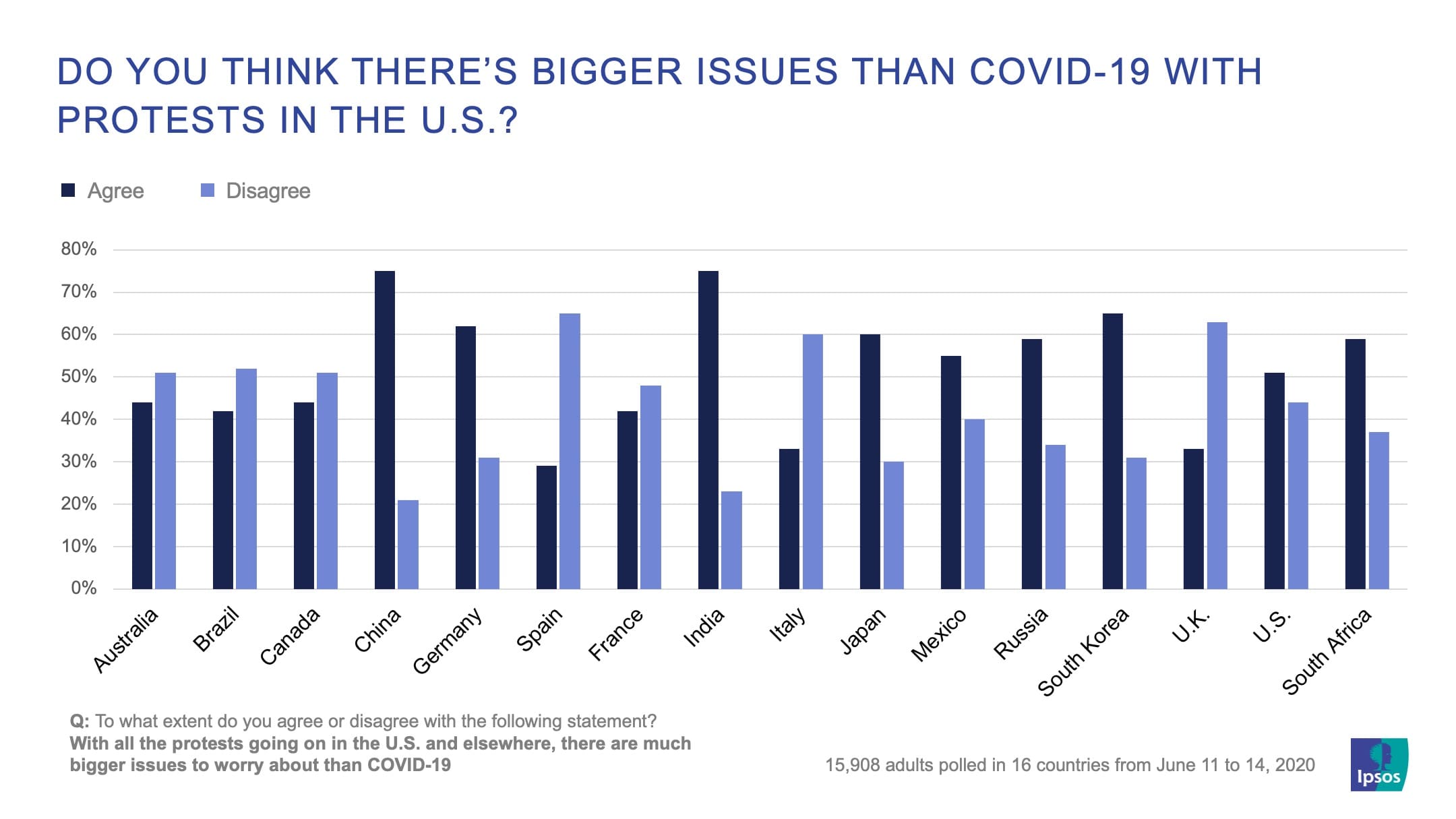
A majority of people in nine out of 16 major countries say there are much bigger issues to worry about than the coronavirus with all protests going on in the United States and elsewhere, according to the latest Ipsos survey.

People in China and India (75%), South Korea (65%), Germany (62%) and Japan (60%) are most likely to agree with this in a poll of nearly 16,000 respondents conducted from June 11 to 14. Those in European countries of Spain (65%), the United Kingdom (63%) and Italy (60%) are most likely to disagree.

France is the most divided country on the issue with only 6 percentage points separating those that agree and disagree with the statement that there are bigger problems to worry about than COVID-19. The U.S. is tied with Canada and Australia for having the second smallest margin between respondents that agree and disagree at 7 points.
Do you think there's bigger issues than Covid-19 with protests in the US? | Ipsos | Essentials

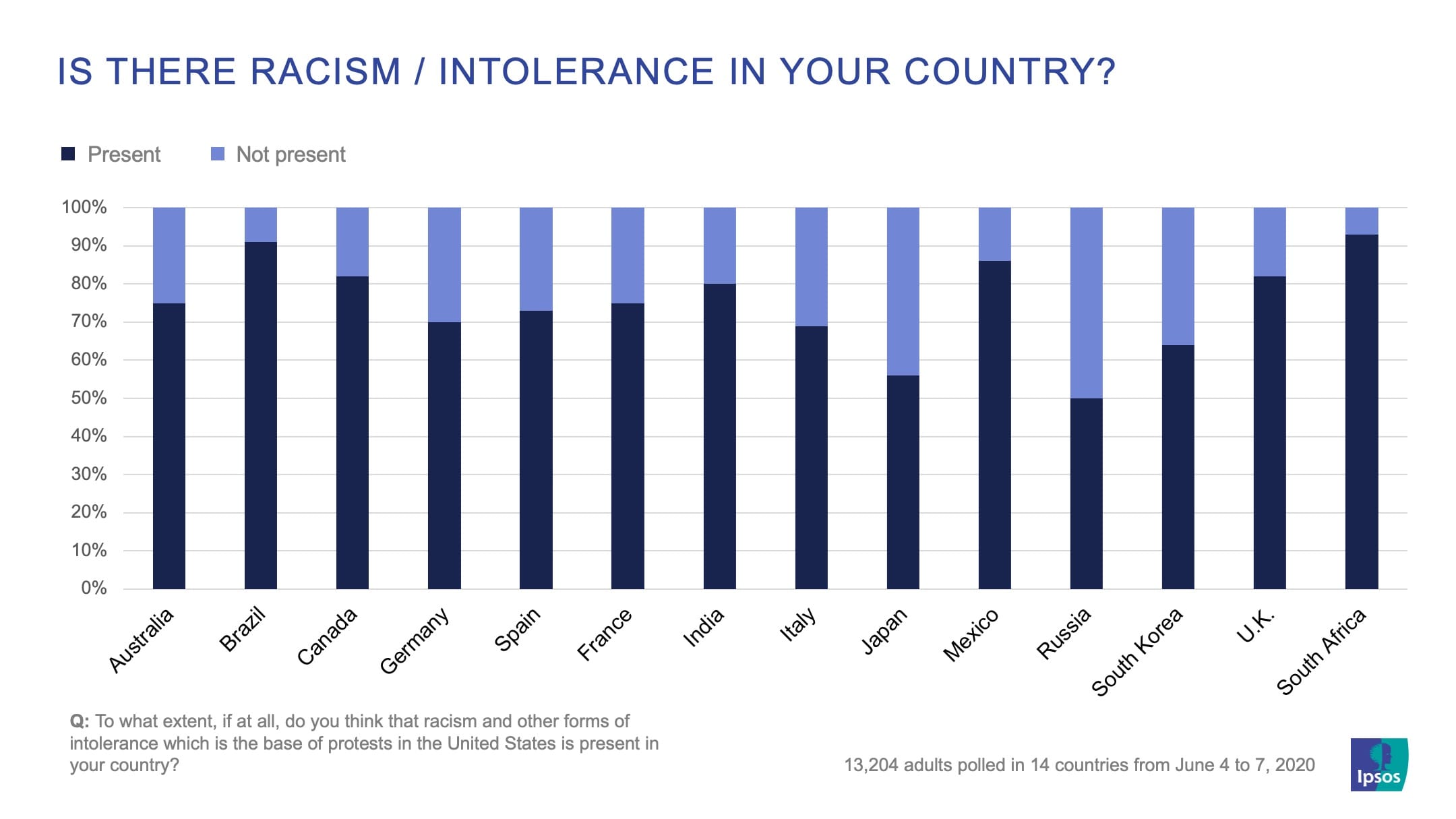
Added to this, in a separate Ipsos poll conducted in 14 major countries outside of the United States from June 4 to 7, a majority in 13 countries said racism and other forms of intolerance, which are the base of the protests in the U.S., is present in their country.

People in emerging markets of South Africa (93%), Brazil (91%) and Mexico (86%) are mostly likely to agree with this, followed by Canada and the U.K. (82%).

Russia is the only country surveyed where respondents are evenly divided on the question at 50%. Other countries where about a third of people said racism and other forms of intolerance is not present are Japan (44%), South Korea (36%) and Italy (31%).
Is there racism / intolerance in your country? | Ipsos | Essentials

These are the results of an Ipsos survey conducted June 11th to 14th, 2020 on the Global Advisor online platform among 15,908 adults aged 18-74 in Canada and the United States and 16-74 in Australia, Brazil, China, France, Germany, Italy, Spain, India, Japan, Mexico, Russia, South Africa, South Korea and the United Kingdom. Where available, tracking results from previous studies conducted through March and April, as well as selected results from February, are referenced by date.

Ähnliche Inhalte

  • Wie sehr machen sich die Deutschen Sorgen, dass sich ein Iran-Krieg auf ihre Urlaubspläne auswirken könnte? Laut einer aktuellen Umfrage sind nur 15 Prozent sehr besorgt, eine knappe Mehrheit von 57 Prozent sorgt sich hingegen nur wenig oder gar nicht.
    Urlaub Pressemitteilung

    Iran-Konflikt trübt Urlaubspläne der Deutschen kaum

    Ipsos-Umfrage zeigt steigende Kosten als Hauptsorge bei der Reiseplanung
  • Welche Themen beschäftigen die Deutschen derzeit am meisten? Laut einer aktuellen Ipsos-Umfrage nehmen seit dem Ausbruch des Iran-Kriegs die Sorgen vor steigenden Preisen und militärischen Konflikten zu. Migration und Kriminalität rücken dagegen in den Hintergrund.
    Krieg/Terrorismus Pressemitteilung

    Stimmung der Deutschen auf dem Tiefpunkt, Sorge vor Krieg und Inflation nimmt deutlich zu

    Ein Jahr nach Amtsantritt der schwarz-roten Bundesregierung sehen 82 Prozent der Deutschen das Land auf dem falschen Kurs – drei Prozentpunkte mehr als im Vormonat. Die Lage der Nation wird damit so pessimistisch eingeschätzt wie selten zuvor. Lediglich nach dem Bruch der Ampelkoalition im Februar 2025 war die Stimmung noch etwas schlechter: Damals lag der Anteil der Zuversichtlichen bei 17 Prozent, aktuell bei 18 Prozent. Auch die wirtschaftliche Lage wird zunehmend kritisch bewertet: Nur noch 22 Prozent der Deutschen halten sie für gut – ein Rückgang um 7 Prozentpunkte gegenüber dem Vormonat.
  • Wie stehen die Menschen zum Klimawandel und zu steigenden Energiepreisen? Laut einer aktuellen Ipsos-Studie zum Tag der Erde nimmt die Klimamüdigkeit weltweit zu, während das Thema Bezahlbarkeit in den Vordergrund rückt.
    Klimawandel Pressemitteilung

    Tag der Erde: Jeder Zweite vertraut nicht auf Klimaplan der Bundesregierung

    Pünktlich zum Tag der Erde (Earth Day) am 22. April zeigen die Ergebnisse einer aktuellen Ipsos-Studie in 31 Ländern ein beunruhigendes Bild: Die Klimamüdigkeit ist weltweit auf dem Vormarsch. Zwar stimmen weltweit 61 Prozent der Befragten der Aussage zu, dass Untätigkeit beim Klimaschutz künftige Generationen im Stich lässt, doch in allen 26 Ländern, in denen Ipsos seit 2021 fortlaufend Daten erhebt, ist die Zustimmung rückläufig. Deutschland bildet dabei keine Ausnahme.