More Americans think news organizations can take an unbiased stance
The Ipsos Consumer Tracker asks Americans questions about culture, the economy and the forces that shape our lives. Here's one thing we learned this week.
Why we asked: At the start of the pandemic, Ipsos worked with the Trust Project, a non-profit focused on trust and transparency in news, on a series of U.S. and global surveys, leading to an issue of our What the Future magazine on the topic of Truth and a companion global report on Trust Misplaced. Those issues uncovered a perfect storm for disinformation as people tend to read free content, which tends to be low quality, and they trust the news they read. We saw those trends continue in last year’s What the Future: News.
But with AI technology proliferating to produce news, or at least news-like content, and it getting harder to trust what we see with our own eyes, we thought it was time to check back in on these crucial topics and see if there had been any improvement in the situation.
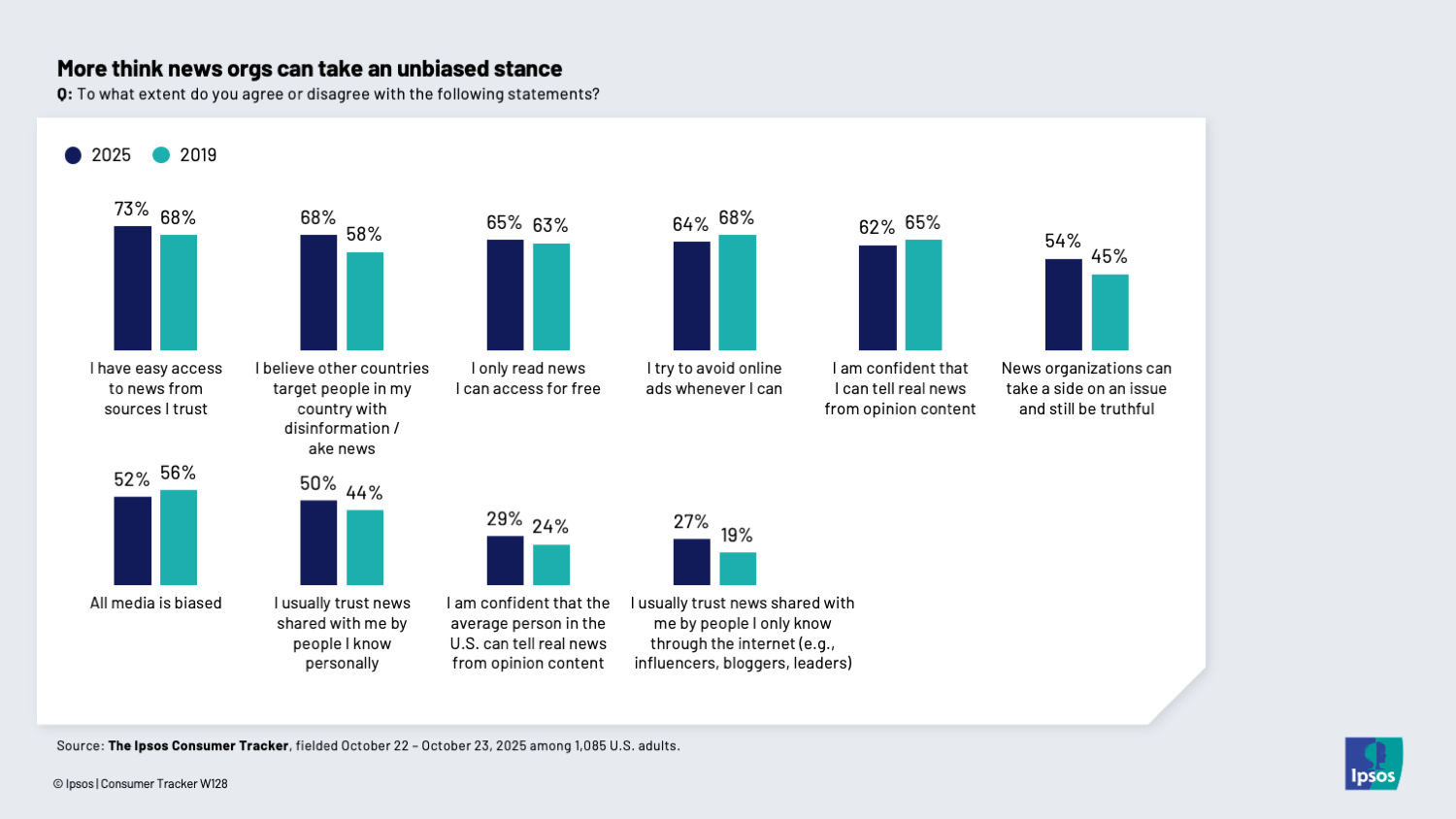
What we found: There is some movement point-to-point. Looking back at 2019, more Americans say they have access to trusted news, and that they trust news shared by people they know personally. But the overall picture remains consistent and … not great.
More (now 27% up from 19%) trust news from influencers or sources they only know online. So the increase in access to trusted news might not be a good thing. We also have a small, but growing, confidence that the average American can tell the difference between news and opinion content, and a continued high confidence (62%) that we can personally tell news from opinion. Americans’ opinion that all media are biased remains divided, with 52% agreeing. Republicans agree more overall (59% to 45%) including three in 10 who strongly agree (30%), double the number of Democrats strongly agreeing.
In terms of what we believe and trust, almost everyone (80% or more) trusts what they see with their own eyes, government records, their memory, and live coverage as it happens. Most also trust researchers and academics. But the really interesting datapoint is the jump from 2019 in those trusting eye witness statements, which popped from 57% to 71% while all other sources remains essentially flat. My hunch: With the rise of AI-generated content, we trust humans more now. We’ll keep an eye on this one, too.
More insights from this wave of the Ipsos Consumer Tracker:
One in three Americans say Halloween is their favorite holiday
Investing seen as best way to build wealth, but homeownership is safest
Are Americans privacy nihilists?
One in three still say corporate DEI stances make them more likely to purchase
The Ipsos Vibe Check: Here's how Americans feel about the government this week
The Ipsos Care-o-Meter: What does America know about vs. what does America care about?