

How America’s ‘stuck at home’ trend is shaping the American Dream
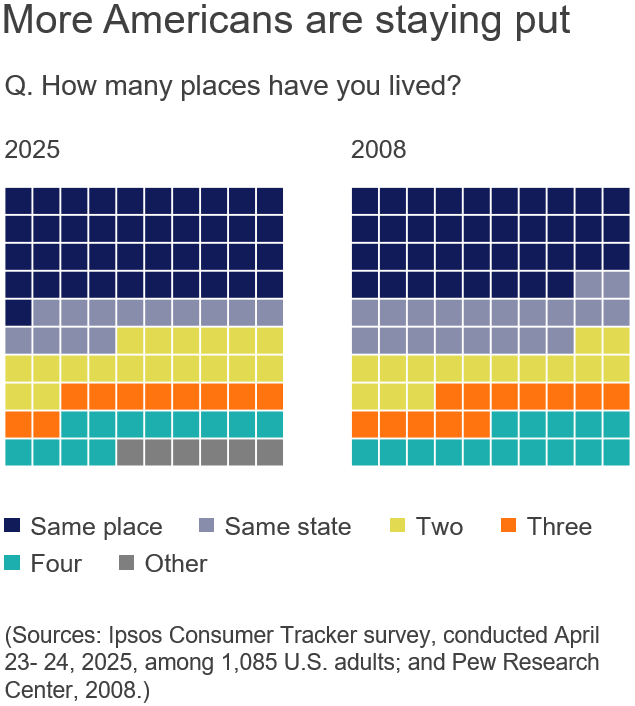
Throughout U.S. history, one key way to achieve the American Dream was to move to somewhere new with different opportunities. There was a time when one in three Americans moved each year. Now it’s just one in 13. Our nation has lost its mobility. Yoni Appelbaum is the author of “Stuck” and deputy executive editor at The Atlantic. When he thinks about the future, he wonders if we can achieve the Dream from where we are, rather than leave home to find it.

Matt Carmichael: The opening line of “Stuck” reads that the last thing you ever wanted to do was move. Why start there in a book about mobility?
Yoni Appelbaum: I wanted to begin this history of the magic of mobility by acknowledging that it’s both a counterintuitive and somewhat uncomfortable argument that most of us instinctively avoid uncomfortable things. And moving is intensely uncomfortable.
Carmichael: America has a history of big movements along the frontier or the Great Migration. Do those opportunities still exist?
Appelbaum: Large-scale migration has been an act of desperate necessity. People have left a place when they had no choice but to leave. In America, it’s typically been the opposite. Most of our internal migration has been more driven by the pull than by the push. The pull has driven Americans with the tantalizing dream that by relocating they can change not only their address, but their destiny.
Carmichael: Does travel count as mobility here?
Appelbaum: Improving transportation infrastructure often left us much further apart. The great challenge of the 21st century is ensuring that we can deliver on the hope of the 19th rather than the disappointment of the 20th.
Carmichael: What do we lose if we become less physically mobile as a society?
Appelbaum: The cost isn’t simply that we’re seeing less social mobility and less economic mobility. It’s a decline in a sense of agency and the bitterness that comes with a lack of personal dignity and the alienation that comes from the correct sense many Americans have that their choices are now constrained by forces far beyond their control. Restoring the American Dream is about the things we can measure economically, but it’s also going to require giving people back that sense of individual agency.
Carmichael: Housing is where most people’s net worth is banked. How do we get communities and residents to agree to more housing if they’re afraid it will hurt values?
Appelbaum: It’s a mistake to assume that most of us are primarily trying to maximize the value of our assets. A theory called the Home Voter Hypothesis posits that people are resistant to new development because they are acting as economically rational people. The problem with that is that people will show up at hearings to oppose development because it will drive down property values. But in my experience when people become convinced that a new development will drive up property values, they oppose it on those grounds.
Carmichael: Do moves for college count?
Appelbaum: There’s a moment in Vice President JD Vance’s autobiography where he looked around at the groomsmen of his wedding and realized each of them is a boy from a small Ohio town who left home to go to college and returned. Higher education as a driver of mobility is incredibly important and it is not enough — because college today is increasingly a privilege of affluent children of people who themselves had access to higher education.
Carmichael: The funding for higher education is being disrupted today. Can anything replace it?
Appelbaum: I don’t know that there will be a replacement for that. America’s higher education system is a precious thing, and it has a lot of flaws. It’s easy to focus on those flaws, to feel anger about the mistakes institutions make and to adopt a “burn it all down” mentality. The current system of higher education gives us lots of things that we’ve come to take for granted, like research and innovation that fuels our economic growth or the chance for students to transform their lives to find their own paths. We tamper with that at our peril. If we end up significantly constricting access to higher education, we’ll leave many more Americans feeling stuck.
Carmichael: “Stuck” talks about how well-meaning public policies have been poorly implemented. Do we need better policies or just to use them better?
Appelbaum: In the middle of the 20th century, large-scale government programs like urban renewal did tremendous damage to many communities and, particularly, to the most vulnerable communities. From that excess, we got an equally excessive reaction. We implemented a set of public policy changes that effectively gave a distributed veto to anyone who wanted to block change of which they disapproved. It was an unequal veto, exercised most easily by the most affluent and the best educated. There’s something ironically, profoundly antidemocratic about this.
 Restoring the American Dream is about the things we can measure economically, but it’s also going to require giving people back that sense of individual agency.”
Carmichael: One recurring theme in “Stuck” is that many of the policies were implemented with racial bias. Could the policies have worked otherwise?
Appelbaum: That’s exactly the right question. When I set out on this research, I wanted to believe that many of the policies we have, from zoning to federal regulation of the housing markets, had been warped and corrupted by American racism and could be cured of those biases. If you arm the current residents of a community with the ability to effectively decide who gets to join them, they will exercise that authority in the service of exclusion.
We should not craft public policy to be implemented by angels. We should craft public policy to be carried out by human beings in all their messiness.
Carmichael: Housing shortages are to blame for a lot of our problems. How do we incentivize more affordable housing?
Appelbaum: That’s the wrong question. We need to allow and don’t even need to incentivize the construction of a lot more housing. The people who get the greatest benefit from the development of new luxury housing are the people at the bottom of the economic spectrum, because there will be a chain of moves within their community that frees up new housing for them, and they will actually experience a greater upgrade.
Carmichael: How much of a factor in our lack of mobility is the rise of dual-income households?
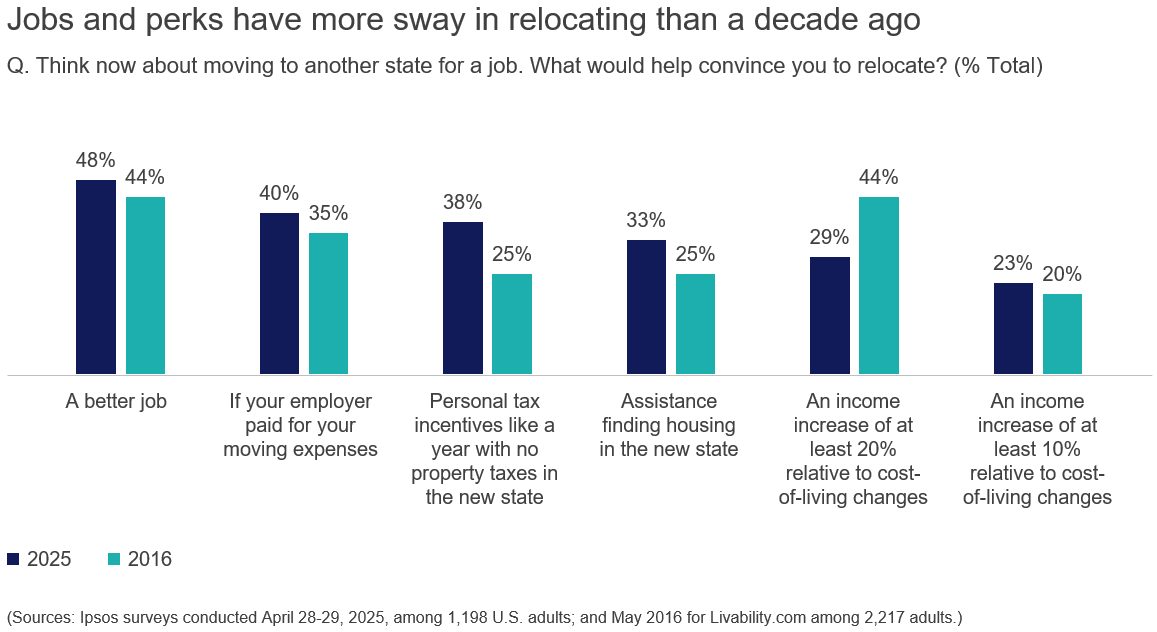
Appelbaum: Mobility over the last 50 years is down more sharply among singles than it is among married couples. It has always been hard for Americans to move away from the support networks of loved ones. Yet for two centuries they did it in astonishing numbers. There are always good reasons not to move. What’s changed is not the strength of the incentives for Americans to stay where they are, it’s the diminishing incentives to go anywhere else.
← Read previous | Read next → |