
How different Gen Beta personas could define the future
 Download the full What The Future: Family issue
2025 is the first year of a new generation. Futurists Joana Lenkova of Futures Forward and Alexandra Whittington teamed up to consider what life will be like for these new kids, creating a series of six personas of Gen Beta. Among them, there’s the Smart City Kid, surrounded by urban tech. There’s the NeoIndigenous Hippie Kid who challenges ideas about climate resilience, drawing on revived ancient wisdom. There’s even the first post-nation kid, born in space. Thinking about these kids now can set up leaders to build a better future for these generations.
Matt Carmichael: What kind of inputs did you use to imagine the worlds these kids would grow up in?
Joana Lenkova: Already nearly half of the world's young people live in areas that are facing extremely high climate risk. By 2050, two-thirds of the world's population will live in cities, which is up from just over 50% today, meaning that these billions of kids will grow up entirely within urban ecosystems. The market for “smart city” tech is projected to increase threefold to over $3.7 trillion. That shows how quickly our living environments change and evolve. This tells us that both society and its underlying systems are preparing for this new generation that will live in a more complex unpredictable world with fluid and unpredictable lives.
Alexandra Whittington: The idea that children could be more prominent or have a more important, even survival, role in society is not a new idea. So we’re looking for the direction or hints about how the culture is changing more so than the signals themselves.
Carmichael: How is childhood itself changing?
Whittington: Children have traditionally had important jobs or roles to play in society. This idea of “childhood” is only about 150 years old, right? Life stages and phases can evolve. I think there may be new demographic categories that are going to alter not just childhood, but parenting and grandparenting.
Carmichael: How did technology surrounding today’s kids factor into the personas?
Lenkova: There is a widening gap between those who have access to tech and those who are impacted severely by resource scarcity. When we are looking at these different personas, we tried to picture what the different childhoods in the future could look like. We’re heading toward a future where some kids will grow up in this hyper-optimized environment where there is governance and learning and schedules, and daily life is somewhat engineered. That could look like a dystopia to someone, but at the same time it could look like utopia to someone else who doesn't have all of that.
Carmichael: Polarity comes up a lot in the personas. Why?
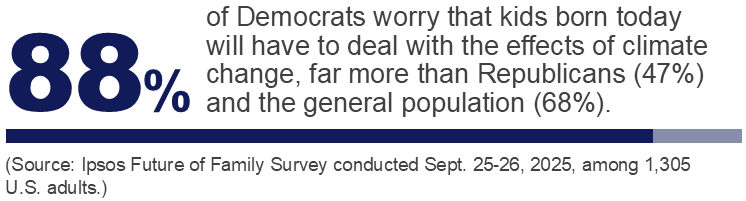
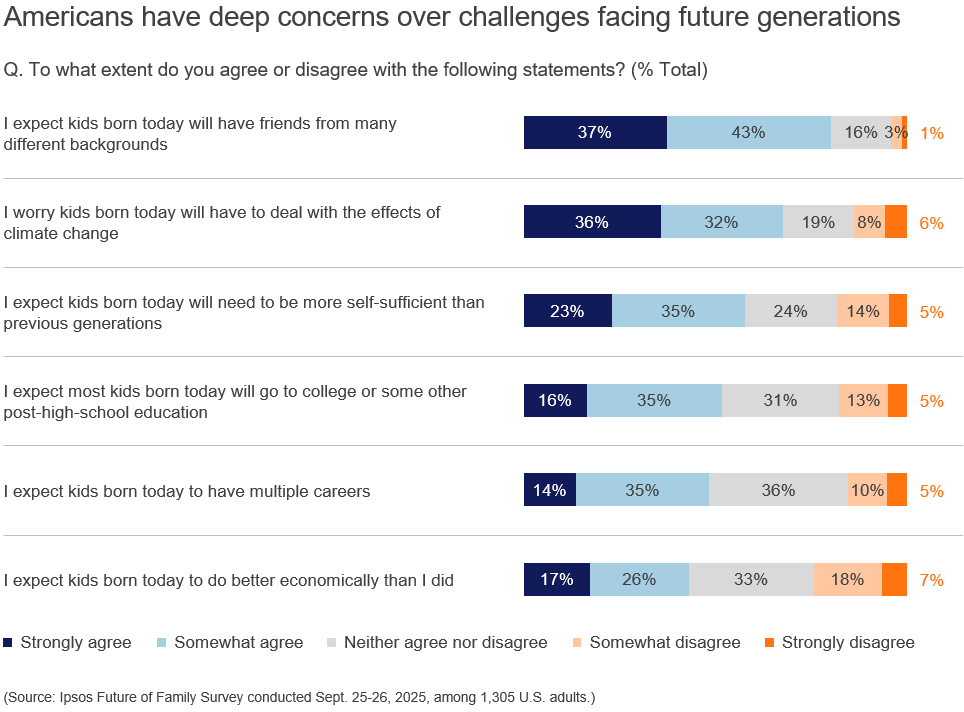
Lenkova: AI, robotics and synthetic biology are going to have a huge impact on how kids learn and how they communicate with each other. Tech will impact what it means to be human. But AI-free and human-made trends are accelerating as well. Parents are trying to find balance between having the kids spending time in the digital environment and being in nature, but we have climate disruption. Eighty-eight percent of adults in your survey believe climate change will shape kids’ futures. That will determine how these kids live and what sort of childhoods they have.
 AI, robotics and synthetic biology are going to have a huge impact on how kids learn and how they communicate with each other. Tech will impact what it means to be human.”
Carmichael: What other big shifts are you watching?
Whittington: This will be the first generation in a while that hasn’t experienced American hegemony. As you talk about in your American Dream issue, we’re seeing different power structures in the world. We and our parents grew up with “America’s No. 1.” I think it’s going to be strange to see a generation where that’s just not in their reality.
Carmichael: How can leaders use these personas to think about the future?
Lenkova: They can help stress test assumptions about the future. One prompt would be, “How do you design for this generation that is expecting to cocreate this environment rather than just consuming it?” Or, “How do you support learning and education and creativity when in one part of the world you have AI mentors and in another you don’t?”
Carmichael: Why is thinking like that useful?
Whittington: If leaders can digest and reverse engineer to their own liking some of the way we put the story together, it can be insightful in how futurists think. When you're talking about generations, we've got 20, 30 years to plan. We should take advantage of it!
← Read previous | Read next → |