
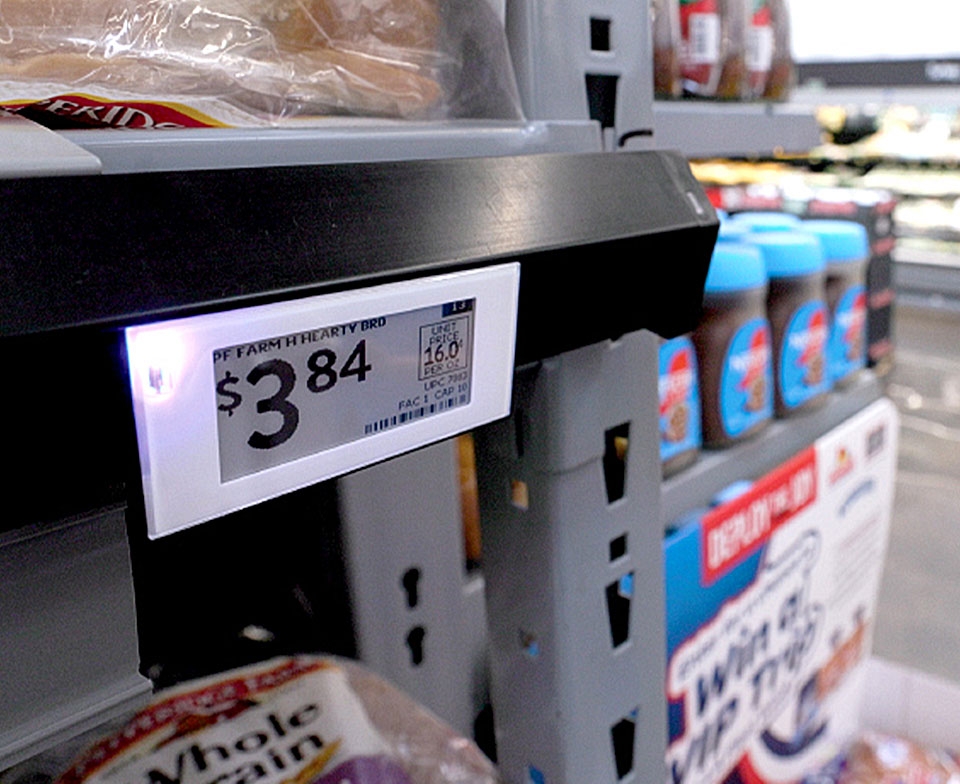
How digital shelf label expansion signals a new era for supermarkets
Imagine walking through your local supermarket where electronic price tags flicker and change as you pass a display. 2026 could make this a reality.
As digital shelf labels go nationwide, they enable prices to change from moment to moment and spark a revolution in how Americans shop for groceries and other everyday goods.
Chains including Whole Foods, Walmart, Kroger and Aldi are among the early adopters in testing electronic shelf labels in their physical stores. Walmart is expanding its digital label pilot chain-wide on the heels of winning a patent for algorithmic pricing updates.
Retailers position digital labels as a win for both employees and customers for cutting manual updates, which also take store employees away from customer service. But customers fear that dynamic pricing like that behind Uber fares and concert tickets is coming to the grocery aisle.
In Walmart’s case, expect the chain to change prices more frequently, but only on a daily basis to maintain the Everyday Low Price position and to run sale experiments, says Robert Phillips, a retired professor and pricing consultant who has worked for Uber, Amazon and other tech companies, as well as a professor for Columbia University and Stanford Graduate School of Business. Its new patent focuses on algorithmic markdowns, similar to a Target patent.
“I don't see them doing intraday pricing now. That'd be quite difficult to do technically and would really get customer pushback, Phillips says. “Anytime anyone changes how they do pricing, consumers immediately assume that it's being done in order to extract more money through from them through higher pricing.”
Americans strongly oppose dynamic pricing, according to a recent Ipsos Consumer Tracker poll. Nearly eight in 10 people (78%) agree that every buyer should pay the same prices, and more than half say dynamic pricing is akin to price gouging. While proponents say it helps shoppers get better deals, only one in three Americans (33%) agree.
Attitudes are changing, though. The Ipsos data also shows younger adults are more likely than older peers to agree that dynamic pricing is fair for merchants and that it allows shoppers to get deals, albeit a minority in both cases. There’s a similar pattern of acceptance among Republicans compared to Democrats.

Like consumers, legislators question the fairness of dynamic pricing strategies. In February, a pair of senators introduced the Stop Price Gouging in Grocery Stores Act of 2026. It aims to ban companies from using the technology to hike grocery prices based on individual shopping patterns or at 120% at or above the average price.
For larger chains, Phillips thinks many stores will ultimately use dynamic pricing for daily price changes. He says where digital labels could most benefit retailers is to help brands experiment with strategies like hi-low pricing that starts high but drives traffic with markdowns. “So it's not just the digital prices go up and down,” says Phillips. “It's like Pepsi on sale this week, only with a big display. Then some stores just do alternating weeks with Pepsi on sale one week, Coke on sale the next week.” This strategy is currently expensive and difficult to implement.
It’s important to remember that simply putting a sign that says “sale” drives revenue, according to Phillips. He adds that making intraday price changes happen will require additional innovation, like stamping the price on the item when you pick it up off the shelf. “Whether consumers will ever accept that or not in a physical environment, I'm more skeptical,” he says.
One thing is sure, as digital labels expand across shelves, supermarkets have a critical need to understand how to advance cutting-edge technology with consumer trust.
“The opportunity for our clients is to understand who is most resistant and determine how to address their concerns so they don't lose their business,” says Kristy Click, senior client officer at Ipsos.
How quiet tech and human insights could revive supersonic flight