
How to fill gaps in teen mental health and social media research
Young people are more stressed than ever, in part because of social media and the internet. On top of that, academic and social pressure and the fast-paced nature of modern society can lead to stress and burnout. But it’s not all that simple, says Barb Solish, national director in the Office of Innovation at the National Alliance on Mental Illness (NAMI). She believes more research is needed to better understand the mental load from tech on teens across demographics to find better ways to help them.
Kate MacArthur: Thinking of teens’ health and technology, what future question do you wish you knew the answer to today?
Barb Solish: We need to be thinking about the different ways that adolescents are interacting with technology. Is that screen time? What does that mean? Is that video games, social media apps? Which apps are we talking about? Are we talking about teenage girls, teenage boys? What age groups are we talking? Gender identities, ethnicities, socioeconomic status? All that research needs to be parsed out and needs to be a lot more specific than we have it right now.
MacArthur: Is there a particular concern regarding technology’s impact on teens’ future lives?
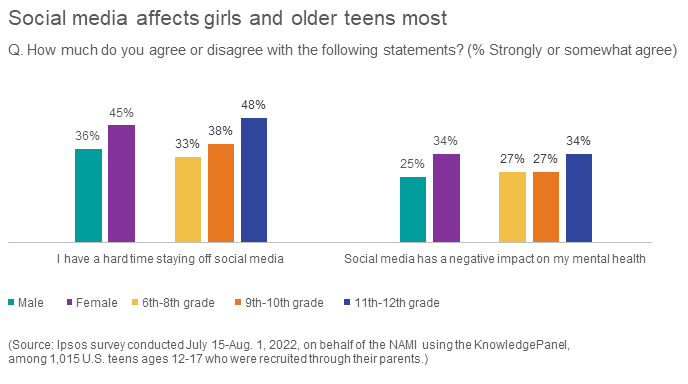
Solish: I would focus on the effects of social media. It's different than text messaging, different than video games. And we have some good evidence that there is an impact of social media and different apps on teen mental health.
MacArthur: How is social media changing the relationships that teens have with other people?
Solish: Some anecdotal evidence and other data show that things like messaging features of an app are a really great way to create community and to talk to your friends in a pretty safe way. But posting and filtering and making sure you have the perfect image and then worrying about how people are reacting to it is a different effect.
MacArthur: How worried should we be about youth addiction to technology?
Solish: We used to have studies that say a little bit of social media is fine and good for community. But the more hours you spend, there’s diminishing returns. But there's conflicting evidence now. It's just not clear and I wish I had a better answer for that. Some people view it as like sugar or salt, like having a little is fine, but having a lot is potentially harmful for your health. But that hasn't borne out in the data now.
MacArthur: One of the societal changes we’re seeing is destigmatizing therapy and medication. Is that due to social sharing or something else?
Solish: It depends. An enormous amount of the decrease in mental health stigma comes a lot from people sharing their stories online. During COVID-19 lockdowns especially, people were isolated, and they were sharing their struggles and it made it a lot less scary to feel like you are not alone. That's a huge positive. Maybe you're living in a community that doesn't recognize a mental illness as [being as] important as a physical illness or even existing. But you're seeing other people who may come from your background being open about it. And that leads to ultimately help-seeking behavior, which is what we want in the end.
“We used to have studies that say a little bit of social media is fine and good for community. But the more hours you spend, there’s diminishing returns. But there’s conflicting evidence now. It’s just not clear and I wish I had a better answer for that.”
MacArthur: What does that change going forward?
Solish: Even seeing it in lawmakers, both sides of the aisle are introducing bills trying to change how we even respond to crisis. The passage of the 988 [Suicide & Crisis Lifeline] bill is monumental to mental health crisis response. Instead of getting a police response, now they can respond with a mental health response. Some say one in five people experience mental health condition worldwide, but five in five people are affected. You either have a mental health condition, or someone you love does. That personal impact is creating change, too.
MacArthur: Is that equally distributed between teens and adults?
Solish: We did a survey with Ipsos, the Teens survey. There was a lot of support and positivity around mental health conversations and mental health policies. For example, schools offering mental health days as excused absences and having mental health education in classrooms. those two are really big in terms of support for those among teens.
MacArthur: Is there anything that we haven’t talked about that is important for teens for the future?
Solish: We didn't talk a lot about filters and slimming apps and things like that. They have been normalized and there's also more pushback against them. And I am seeing at least some drive for authenticity. But there's even more of that rawness that young people are striving for. But influencers and influencer culture are still using those filters. I go back to parent and caregiver and teacher education of asking the question: What do you think is real? What do you think of the filters? It might get at the core of what a young person might think about it. And it may question how they view a filter as something real or not, and how taking that extra therapeutic look at what that might mean for them.
|
← Read previous |
Read next → |
For further reading
Mind matters: Exploring generational perspectives on mental health
Mental health is now the number one health problem, ahead of cancer and coronavirus
Teens comfortable talking about mental health, but fewer are actually doing so