
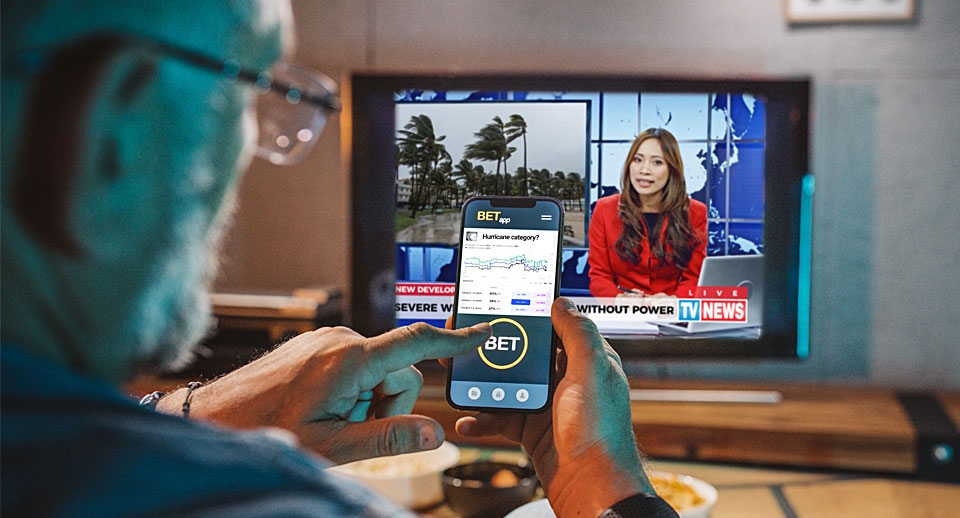
How overconfidence fuels the indulgence of risk in prediction markets
 Download the full What The Future: Indulgence issue
Traditional betting, where people bet against a central entity (“the house”), has been legalized in many states. Prediction markets — where people bet against each other instead of the house on event contracts from sports to weather to elections — also seem to be operating on more solid legal footing these days after a series of court cases. That could change, says Eric Zitzewitz, an economics professor at Dartmouth College who studies these behaviors, if the political winds blow another way in the future. In the meantime, who takes part in these bets and what do they say about the future of risk as an indulgence?

Matt Carmichael: What kind of people are drawn to prediction markets?
Eric Zitzewitz: Participants tend to be non-representative in a number of ways. They tend to be more educated, younger, male and white. They tend to be a bit more Republican. But it turns out that when they're trading, they're pretty much just trying to make money, so there don't seem to be biases for one party or another that are systematic from electoral cycle to electoral cycle.
Carmichael: Why do you think that profile is drawn to these risks?
Zitzewitz: Men are more overconfident in many contexts, including finance. You have to be a little bit overconfident to trade in a market that's inherently zero sum and then also charges you fees, right? Because you know that the average investor’s going to lose money in a market like that because the house is going to get its take. Overconfidence is actually what makes these markets go. People might have other trading motives and be willing to lose money because it's fun.
Carmichael: There’s a Stanford study that people remain overconfident even when they have past losses.
Zitzewitz: Live and don’t learn!

Carmichael: What can prediction markets tell us about the broader world?
Zitzewitz: I'm most interested in prediction markets that are pricing something that's of economic interest, in particular how other financial asset prices are moving along with those odds. Like the odds of a policy being undertaken. Sometimes policies are important and have big effects on other asset prices, like to go to war with Iraq in 2003. Potentially looking at how markets are moving with prediction markets on whether we undertake a policy can inform whether to undertake the policy in the first place. That's potentially really valuable.
Carmichael: Are young men especially drawn to these markets to “get rich quick”?
Zitzewitz: One reason you might end up being overconfident is that you're trying to figure out how to get rich quick, for lack of a better idiom. You're constantly on the lookout and very willing to update when the data is positive whether this is going to really make you rich. The question is whether it's a new phenomenon or this has always been what you do when you're young.
 Overconfidence is actually what makes these markets go. People might have other trading motives and be willing to lose money because it’s fun.”
Carmichael: How much of the future of these markets hinges on policy, and who’s crafting it?
Zitzewitz: It wasn't always the case that this was a partisan issue. In the run-up to the 2022 midterms, the markets were a bit more bullish about Republicans’ chances, which turned out to be mostly incorrect relative to people in the media. But I started to sense that left-leaning media viewed prediction markets as, I don’t want to say, “competition,” but as threatening their ability to control the narrative in some sense. It started to become a partisan issue. It was President Barack Obama's Commodity Futures Trading Commission that let prediction markets first get started in 2014.
Carmichael: To what extent do these markets need casual/indulgence users to function?
Zitzewitz: These markets don't work if everybody's informed and trading with a profit motive. The problem with a market like that is that whoever's the least good weather nerd, or what have you, figures out they're the worst weather nerd and they drop out, then the second-worst weather nerd drops out, and the really smart person is left with no one to trade with. For markets to work you need either people to be overconfident or willing to lose money on average because it's fun. One of the ways you get both types of people is by having markets on things like politics and sports. They’re fun and natural topics to be overconfident about. That makes it possible for there to be people who are informed and making money systematically and still have people to trade with.
← Read previous | Read next → |