

What business and institutions need to know about changing norms of love
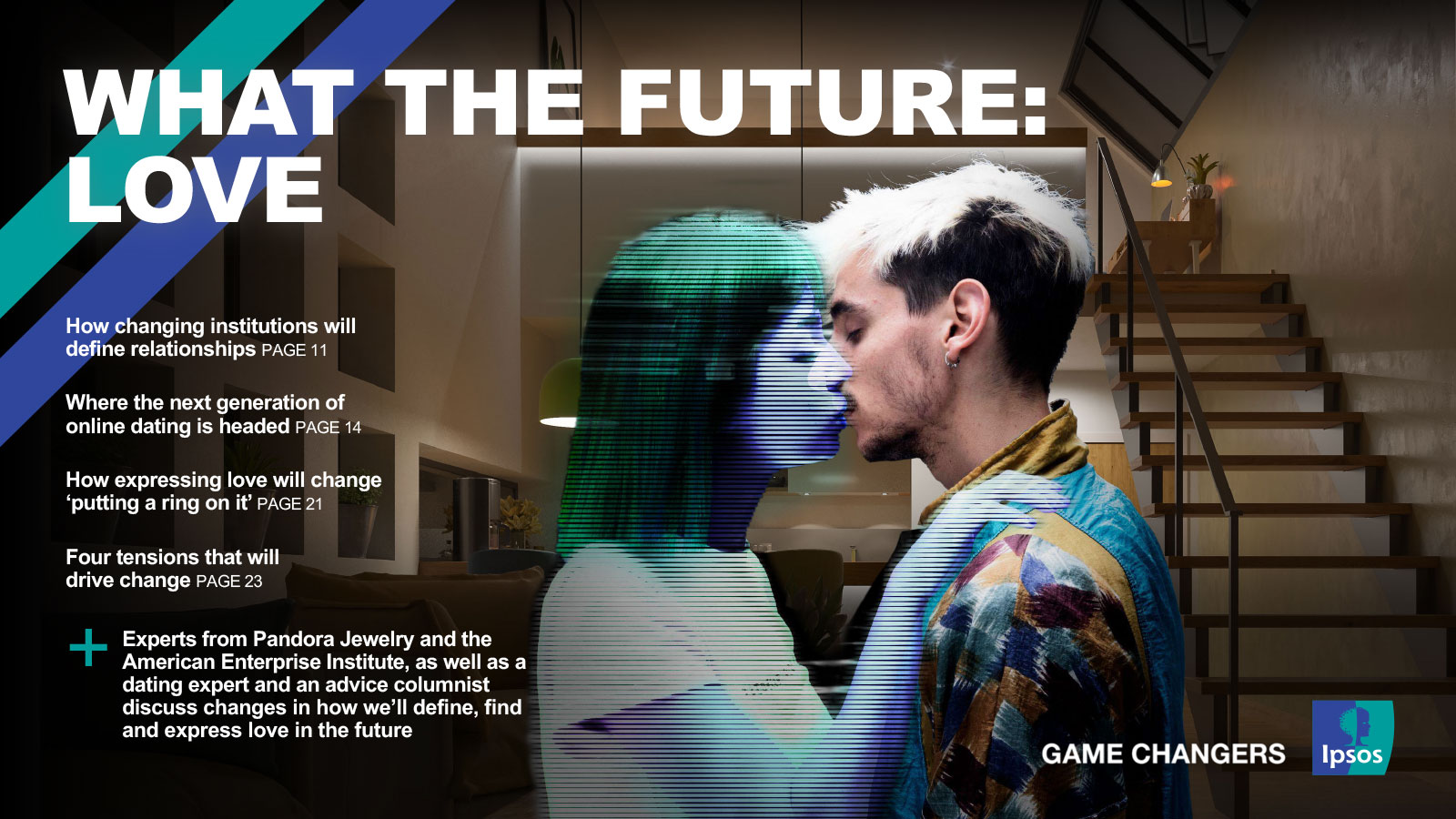
Love issue
Imagine it’s 2030.
How did you meet your spouse or partner? It’s a basic cocktail party question. When fielded as a survey prompt, we see a lot of expected answers: work, school, friends, etc. But then sometimes verbatims bring home the gold: “He came to my house to serve my foreclosure notice.”
Now there’s a story of love. And who knows, with interest rates where they are maybe we’ll see more of this kind of answer in the future. Because love and marriage and money are inextricably tied up with each other. Always have been, and plausibly always will.
The Philosopher of Love, Huey Lewis, once sang that, “The power of love is a curious thing. Make a one man weep, make another man sing.” I would argue it could make the same man do both, but I digress. In foresight, it’s a contractual obligation that you are a fan of “Back to the Future,” so this key soundtrack song fits this issue in multiple ways.
We are curious about love, its future, and how changes in how we love, who we love, how we express our love and how we navigate the functional constructs of love will impact everything from housing to financial services to jewelry and retail and more.
Some aspects of love, like marriage, have been changing over the decades. The median age at first marriage has risen to over 30 for men and over 28 for women. Importantly, the portion of the never-married population has also been rising for decades. All of that is the nuts and bolts of relationships (or lack thereof), so what of love itself?
How will we meet our partners? How many will we have at once, and over our lifetimes? These answers are changing, and increasingly technology and platforms are playing a role. Like so many aspects of our lives, love is now moderated and mediated by screens and tech. Enter ChatGPT and its AI successors.
In this issue we’ll talk to dating expert and former Tinder sociologist Dr. Jess Carbino who thinks there is a lot of potential for AI to assist in the dating process, especially since matchmaking sites have such a trove of data to train it on. But even without insider access, ChatGPT is doing a reasonable job. I asked it to write a dating profile for a 25-year-old guy who likes the outdoors, cooking and action movies and wants a female partner. It did a decent job. But as Carbino told me, humans are bad at doing that themselves.
Having an AI tell you that a dating profile should be “honest about who are you” as it writes you a dating profile is a little mind-bending.
So I told the AI that it had been trained on suboptimal inputs (there’s a larger story of AI here, for sure). I asked it to write me something it thought would be more effective. And it said, “An effective dating profile should be clear, concise, and honest about who you are and what you’re looking for. … Here is a possible example of a more effective dating profile,” and it wrote me one. I had the AI write me a couple of scenarios for if this guy found love and if he didn’t. They were cheesy and trite.
“One day, while they were on a trip to a new city, the guy got down on one knee and proposed. The woman was overjoyed and said, ‘Yes.’ They were excited to start their new life together as a committed couple.” Not far off the mark as romance fiction goes, eh? AI has the power to transform how we date and find the people we date in ways that could be viewed as positive or negative, maybe making it easier, maybe harder.
In WTF Aging, we talked about an AI-assisted companion for the elder community, ElliQ. As more young Americans remain single for longer — or forever — how far can we be from normalizing similar products aimed at those who are living alone at different phases of our lives?
The future of love is tied to the institutions that have historically shaped and defined it: religions, governments, etc. As our relationships with those structures change, so will our relationships to each other.
Certainly, love in all its forms will be a driver of how we live, spend, relate and even vote. And I would love it if you’d read on, subscribe to What the Future and forgive/indulge the Huey Lewis earworm I lodged in your brain.
|
← Read previous |
Read next → |