
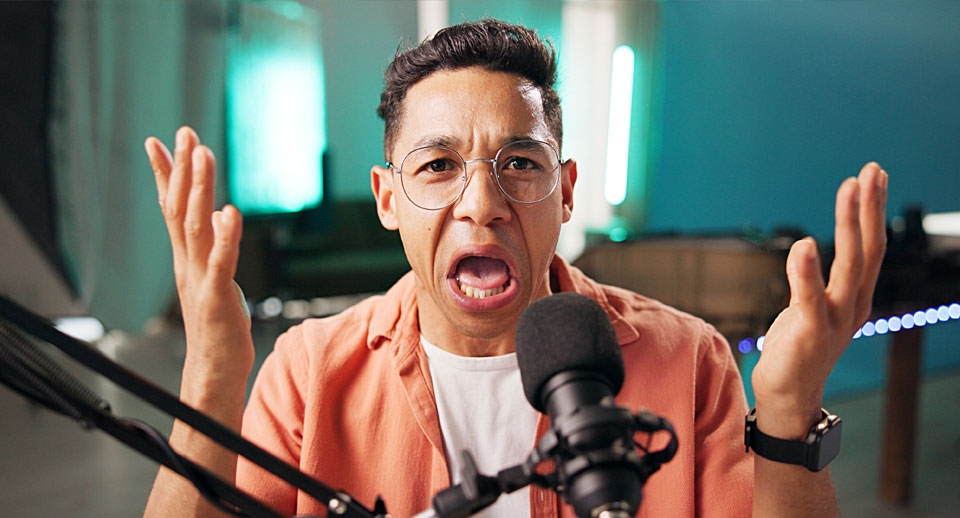
Content is full of cheap conflict attention grabs. It’s time to craft a new narrative
 Read the full What the Future: Attention issue
Journalists (and marketers) are taught that conflict is a great way to get and keep attention. That’s certainly what journalist and author Amanda Ripley’s first editor, the legendary newspaper editor, David Carr, taught her. But she wonders if journalism and other forms of storytelling have come to define conflict too narrowly.
For instance, internal conflict or the tension of the unexpected can both be gripping. Instead, the focus is almost always on some sort of fight. This conflict can be intentional (disinformation campaigns, for instance) or unintentional. It can be constructive conflict that leads to progress, or quite the opposite. The fight-centric narrative has helped lead us into a period of high conflict, the titular subject of Amanda Ripley’s book, and the center of her current work.

What is all the conflict about, can we get attention without it and is there a way out of it? How can we dial it down so we can have conversations that align with our values and don’t just create more conflict? Can you get attention without it today? And will AI make this all better, worse or just different?
Matt Carmichael: How does conflict get attention and keep it?
Amanda Ripley: If we go back to the science of storytelling, we know that the thing that rivets the human imagination is unexpected change. That's why mysteries and science stories are interesting. When you're constantly bombarded with dysfunctional conflict, functional conflict is unexpected, mysterious and intriguing in a way that it would not have been 20 years ago. I did a story for the Washington Post about a congressional committee that was half Republican, half Democrat, and they got a bunch of stuff done. If I had pitched that story 10 years ago, my editor would be like, "Are you kidding? It's incredibly boring." But because this is now unexpected, you can write it that way. The brain wants to know, "How did they do it?" Because in the beginning it looked impossible.
Carmichael: Let’s back up. What is high conflict?
Ripley: High conflict is sometimes called intractable or malignant conflict. It escalates to a point where our behavior and perception get extra distorted. Whatever the conflict started to be about, it's now about something else. It fuels itself like a negative feedback loop. Every intuitive thing you do tends to make things worse. You have to do quite counterintuitive things, which we don't have a lot of experience or training for.

Carmichael: And in politics?
Ripley: The same is true in high-conflict politics. You might think impeaching a president would make him less popular. That's not how high conflict works. You might think that overturning Roe v. Wade would lead to fewer abortions in the United States. That's not what happened. The nature of polarization is that each action leads to a corresponding action. It's important to understand that this kind of conflict does not react the way you think it will.
Carmichael: What are the conditions for high conflict?
Ripley: One is the presence of corruption. Institutions aren't trusted to do what people count on them to do, which is when people take matters into their own hands. Another condition is the presence of conflict entrepreneurs. These are people or companies that exploit and inflame conflict for their own ends. One difference between now and the high-conflict time of the Nixon administration is that we have a bunch of institutions that really reward, celebrate and manufacture conflict entrepreneurs, from social media to my own profession of journalism to politics. There has never been a better time to thrive as a conflict entrepreneur in human history.
Carmichael: Former representative Marjorie Taylor Greene was a conflict entrepreneur, but kind of recanted as she retired from Congress. And she was great at garnering attention. Could that situation help diffuse some of the high conflict she stoked?
Ripley: She was on CNN being interviewed by Dana Bash, and she apologized for her role in polarizing the country. Immediately, Dana Bash did what we journalists always do, which is basically call her a hypocrite by pointing out her past actions. I wish she had just said what she was probably thinking: "I don't believe you. Show me why I should believe you. What actions could you take in the next six months so Americans like me can believe that you're serious?" That would've been a great response, as opposed to, "Well, in 2020, you said this on Facebook." When people are starting to exit high conflict, it’s a very lonely, difficult thing to do. If you just do the intuitive thing and look tough for your audience. It doesn't change this dynamic that we're in.

Carmichael: You’re actually doing something about this with your organization, Good Conflict.
Ripley: We've trained a couple thousand journalists in how to cover conflict differently. A couple of things we've learned give me hope. First, there are a lot of journalists, especially younger local journalists, who are absolutely desperate to do this differently. They understand that this is broken. Second, there is a business reason to do it differently because four out of ten Americans are now often or sometimes avoiding contact with the news.
Carmichael: That sounds like a market.
Ripley: It’s a big market. That's roughly 100 million Americans. This avoidance problem is a paradox. A minority of people are deeply engaged with the news because high conflict is so magnetic. They are sending signals to the business that they want more high conflict, controversy, and outrage. At the very same time, you have this much larger group of people who are becoming allergic to the news. They literally cannot metabolize it. Big marquee national media are probably never going to accept this, and they may go down with the ship. But for newer, more innovative local media, I think there's still a chance they will fundamentally revisit how they do journalism because it is in their business, spiritual, and moral interest to do so.
Carmichael: Who’s filling the void for those people?
Ripley: For now, the people serving that market tend to be influencers, wellness people and podcasters who are not doing journalism but are likable, genuine and not super overproduced, so they feel more trustworthy.
People are filling that void, but I don't think it is nearly as good as it could be. There's a huge opportunity there. That's what I spend much of my time trying to figure out: How can you do this whole news business very differently?
 We have played a bit with AI and found it to be shockingly good at coaching humans to be better communicators in conflict.”
Carmichael: So it’s more content than news?
Ripley: Yeah, I think that's right. Or sometimes journalism-adjacent content.
Carmichael: AI is clearly going to allow and already is allowing disinformation at scale. Bots are like artificial conflict entrepreneurs. But can AI be part of the solution, too?
Ripley: We have played a bit with AI and found it to be shockingly good at coaching humans to be better communicators in conflict. Most of us are not well-skilled in intelligent, healthy conflict skills — we never get that training, and we certainly don't see it modeled in our politics or culture. To thrive in the modern age, you're going to have to get much better at it quickly. We have found AI tools to be very good at helping humans, for example, get better at listening.
← Read previous | Read next → |
For further reading: