
What business can learn from faith leaders on shaping a changing world

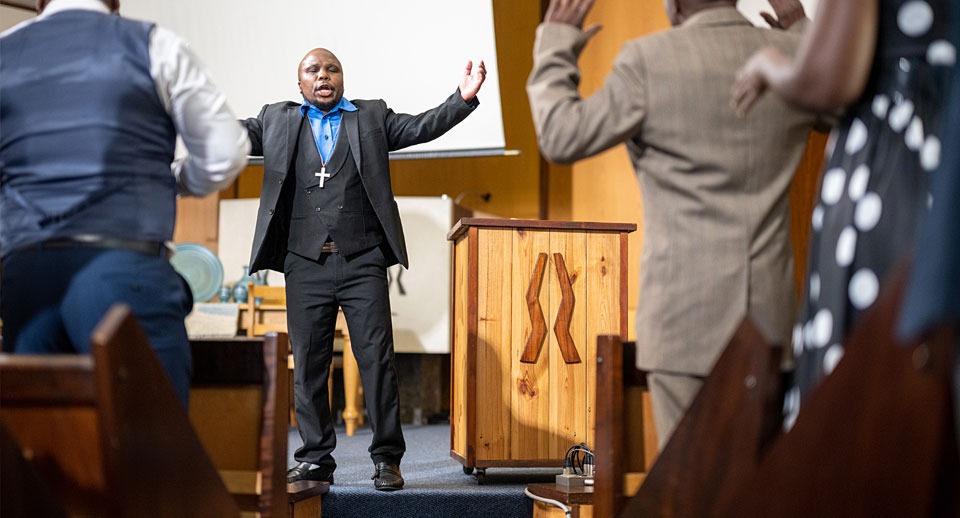
Clergy of all faiths try to steer their followers on a certain moral path. They are the OG influencers, and their influence echoes in other realms. Rev. Bonnie Perry, an Episcopal bishop, uses her pulpit to persuade people on the gospel of Christ, but also LGBTQ+ issues and to help create a sensible gun culture. When she thinks about the future, she’s thinking about the importance of connecting with younger audiences.

Matt Carmichael: Influence is about shaping the present, but also shaping the future, often among people on various sides of issues. How do we get to a future we want through persuasion?
Rev. Bonnie Perry: For context, if I’m thinking about the future I long for, it's a future influenced by gospel values like Matthew 25, about a world that is not about who's in and who's out, but how we include all. That’s the world I'm looking for with God's help. If it's all on us and on me, then we're probably screwed. But if it's more than that, then we have some hope.
How do I do that? I think it's about relationships and mutual respect in those relationships. I think it's about a personal experience and then facts and perhaps an appeal to a higher authority. Not necessarily in that order or linear. But if you made a big Venn diagram with more than three circles, I bet those pieces would play in.
Carmichael: How does persuasion different differ in the realm of faith versus fact versus opinion?
Perry: In terms of fact in the world of faith, I can come up with empirical evidence, but I'm not sure everyone's going to go for it. My fact would be when I approach someone with care and love, the fact of the matter is people respond much differently than if I approach them with disdain, arrogance and hate.

Carmichael: Religious centers and their leaders often weigh in and have influence on a wide variety of moral issues. How does influence extend from one sphere to another for you? For instance, you work on building a safer gun culture.
Perry: I look at other areas that folks might say are not in the world of religion. But I worship a God, Jesus Christ, who came into the world of flesh and blood. So the matters of the world concern me. But I don't ever get to say, particularly in this country, “This is what you must believe.” I can say, “This is how I act. This is what I care about. This is what I believe a just moral society entails.”
Carmichael: In our Future of Influence survey, people said that emotional appeals sway them way less than factual ones. Does that surprise you?
Perry: I’m going to go back to my Venn diagram (and feel bad if a Venn diagram only gets three circles). In terms of relationships, say I have a connection with my cousin. I’m going to listen to that person because I have a relationship with them. Then there’s personal experience. And if we think about LGBT issues, I have personal experience as someone who happens to be gay. I used to think that that was a horrible thing. But then I connect with someone who happens to be gay, and I look at their life and actually they’re gracious, they’re really good parents, they’re a good coworker. I’m like, “Huh, I don’t see evidence of evil.” Then in terms of facts, in the past, people conflated homosexuality with pedophilia but they’re not the same thing. If you look at the facts, the vast majority of [pedophilia] is heterosexual men to girls. For the higher authority, scripture says, “Love one another as I’ve loved you,” right? What does Jesus say about homosexuality? Absolutely nothing. There’s nothing in Matthew, Mark, Luke or John that Jesus ever uttered on it.
 In terms of fact in the world of faith, I can come up with empirical evidence, but I'm not sure everyone's going to go for it.”
Carmichael: How much of persuasion to you is about building consensus, and how much is about bringing people around to your viewpoint?
Perry: The middle view is probably what’s going to move us forward. And I think it kind of depends on what it is. I mean, I’m happy to come to a middle view on … tariffs?
Carmichael: Are there generational differences in how you talk to audiences?
Perry: There needs to be. Many of our communities of faith, certainly not all, have bored people to death for decades. In the ’50s, we probably might not have been that interesting, but there was nothing else. Now there's a whole lot more. So for my money, we had better learn to speak to this generation. And more to the point, listen to this generation.
← Read previous | Read next → |