
Why news is worth protecting and how to save it for our collective futures
Imagine it’s 2034, and the news has all but vanished. And … well, we’re entering uncharted waters for brands and everything else in the world’s largest, most diverse democracy. (We’ll try to imagine that together later.)
My great aunt Edith was publisher of the Gotebo Record Times, in Gotebo, Oklahoma. She handset type on her massive press until she died in her 80s, during the 1980s. When she died, so did the paper, and it’s not much of a stretch to say that Gotebo did, too. Today’s population could fit in a New York subway car.
The Washington Post lays it bare: “Newspapers lost 77% of their jobs over the past 20 years, the single steepest dive among any of the 532 industries tracked by the Bureau of Labor Statistics.” Reporters drained out of newsrooms. But where did they go? They’re still “reporting,” according to the Post analysis. They’re just doing it for corporations.
What does that look like? Well, um, you’re reading an example of that right now. The editorial team at What the Future used to work in traditional journalism. The future of news is something we think about a lot. And you could take it as a sign that when we envisioned our personal futures in journalism, we … left. It’s certainly positive that reporters are still doing what they are skilled at.
But according to everyone interviewed for this issue, and common sense, it’s not great for democracy or the practice of holding leaders in all aspects of our lives (business, entertainment) accountable.
What’s the problem with news, today? Saying, “It depends on whom you ask,” says a lot about the problem. For some, “the media” has become this aggregated piñata filled with grievances. People beat “the media” (aka the mainstream media) with sticks like “enemy of the people” or “biased” or “fake news.” For others, the problem is that the issues that are important to them aren’t covered in enough depth. For others, it’s that the news is too sensational.
If it bleeds, it leads.
When I was a kid, my older sister learned of the death of a friend on the local news. I heard her horrified shriek from the other end of the house. And I wondered what possible good was being done by reporting crime day in and day out.
Sure, it’s low-hanging fruit because crime stories are always available. But if it happens daily, is it “news?” All that said, the problem with the future of news hasn’t necessarily been the content. Sure, it’s possible that the search for engagement and shares and clicks has led to a watering and dumbing down, but it’s a vicious cycle.

Now it’s the business that’s bleeding.
Back in the ‘90s internet boom, ad revenue was everywhere. Dot-com dollars flooded the media space. There were those among us who followed the mantra of “information wants to be free.” In fairness, that kinda worked. We could publish online content free — and employ a full newsroom — because those ad dollars in the print and online publications made that possible.
But it was also short-sighted. The platforms evolved. The publisher of AdAge at the time railed against Craigslist, not because of the competition or the disruption to the classified business. But because of what he viewed as the anti-capitalist nature of it all. “They took something that supported a lot of industries well and replaced it with something they didn’t even try to make money from,” he would rant with indignation. The business model of news fell apart as the ad money shifted from the creators of journalism to the platforms that host it and the engines that search it. That’s true for broadcast, print and even non-venture-backed online publications.
What will AI do to the future of news?
As a softball dad, I’m the guy who keeps score using an app called GameChanger (IYKYK). As soon as I tap “game over,” I get a narrative summary of the game, AI-generated from the box scores. It’s amazing, and not new. A company called Automated Insights was doing this (relative) ages ago — using AI to create “journalism” from structured data, like box scores or annual reports.
There were clear benefits. The sports section of a local paper could now “cover” every high school game, as long as the scoresheets were available. Clearly, that wouldn’t happen otherwise. Analysts had access to annual report summaries within minutes.
But what of AI-generated news content? What will an AI-curated social feed look like and how will that impact our news bubbles? AI newscasters already are a thing. What will that do to trust? What does writing news for AI look like versus for SEO?
And what of disinformation? Most people think they can spot disinformation when they see it. But are they right? Many social feeds are already full of disinformation, often masquerading as breaking news or reporting.
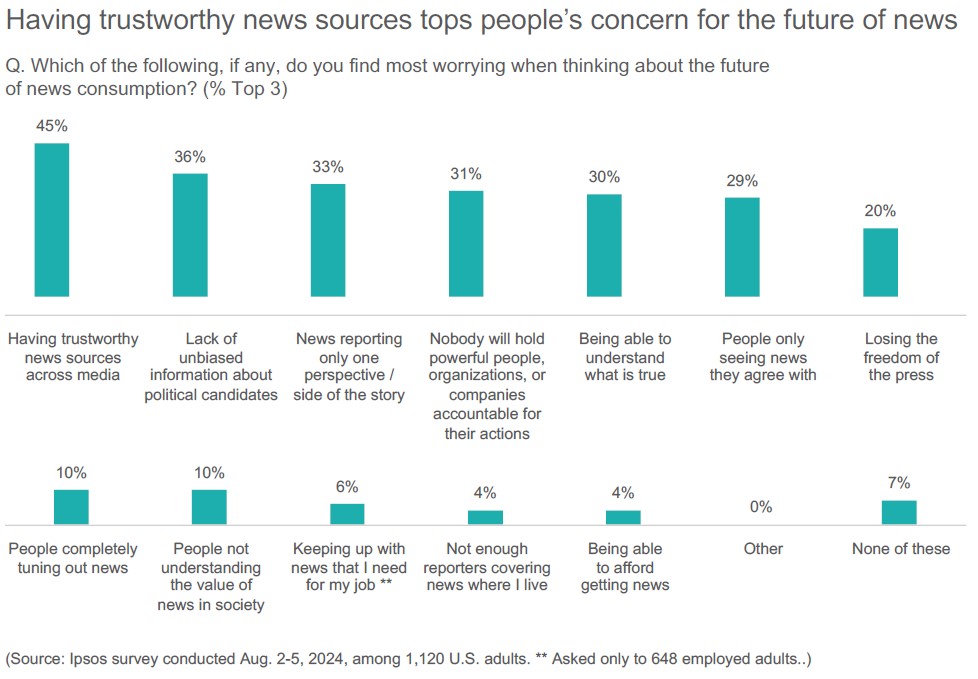
Disinformation: Bad news for brands, too.
Even Ipsos is not immune. Atter the contested elections in Venezuela, Ipsos was forced to publish a statement that exit results attributed to the company were false because Ipsos didn’t do any polling in that election.
How do you get a real brand story out if trust in information declines? How do customers and citizens alike know what to trust?
In this issue, you’ll hear from and about organizations that are making journalism work in many ways using a variety of models. Some are more scalable than others, but as David Rubin of The New York Times points out, digital journalism is a relatively new industry. We’re still figuring it out. And the stakes are high.
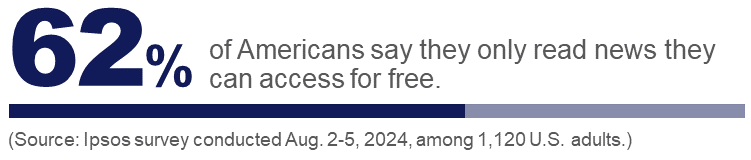
In What the Future: Truth, we saw a perfect storm for disinformation as people tend to read free content, which tends to be low quality, and they trust the news they read. This is a bad recipe, and especially dangerous for local news, which is critically important and endangered. Local newsrooms are finding a small renaissance, but what happens without one?
“People are less likely to vote. They’re less civically engaged. They're less politically knowledgeable,” Victor Pickard, University of Pennsylvania professor and author of “Democracy Without Journalism? Confronting the Misinformation Society,” told me. “Meanwhile, there are higher levels of corruption, growing levels of polarization and extremism. We can now show empirically what we've all already known to be intuitively true: Democracy is seriously harmed by the collapse of local journalism.”
What lessons apply to you?
Unlike me, you likely are not a journalist. So what can you learn from this issue?
- Trust issues spill over. Most of the issues facing news and journalism apply to your brand messaging, too.
- Whatever industry you’re in, you need to look outside of it for innovative solutions to problems you’re facing, because somewhere else, someone has likely solved it.
- Finding a safe space for your brand message will be a lot easier if there’s quality news to put it against. Because people devour news content, still.
← Read previous | Read next → |