
How indoor farms make food more accessible
Food issue
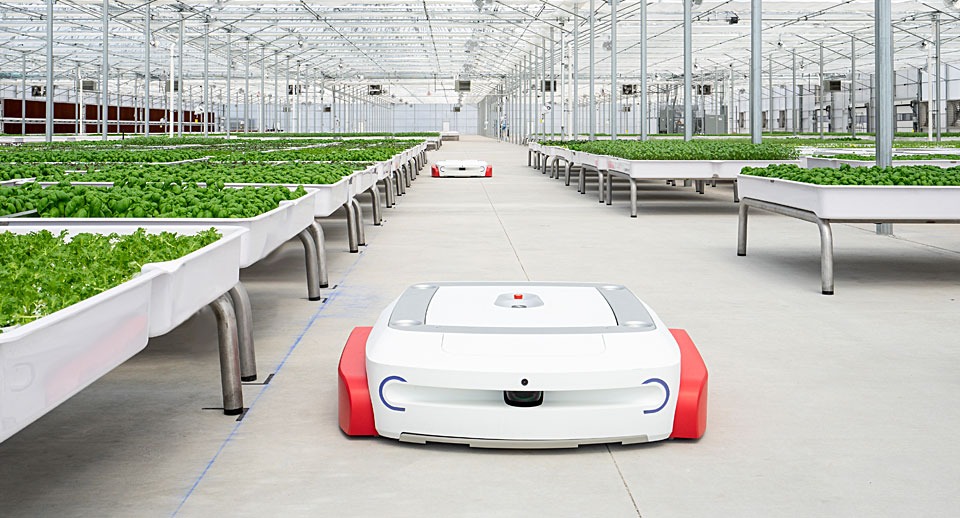
Iron Ox is an indoor farm. But don’t call it a vertical farm. It’s an automated greenhouse where robots do much of the cultivation. That allows the company to control its food-growing environment while helping the broader environment by using less energy, water and land. Sarah Osentoski, senior vice president of engineering, uses her background in robotics and machine learning to make that happen as efficiently as possible.
Kate MacArthur: What exactly is Iron Ox?
Sarah Osentoski: We sell food for people to eat, but we’re also a technology developer, and we build vertically integrated greenhouses to grow food precisely, efficiently, modularly and flexibly. So, we’re focused on redesigning the farm from seed to harvest, to achieve particular goals with respect to efficiencies. We use sunlight to grow, so we’re using greenhouse technology. That allows us to be 75% more energy efficient since we don’t need to supplement or use artificial lighting for every part of the plant development cycle.
MacArthur: How big is a typical farm?
Osentoski: We’re in the process of bringing up our largest facility in Lockhart, Texas, and that facility has currently about 400 modules in it. But by the time it's finished, we'll have about 5,400 modules. Each of those modules is a 6-foot by 6-foot tub of water. In that tub of water, a bunch of plants are sitting in pots in rafts, and they float there. For each phase of the farm, we focus on making the plants as close together as they can be. Then we use technology, automation and robotics to transition the plants to the next phase of this farm. We can cycle crops through, like basil or lettuce, rather regularly. We'll spend two to three weeks in this portion of the farm, and then we have a new crop go in. We flip this farm over multiple times.
MacArthur: Is that happening in the background with algorithms?
Osentoski: The farm is also kind of a data farm. The greenhouse is collecting all this data. Then in the background, we have algorithms, machine learning and plant scientists looking at all of this data and doing detections and optimizations to the greenhouse. The other nice thing about the robotics is that those optimizations can start to be programmed in. The robot can make changes to the growing cycle without any intervention.
MacArthur: Tell me about the robots.
Osentoski: We have Grover, our mobile robot, who moves these modules around so that people don’t have to walk this entire farm all day. The module goes to different work cells. In those work cells, data might be taken, new plants might be put in, plants will be harvested. We might sample the water, put new nutrients and water in. Phil is our robot that fills, and he puts new water into modules while Grover brings them over. They collaborate together and with people to make these decisions that make the farm work.
MacArthur: What are they capable of?
Osentoski: Robots are capable of sensing data at scale without bias. People always have biases.
MacArthur: How many people operate this farm compared to a traditional farm?
Osentoski: We have engineers, people who work in operations, technicians and plant scientists all working together. It’s very cross-functional. There are also jobs here for people who are doing things like picking and doing manual tasks that robots aren't ready for right now. And we also have people working with the robots and doing repairs.
MacArthur: People want to protect the climate, but they want leafy greens year-round. How does this model make those kinds of demands consistent and affordable?
Osentoski: By working to automatically control your input. Our approach is getting this initial system in place, and then once we have it, we can drive those inputs down. That also helps consumers because we can start to work on achieving a good price for them as well.
MacArthur: How did the pandemic affect your ability to get product out, and what does that tell us about the future of the supply chain?
Osentoski: We remained open through the entirety of the pandemic, and we were able to provide food to our customers. Each step where someone has to handle the product provides a risk for a stoppage. In our case, that distributed nature will also have more food being grown closer to local communities.
MacArthur: How might this fit into the future of the broader agriculture industry?
Osentoski: We can both be gentler to Earth as we grow, as well as be better for the planet in that we can grow more food to help sustain this growing population.