

How AI, geopolitics, and sustainability are changing how we make things
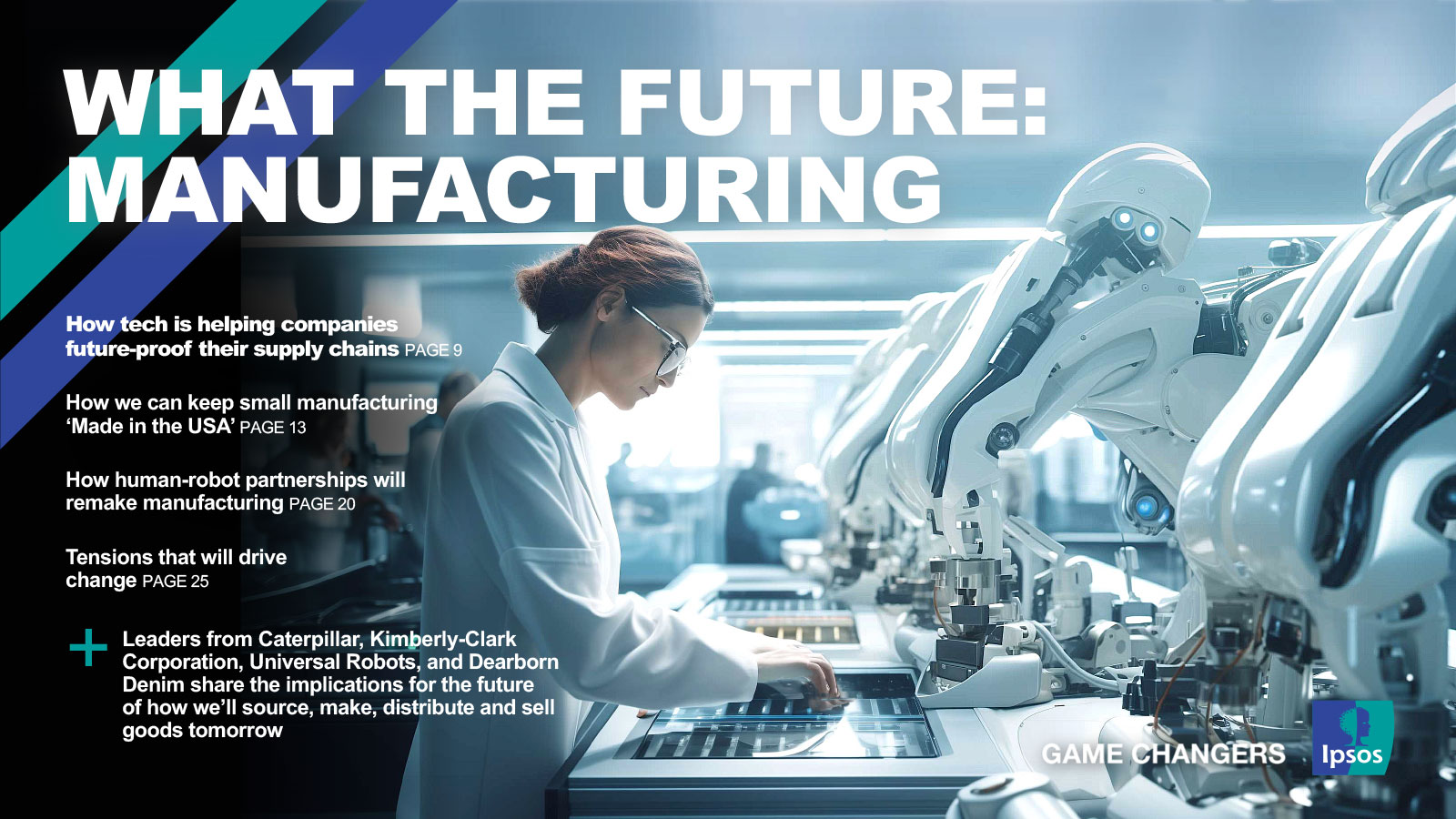
Imagine it’s 2034. Manufacturing in the U.S. looks different than it does today. Output continues to increase; jobs continue to decline.
Today, in a warehouse in Chicago, a room full of workers cut, stretch and sew blue jeans, t-shirts and other apparel. Denim, zippers, rivets and leather patches are sourced from around the U.S. and Mexico, but it’s all put together here at Dearborn Denim.
On the opposite end of the spectrum, Caterpillar operates on a vastly different scale. It has manufacturing or distribution centers in nearly every state and every region of the world and is a leading U.S. exporter.
What will those companies look like tomorrow? It’s a future that will be shaped by macro forces like increased automation and employee power shifts, but also by attitudes and tensions between nationalism and globalism.
The “death of manufacturing” in the U.S. is one of those tropes that has made headlines for decades.
In truth, it’s a huge, steady sector of the economy (give or take $7 trillion, or 11% of GDP). What people are really talking about is a long decline in manufacturing jobs since their peak in the late 1970s, according to the Bureau of Labor Statistics.
Will automation, especially when coupled with new artificial intelligence capabilities, hasten that decline? Or will social media enable more direct-to-consumer manufacturing brands to survive and employ local workers? Or will an increased ability to 3D-print and fabricate goods at home or central “fab labs” further disrupt skilled manufacturing jobs? These futures aren’t mutually exclusive by any means.
In the data, we see that we’re much more optimistic that we’ll be making more stuff at home than we are pessimistic that those technologies will get worse. We’re less optimistic that we’ll be able to access affordable goods made in the U.S. or that goods will become cheaper, or more sustainable, or higher quality.
There are a couple of central tensions in any discussion about manufacturing in the U.S. One is the tension between U.S.-made goods vs. those made elsewhere. Sustainability is another key issue as it often comes with a trade-off for price.
And price in many global markets, including the U.S., is an ongoing concern as an uncertain economy has people making trade-offs in various line items of their budgets. Price vs. quality. Price vs. brand preference. Price vs. where it’s made. In Ipsos Global Trends, we see a shift developing between supporting a brand for its values and supporting a brand that delivers value. We want to support our values. But we can’t always afford to walk the walk.
The tension between buying American-made and overseas goods
From my recent tour of China, it seemed that Chinese companies lacked confidence about trying to break into the U.S. market. There’s good reason for that hesitation in the data. Americans value American-made goods. Most say they consider if a product is American-made in their purchase decisions. Two in three (68%) associate products being made in America with higher quality.
But if a product is made in China, Americans are more than five times as likely to say they would be less likely to buy it (44%) than more likely (8%).
That said, we buy nearly $600 billion of Chinese goods every year often manufactured for American brands we have grown to trust. While Americans see less benefit of globalization compared to other countries (see global chart below), they also appreciate all the inexpensive goods and quality electronics we buy from overseas.
The answer for many foreign brands is to lead with quality, not country of origin. Unless they’re German cars, or French luxury goods where that is the selling point, of course.
Because quality is something people say they’ll pay a premium for. That’s unlikely to change in the future.

Context also matters
Ipsos research shows that understanding the context in which people engage with your brand matters. Someone might want to buy U.S.-made jeans if they are willing to pay the perceived premium.
Oftentimes, U.S.-made goods cost more than those made overseas. Or someone might be willing to pay more because they understand there’s often a quality benefit: You might pay more today but save over time because the product won’t need to be replaced as often.
But if people are buying something like a TV, there might not be a U.S.-made product on the market for them to choose from, so they’ll weigh other factors to make their decisions.
ESG as a USP
Sustainability is another manufacturing-based driver for sales. People are split evenly on whether they’re willing to pay more for sustainably produced goods. Which means that half of the market considers this a valuable selling point. And according to an Ipsos segmentation, about 17% of shoppers across several markets actually walk the walk with no gap between the attitudes they express and their behaviors.
But despite ongoing advances in manufacturing techniques, only one in three people think the products they buy will get more sustainable in coming years.
Every day we read new headlines about the ways AI is changing the job market. Robots have already been a factor in the decline of manufacturing jobs. The next evolution of robots is collaborative robots, or cobots. With mechanisms that enable greater performance in humans, will we need as many humans to work in cobot-enabled factories?
Maybe we’ll need all the robotic help we can get. The Manufacturing Institute estimates that millions of manufacturing jobs could be vacant in 2030 if more people don’t get inspired to pursue manufacturing careers.
Of course, that’s a dangerous spiral of fewer jobs, leading to less interest, leading to more automation, leading to less interest.

A small example
Let’s close with a brand story that gives some inspiration for manufacturing on the smaller side. Bellroy is an Australian maker of backpacks, phone cases, wallets and the like, founded in 2010. The founders also started Carryology.com, to write about the things people carry and the packs and slings they carry them in. That led to a Facebook group, now 30,000+ strong. That led to co-branded collaborations with
a host of small manufacturers and artisans in the space. Those product drops typically sell out in minutes or even seconds. It’s a great example of creating an ecosystem within a niche that is both collaborative and consumer-ish but also a community of collectors. It’s helping support all the businesses involved. It’s also almost entirely direct-to-consumer and socially driven (there is a store tied to the community in Hong Kong).
- Manufacturers large and small face similar business questions that we’ll address in this issue:
- Will small business manufacturing survive?
- Will U.S. manufacturing be able to compete?
- Will global brands be able to enter the U.S. market? Or will anti-globalization sentiment make that challenging?
- Will we get to a more sustainable future?
- How do you staff from a shrinking talent pool, but also a more automated workforce?
The future we make together will hinge on those answers.

| ← Read previous How AI, sustainability and politics are reshaping the future of manufacturing | Read next → |