

How the American Dream is shifting for entrepreneurs

Tom Sullivan sees the American Dream in entrepreneurs he works with daily as senior VP for small business policy at the U.S. Chamber of Commerce. From tech innovators to refugee restaurateurs, he believes their fusion of passion for America with brilliant ideas could shape the country’s economic future. But he cautions that evolving trade policies, especially tariffs, could cause long-term challenges to their entrepreneurial dreams. He urges policy shifts to help business owners navigate these economic shifts to keep their ambitions on track.

Kate MacArthur: How has small business ownership been a gateway to the American Dream?
Tom Sullivan: The idea that you would have something that solves a problem or satisfies a need, and you’re able to make money from it to provide for you and your family, and perhaps even your community, that’s uniquely American. This idea that an entrepreneur would move to a place that fosters entrepreneurship better than the place they came from, that also is uniquely American. There is a part of entrepreneurship that is uniquely American.
MacArthur: How much of the American Dream relies on immigrant entrepreneurship?
Sullivan: A tremendous amount. One way is what I call “survival entrepreneurship.”`If I were to put bets on what entrepreneur would be successful, I’d put all my money on a single mom immigrant to the United States, because if she is not successful, her child starves. There’s history and data to support that bet. Why do people come to the United States to start a business? It gets back to the American Dream. I mean, it’s real. They want to do it in America because they know that America has a rule of law. When you have an idea and you patent that idea, then no one can steal that idea and use it for themselves. The rule of law is part of the economic freedom that attracts men and women from all over the world to the United States.
MacArthur: What role do local businesses play in revitalizing the economy, especially where there’s a lack of economic development?
Sullivan: When we look at the best ingredient for economic development, there isn’t one specific ingredient. There’s a whole ton of them. One is a large university presence; one is a large business presence. But we also know a key ingredient in development is the small businesses themselves. That whole ecosystem is what contributes to the development of the community, the town, and the region writ large.
MacArthur: If a business owner wants to retire and their kids don’t want to take over, what are the implications for the business and community?
Sullivan: That question of “What is the plan?” is a luxury many small business owners don’t have. When they do start thinking about it, there’s a process they go through. Sometimes it ends up successful and sometimes doesn’t. When legacy businesses close, sometimes it’s as though the heartbeat is stopped in a particular community. And it leaves a scar.
MacArthur: When private equity gets involved in brokering small businesses to new owners, does it make it harder to know who owns the business?
Sullivan: The simple answer is, it does.
 If I were to put bets on what entrepreneur would be successful, I’d put all my money on a single mom immigrant to the United States, because if she is not successful, her child starves.”
MacArthur: How will tariffs impact small business?
Sullivan: Unfortunately, this shock to the system has resulted in a slowdown. Small business owners put the brakes on growth plans. And because many just don’t have other options, it’s bad. The push to reshore and to build greater manufacturing capacity in the United States is happening, but it takes a long time. What small businesses are struggling with is how to bridge between now and that time. I think the president has an opportunity to give small businesses time, and the U.S. Chamber of Commerce has asked the president to consider that.
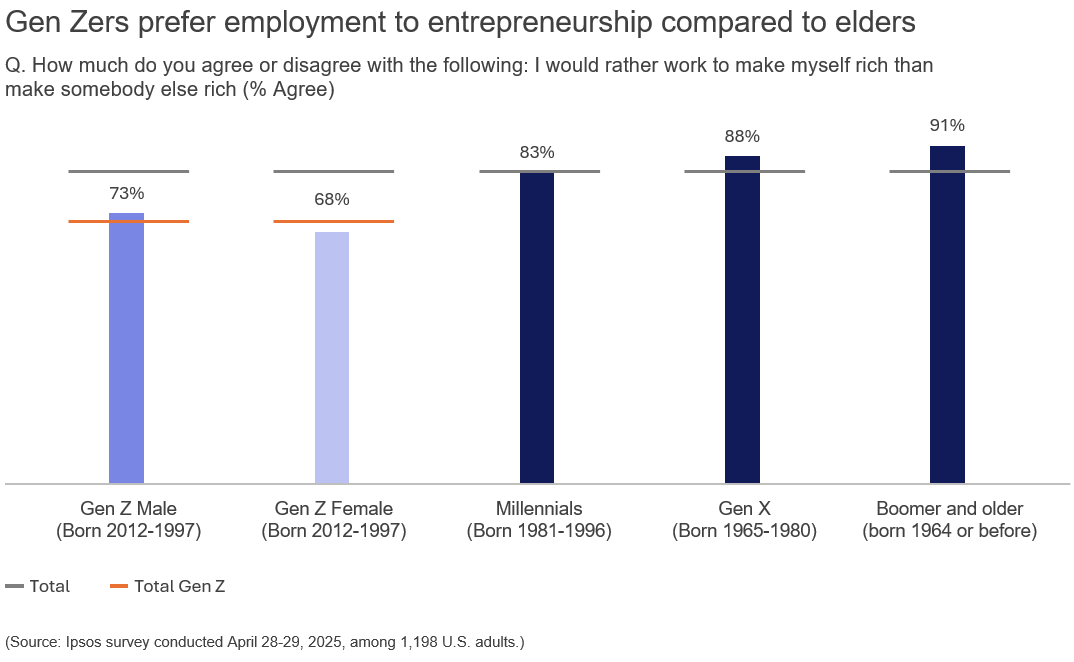
MacArthur: Our survey shows Gen Zers had lower interest than older peers in working for themselves. What do you make of this?
Sullivan: This tells me more young people are realizing how tough being a successful entrepreneur is. The difficulty and time and sweat equity it takes to be a successful small business owner is well-known within the small business community. And it’s encouraging that younger people are realizing that, and perhaps they don’t necessarily want to do that, at least early on in their career. Another way to look at this is success rates for entrepreneurs increase when you get older. Your network is bigger and stronger the older you get.
← Read previous | Read next → |