
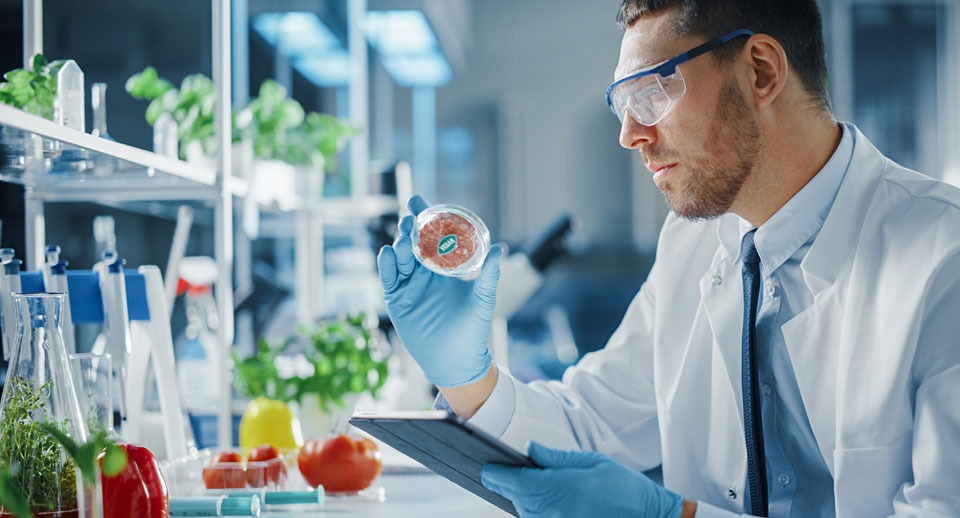
How big food must evolve to feed the world sustainably
Farming issue
How do you feed the world sustainably in an increasingly climate-stressed planet? Tyson Foods, one of the world’s largest food companies and a recognized leader in protein through its brands like Tyson, Hillshire Farm and Jimmy Dean, sees innovation as the answer. Rahul Ray is senior director and investment lead at Tyson Ventures, the company’s venture capital group. Ray’s team is exploring innovation, AI and other technologies to produce more proteins for more people sustainably.
Kate MacArthur: How does sustainability fit into the larger priority of feeding the world?
Rahul Ray: Everything has to be seen through the lens of sustainability.
MacArthur: What’s the biggest opportunity for innovation to solve for feeding the world at scale?
Ray: We're going to add about 2 billion people in the next 30 years. We need to be able to find ways to produce more high-quality food sustainably and affordably. So, it's really a question of and, not or. We are innovating on the protein production side, not just conventional protein, but alternative proteins. Then how do you get the produced protein to the consumer. That is a whole supply chain problem. Finally, we look at how we do this in the context of sustainability.
MacArthur: Is there one area that’s a bigger priority than others?
Ray: A big part of our challenge is managing the cadence of supply and demand, which is unique to food. We talk about the automotive industry; you can flex up and down your production based on your consumer demand. In the food space, you have an organic product that's coming in the door no matter what. You have to manage your supply and demand in a way that you eliminate waste.
MacArthur: Speaking of cutting waste, you are recruiting your next class of startups in the venture group, and you’re focusing on upcycling. Where does that fit in?
Ray: It all goes back to we have finite natural resources, and how you optimize it more is by reducing waste. One way is taking only the inputs that you need to produce what you need. The other way is to recycle what you don't need and upcycle it in a way that you can produce some value. We can look at waste from our plants and say, “Hey, how can I take this into adjacent industries?”
MacArthur: Can you give an example?
Ray: We looked at one of our waste products from our cattle program and how can we convert that into fiber so it can be used for footwear. Another classic point is looking at insect proteins, so how you take waste and feed it to black soldier flies. Black soldier flies are these amazing creatures that have an amazing DNA composition. They never get sick. But more importantly, they have a high protein content that can be used as fish meal.
MacArthur: How important are alternative proteins?
Ray: Absolutely important. The math is you have population growth, and then on top of that you have more people eating more protein. So, when you look at it through that lens, it's not either, or; you need all of it and that's when alternate protein is important. We were early investors in Beyond Meat way back when. We invested in cell-cultured meat, we invested in mushroom-based, we look at all forms of protein. The question that we have to ask not just us, but the whole industry, is how do you separate the mission versus the business models?
MacArthur: How are you understanding consumer interest in conventional versus alternative proteins?
Ray: Consumers care about three things: price, taste and personal health. So you have to be able to address those. It's only so much you can get a consumer to pay up on the basis of mission if it's a consumer staple, and you have to pay a premium for it. We are right now in that second phase of how do we solve that viable business model?
MacArthur: For many people, a benefit of small-scale, local food is feeling connected to what you’re eating. How can large-scale protein providers facilitate that trust and connection?
Ray: Traceability is key to all of that, to be able to see where your protein came from, who produced it, and how it made its way to your table.
MacArthur: Is that a blockchain solution?
Ray: Blockchain is one solution, but we don’t know how it’s going to play out. You don’t even need a blockchain solution as long as you have a proper form of record-keeping that goes from source to table. There’s a lot of paper involved, and the more we can digitize it, the more information can flow and the more you can trace it. That's key. We had an investment in a company called FoodLogiQ, which we recently sold, that was all about traceability to be able to track where it came from and connecting the dots.
|
← Read previous |
Read next → |