
How the fandom revolution is changing the game for brand growth
Imagine it’s 2035.
“Fandom is where I live,” said a teenage What the Future reader. That’s likely not an exaggeration. Fans binge the shows and books themselves and immerse in the fan fiction and related Discord channels and livestreams. And vice versa. Interacting with fan content can drive people to become fans of the original content. All of this can be a massive time suck.
It’s also big business, and one that is increasingly digital as fans engage virtually across platforms, which you’ll see in this issue.

Think about just some of the industries people are fans of: movies, music, sports, books and the individual entertainers, athletes and authors involved. Through creators and influencers, even fans have fans. Fandom has, for some, gone pro.
In the What the Future: Identity issue, cultural preferences (i.e., things we are fans of) were among the most important components of how people think about themselves after aspects of their physical selves and their lived experiences. In this issue, we explore the topic in much more depth.
Fan, remember, is short for fanatic
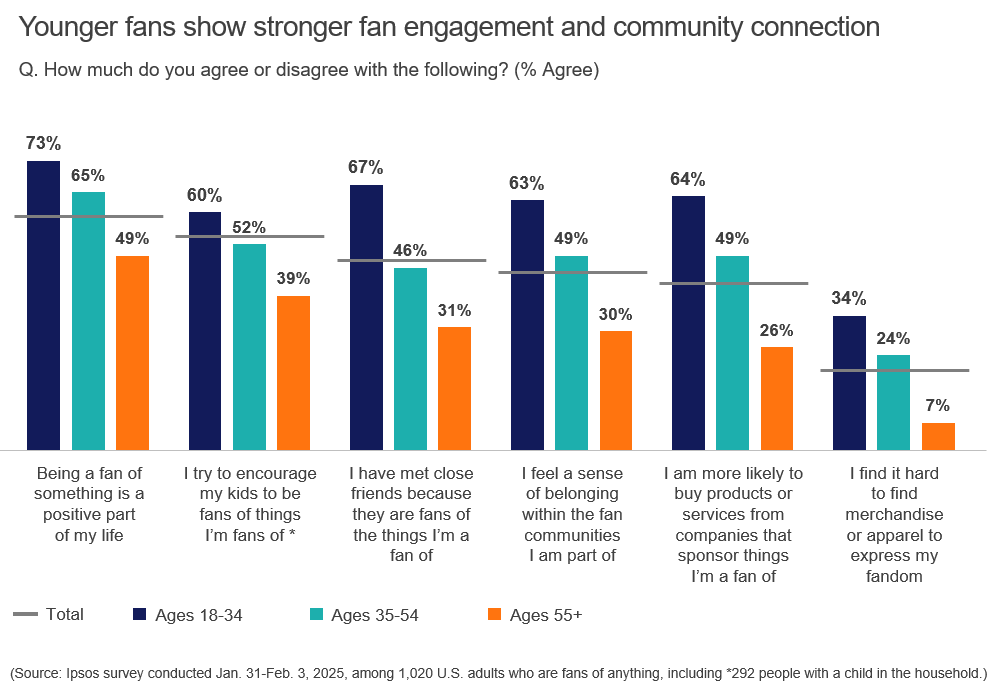
And who’s more fanatic than the youth? Younger Americans (under age 34) are twice as likely to say they are fans of specific brands and specific athletes than older Americans (ages 55+). They’re four to five times as likely to be fans of celebrities and influencers (often used to deliver brand messages and endorsements) and four times as likely to be fans of video games, a channel to reach young people on.
All of this is good news for brands, because younger consumers are notoriously hard to reach and younger fans are more than twice as likely to say they are more likely to buy products or services from sponsors of things they are fans of.
Fandom offers a powerful way in. You don’t even have to work with the object of the audience’s fandom. Who hasn’t had a conversation about whether a band sold out? Fandom gives brands a way to do an end run around that problem. Band won’t take your money? Fine, support the fandom directly or its fan influencers.
Fandom is for the youth and that’s too bad
People of color are also more likely to put the fanatic in fandom, according to the Future of Fandom survey. One demographic is sitting this out to some degree: older Americans. That’s a shame.
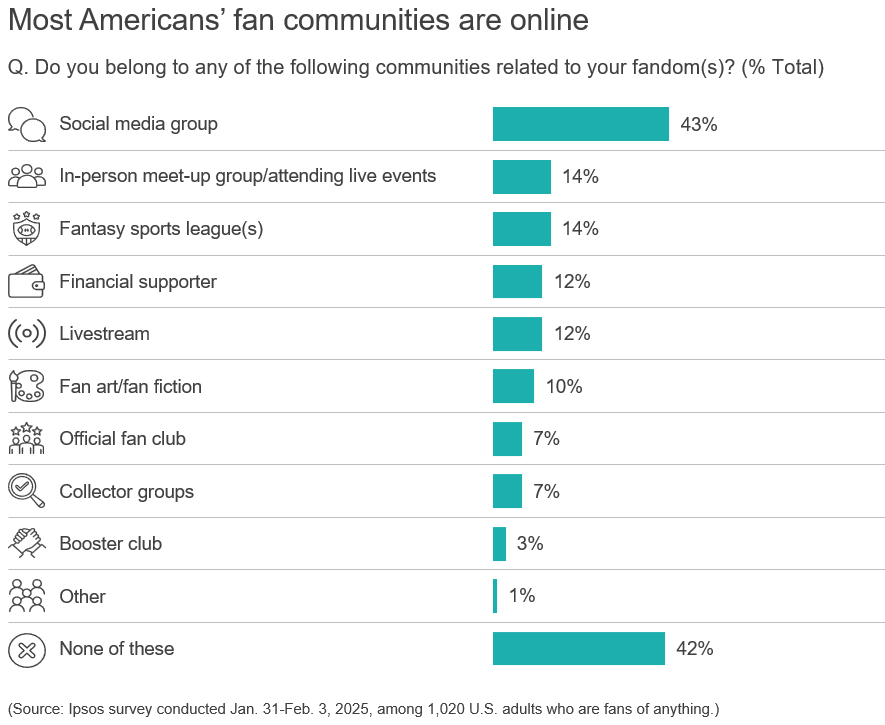
Fandom is a gateway to community, something that older Americans are generally seen as lacking. Perhaps that’s because so much of fandom (and everything) takes place online and on social media, where older Americans are less comfortable.
Whatever your fan jam — maybe you collect records or Hummel figurines or you’re a genealogy buff — there are online and offline ways to experience community through fandom.
Niche vs. scale in reaching fandoms
For brands, one challenge is appealing to fans at scale. Once you’re past the major sports, biggest chart-topping bands and TV shows, fandoms can get niche fast. And deeply intersectional. Are you a fan of beach volleyball and also a goth? Then you’re likely a fan of Boise State University’s Nora Hayd.
While we’re talking about college sports and women, it’s worth pausing to talk about the importance of youth sports as a pipeline to fandom. By definition, kids who play a sport are generally a fan of that sport. Often, for life.
The issues with the sports fandom pipeline
It’s harder and harder to be a youth athlete these days. For one thing, it’s gotten super competitive. “The level of programming and activity has gotten more and more sophisticated at the youth level,” says Jason Clement, co-founder and CEO at The Sports Facilities Companies, which is exactly what you think it is.
“The philosophies and approach that used to be reserved for the professional or collegiate level has found its way down to the youth level of instruction and the increased level of investment for families. That has expanded exponentially over the last two decades.”
That growth shows no sign of letting up. But a parallel phenomenon is the rise of women’s and girls’ sports and with them, brand tie-ins. One youth softball player and What the Future reader found their favorite player had their own line of batting gloves. They didn’t really like the style, but they at least saw that it’s now possible for female athletes to have product endorsements like that. That’s relatively new and could be a game-changer for fans and brands alike.
One reason tech platforms are so successful is they aggregate niches and help us be fans of each other. And often it’s led by those smaller communities bottom-up instead of the behemoths top-down.
So, we’ve made a case up until this point that brands have a place in fandom. But there’s a danger. The people and organizations people are fans of are often … humans.

The one that (thankfully) got away
The pages of What the Future have often featured interviews with people and brands our writers are fans of. Hopefully you couldn’t tell that by reading the interviews, but sometimes our passions likely surface. But there was one interview we tried for repeatedly and never landed. That turned out to be OK, sadly, because the potential interviewee, author Neil Gaiman, has now been accused of all kinds of awful things by a growing number of women.
There are two reasons to bring this up. One is because of the obvious brand risks for being involved with or sponsoring humans. Humans range from imperfect to deeply flawed. You don’t always know how these situations will play out.
Two, fandoms are often left doing their unique calculus about how far is too far, and when you stop being a fan of either the human or their work or their legacy or their team or their sponsors or all of the above.
That leaves us with a whole host of questions and opportunities for brands and companies alike:
- How do you tap into fans authentically, especially the 28% who consider themselves actively engaged in fan communities?
- How do you find the fandoms that will resonate with your current and, even better, your potential customers?
- How can your brand make the experience of being a fan better for those fans, not just for your brand?
- How can you help grow the pipeline of fans for the communities your brand takes part in?
- How can you help diversify and enable access to those communities or maybe create exclusive sub-communities?
We’ll get into those topics in this issue with our amazing panel. And if you’re a fan of What the Future, smash that like button and subscribe, eh?
← Read previous | Read next → |