
Why flexibility will drive the future of work and cities
One of the biggest debates about the future of cities is whether they can thrive if people don’t return to offices most days a week. The implications for central business districts and tax bases as well as employers and workers are huge. Martin Schwarz, global solution architect on computer maker HP’s Future of Work team, says flexibility and mobility will be key for workers to be productive from anywhere, including the office.
Kate MacArthur: How will evolving work styles shape how teams work in the future?
Martin Schwarz: To me it’s really two words: hybrid and flexible. The companies that get hybrid right and get flexible work right are going to be the most successful.
MacArthur: How will workspaces need to adapt to accommodate workers’ needs?
Schwarz: Companies should have a balance between the employer and employee objectives and needs. So, hybrid and flexible has time in the office, measurable success factors to create people-time, face-to-face social interactions, create that cultural or culture behavior within the company and emphasize that. But there’s also measurable success factors for time at home to do focused productivity, focused work, to support life balance, to support wellness initiatives for the employee.
MacArthur: What happens if everything goes back to five days a week at the office?
Schwarz: I’m not sure we’ll ever go back to that. Let’s just say it happens, and yes, we’re all back to the office. What changes? Not a lot. Then is it going to be a full five days back at the office? Well, if it is and it’s going to be long term, there might be a change in the type of device you use. It would just be an adaptation and in the future, companies like HP will build out services to be able to accommodate that.
MacArthur: Will platforms influence how people manage teams or will it really start with the worker?
Schwarz: We’re going to find AI is going to drastically change the situation. It will be less of a platform and a place argument. It’s going to be how and what does the work itself. We’re building AI directly in the computer.
MacArthur: Some people are predicting generative AI’s demise due to intellectual property lawsuits. So how can companies prepare for their teams to work with AI well versus if some or all of it goes away?
Schwarz: As gen AI and additional AI resources and tools become available, because it’s a personal computer device, it won’t all happen in the cloud. Some of it will happen at the edge or at the device itself. Your question touches on what part of the work is being done by the machine [versus] what part of the work is being done by the user, and all that’s still being played out. We’re going to continue optimizing our devices to do it better than others and do it responsively going forward as well.
“Let’s just say it happens, and yes, we’re all back to the office. What changes? Not a lot. You’re still going to have some people with mobility requirements.”
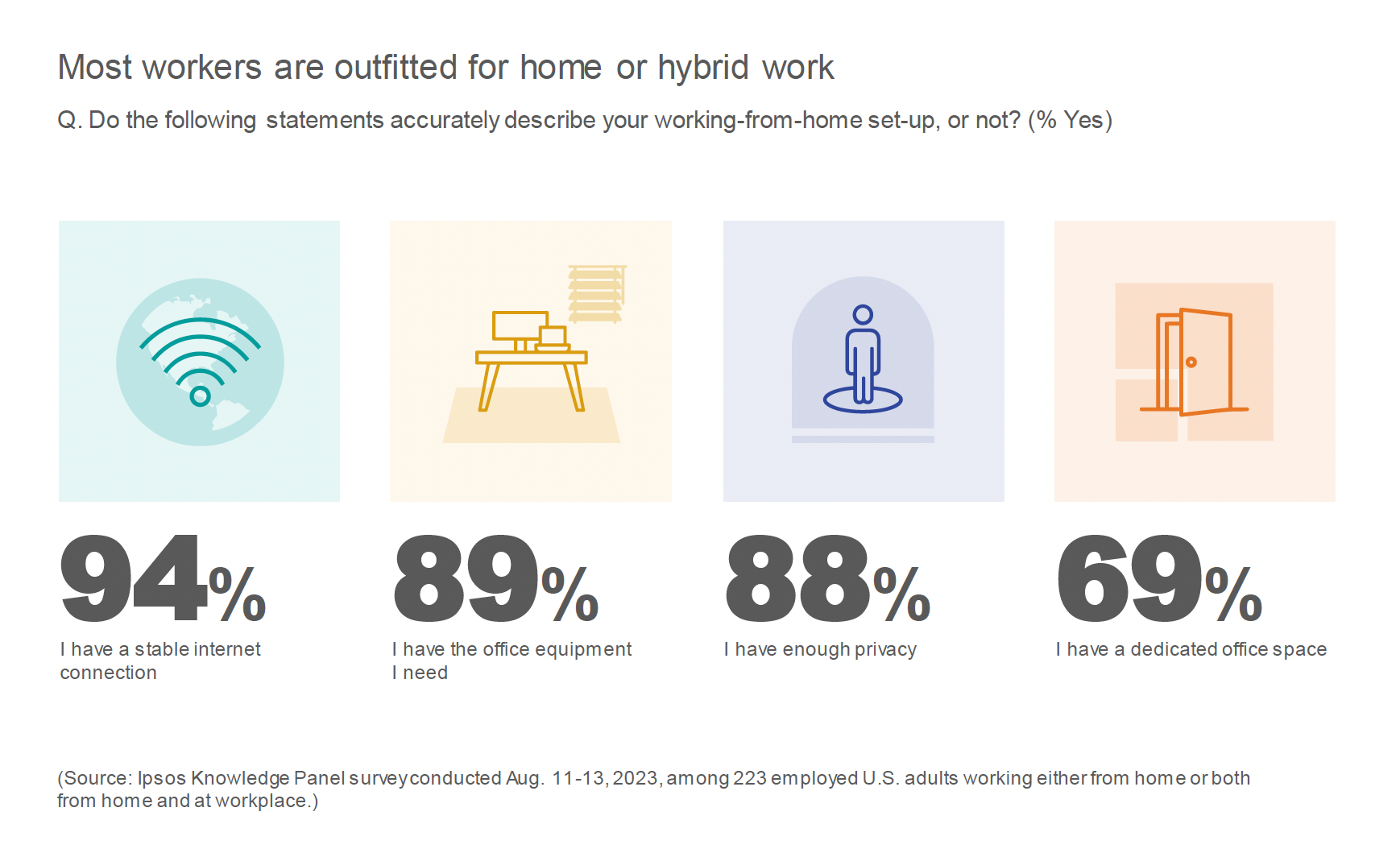
MacArthur: Our research found that most workers are outfitted for home or hybrid work. What does that signal to you about the way people may want to work?
Schwarz: We design many of our products for hybrid where we’re workspace-aware or spatial-aware or we allow for seamless transitions between workspaces. Many of these workers still need to collaborate, still need to connect with their coworkers through collaboration sessions, through conferencing, for instance. Well, that means we need to be aware of the audio and video experiences that they’re going to have.
Another thing is the type of devices we build. We build X360-type design laptops where they can become a two-in-one type of device. In some modes it’s a PC mode, other modes it’s more of a tablet to allow for those changing environments and changing scenarios that users are in, based off of what type of productivity and what kind of application those users want to use.
MacArthur: Connectivity is an issue for people spending part of their commute in the transit. What are the questions to think about to help people maintain access to the devices while they’re in motion?
Schwarz: We make sure our devices are enabled with Wi-Fi and other technologies like Bluetooth, etc. Also, we’ve got capabilities in our mobile laptop devices to do 5G connectivity. We’ll have 6G probably many years out that’s promising more capabilities, more bandwidth, and different types of connectivity capabilities. And we plan to be right at the forefront of being able to support those technologies and those spectrums as well.
|
← Read previous |
Read next → |
For further reading
Here’s what workers really care about, according to a Post-Ipsos poll