
How our DNA could change how we think about health
When the first direct-to-consumer DNA tests for tracing our ancestry hit the market in 2007, it also blew open the genomic health field. Testing has expanded to identify genetic health risks and optimize wellness. The next frontier is to create drugs and other treatments to restore health and even prevent disease. Internist and medical geneticist Dr. Noura Abul-Husn is vice president of Genomic Health at consumer genetics company 23andMe. When she thinks about the future, she hopes genetics will expand into all areas of medicine
Kate MacArthur: How do DNA testing companies fit into the larger landscape of health and wellness?
Dr. Noura Abul-Husn: There have been robust ways that genetic testing is used in medicine but all of them are very specific areas that people would need to seek out, or that a physician would need to tell you that this is something that you should consider. There's a whole realm of possibilities for genetics to be used that don't necessarily fit into those discrete areas or necessarily a way that is applied in the medical world today.
MacArthur: How so?
Abul-Husn: This is now putting genetics first to optimize health. That’s a different way of thinking about genetics and its place as more of a screening test than an indication-based or a diagnostic test.
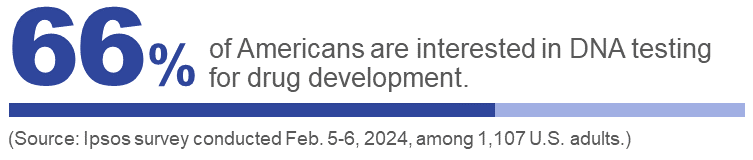
MacArthur: Americans are most interested in DNA testing to learn about their ancestry, then health. How big of a priority is the moonshot drug race?
Abul-Husn: The interest in leveraging genetic information to make better drugs, better medications, is very well justified. That’s an exciting space, especially at a time where gene therapy is a reality. The fact that we can correct genetic defects today is unbelievable; a one-time cure for disorders that have been considered uncurable in the not-so-distant past.
MacArthur: What changes do you anticipate in the next five to 10 years?
Abul-Husn: In addition to understanding these single gene variants that are often rare, but that have clear association with disease, now we have a different kind of test that can also give us information about much more common diseases. It puts people on this bell curve of likelihood for a disease and looks at each individual to see where they are on that spectrum. If you do this across populations, you now capture a much larger proportion of the population that has risk for common diseases like heart disease, diabetes and kidney disease.

MacArthur: What does that shift for the future?
Abul-Husn: It puts genetics and genetic screening using polygenic risk scores into the realm of primary care medicine, where you're thinking about your health, you go for your wellness checkups, your routine labs, and hopefully, many people are asked about their family history for disease and that gets taken into consideration. It’s an opportunity for shared decision-making between a patient and their physician to understand their real risk factors, and then potentially initiate therapy earlier and be more aggressive about it and really monitor it.
MacArthur: How do you see attitudes shifting toward tech companies versus medical providers for personal health management?
Abul-Husn: The future of health is to bring all types of data from your genes, your wearables, your continuous monitoring into real life, bring AI into the picture, and make sure everyone is optimizing their health in a very personalized way. There's no medical training for that yet today. We just haven't figured out yet how to routinize genetics and all the newer technologies in traditional healthcare. That's something that the consumer side is pushing for change in that direction.
“The future of health is to bring all types of data from your genes, your wearables, your continuous monitoring into real life, bring AI into the picture, and make sure everyone is optimizing their health in a very personalized way.”
MacArthur: Privacy, and even security, are barriers for some people to have personalized health. What convinces people to make that trade-off?
Abul-Husn: We're in a digital world. We're making tradeoffs all the time. There are a lot of considerations that come into play when you're considering personalized healthcare. You need data about an individual to be able to offer personalization, and people know that and recognize it. Those are choices that we have to make every day.
| ← Read previous Why brands need to understand tech and mental health across generations | Read next → |