
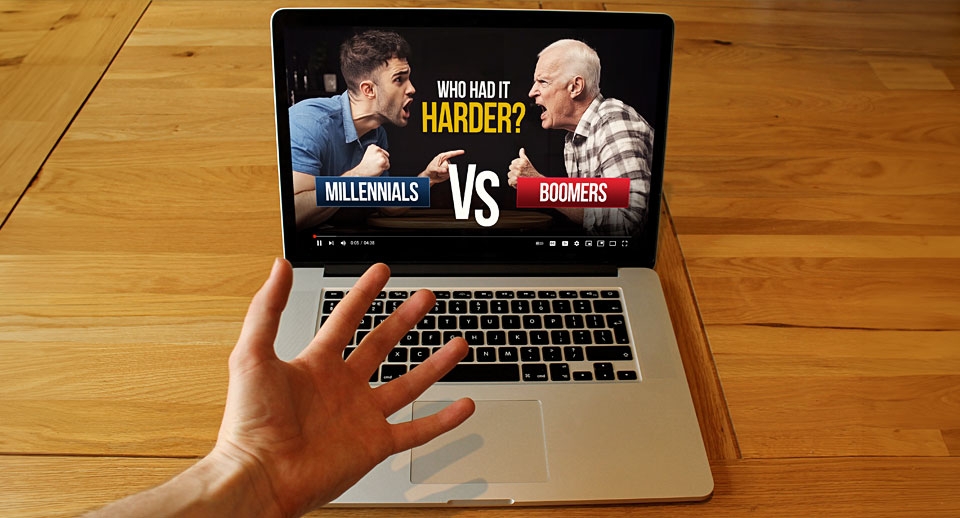
How disinformation and ‘conflict entrepreneurs’ thrive in the modern attention economy
 Read the full What the Future: Attention issue
Since April 2020, Ipsos has surveyed American consumer attitudes on topics like the economy, artificial intelligence (AI) and current events via the biweekly Consumer Tracker. Sometimes, questions build on prior What the Future questions. Here's what we learned when we resurveyed a 2020 question from our Truth issue on the Consumer Tracker.
Why we asked: As brands battle for people’s attention, they no longer control their brand messages nor the ecosystem they exist in. Their worlds are continually shaped by user-generated content, disruption and declining trust. Couple that with growing competition among content creators for people’s attention and the environment is ripe for hyperbole, misinformation and disinformation to thrive.

In the interview with journalist and author Amanda Ripley, she discusses how in polarized markets, “conflict entrepreneurs” inflame polarity for profit, importance, attention, among other reasons. This breed of influencer thrives on crafting high-conflict narratives in uncontrolled, trust-deficient spaces.
There are plenty of unintentional ways that brands get drawn into conflict or misinformation, but when a conflict entrepreneur gets involved, brand messages can spiral out of control. The challenge is universal, affecting both consumer and business-to-business environments. Marketers on both sides recognize the need for trust. To arm brands against these unchecked narratives, information and truth are the best defenses to remain resilient, understand the message impacts and manage trust effectively.
What we found: More than three in four people across 20 countries identified that spreading disinformation to influence public opinion as the top global threat, and 82% of Americans agree, according to an Ipsos poll for the Halifax Security Forum. So strategic insight is critical to navigate these challenges.
The Ipsos Consumer Tracker showed that nearly two in three Americans (62%) are confident in their own ability to tell news content from opinion content. That’s not necessarily encouraging because behavioral science tells us that people tend to be overconfident, rather than have a healthy skepticism in an environment where we know disinformation exists and flourishes.
Meanwhile, more than half (52%) feel that all media is biased. These opinions didn’t veer far from those in Ipsos’ 2020 What the Future: Truth survey. This could explain why people feel less concerned about disinformation compared to other threats than their global peers. Interestingly, American perceptions of news organizations’ ability to remain truthful even when taking sides has improved to 54% from 45% in the Truth survey.
Businesses need to identify and monitor potential conflict entrepreneurs, starve them of the fuel for conflict, prevent them from fueling drama and set boundaries rather than trying to convince them. (You can read our Q&A with Amanda Ripley on the next page.)
To disarm or limit their influence, companies can turn to a variety of trust-focused research tools to understand:
- What are the overarching drivers for trust in your sector and specific drivers for your company
- The impact of media messages and their credibility
- How large language models portray a brand and the associated key attributes and themes
- Which sources influence how a brand is described by large language models
- Where misinformation is occurring
- Which creators are most influential about a message or brand
By understanding a brand’s sources of trust and how customers connect to them, companies can be more resilient to disruptions from both conflict entrepreneurs as well as less intentional misinformation.
← Read previous | Read next → |
For further reading: